
Contents
- 2026 Conference Overview: 35 Years of Powering Tomorrow
- WTUI Leadership: Foundation for Success
- 2025 WTUI Recap: LM Engine Breakout Sessions
- 2025 WTUI Recap: Special Technical Presentations
- Acronyms to remember for aeroderivative gas turbine equipment
Western Turbine Users Inc, the world’s largest independent organization of aeroderivative gas-turbine owner/operators, celebrates another year of service to the industry at its annual conference and expo, April 7-April 10, 2026, in the Long Beach Convention Center. One of the biggest changes this year is a switch to a Tuesday-Friday schedule rather than its traditional Sunday-Wednesday program.
What follows is an overview of the upcoming 35th WTUI meeting, plus technical highlights from last year’s conference. Presentations from the 2025 meeting, as well as those from earlier conferences, are available at https://wtui.com/forums for WTUI members wanting to dig into the details. For access, email Wayne Feragen, treasurer and webmaster, at wferagen@wtui.com.
President’s welcome
On behalf of the board of directors, officers, breakout-session chairs, and support staff, welcome to the 35th annual conference of the Western Turbine Users.
In the late 1980s, a handful of investors brought early LM2500 and LM5000 gas turbines to California. Their O&M teams quickly recognized shared challenges and advantages, and began meeting to compare experiences and develop solutions to take back to the OEM. From that practical, peer-to-peer problem solving, WTUI was born.
Incorporating in 1990, the organization grew from a small group of plant representatives to 50 members, then 100, then 500, and today more than 1000 strong. You are part of a legacy with a rich history and worldwide influence, built by users committed to improving equipment performance, reliability, and long-term value.
That legacy matters more than ever. Our industry is seeing explosive growth in demand for reliable, firm dispatchable power to secure the grid and support the “always on” requirements of the data-center revolution. Aeroderivatives are increasingly relied on for flexibility, responsiveness, and availability as power systems evolve.
Users like you have challenged equipment suppliers to improve their products, as we demand new uses and extend the lives of our gas turbines. Your participation is the root of our success. Thank you for contributing to this volunteer organization as we move forward together.
Ed Jackson
President, WTUI
WTUI 35 (2026)
The Long Beach conference offers the opportunity to reconnect with colleagues, some of whom you may not have seen recently because of all the industry changes. WTUI organizers provide plenty of time to fulfill this objective.
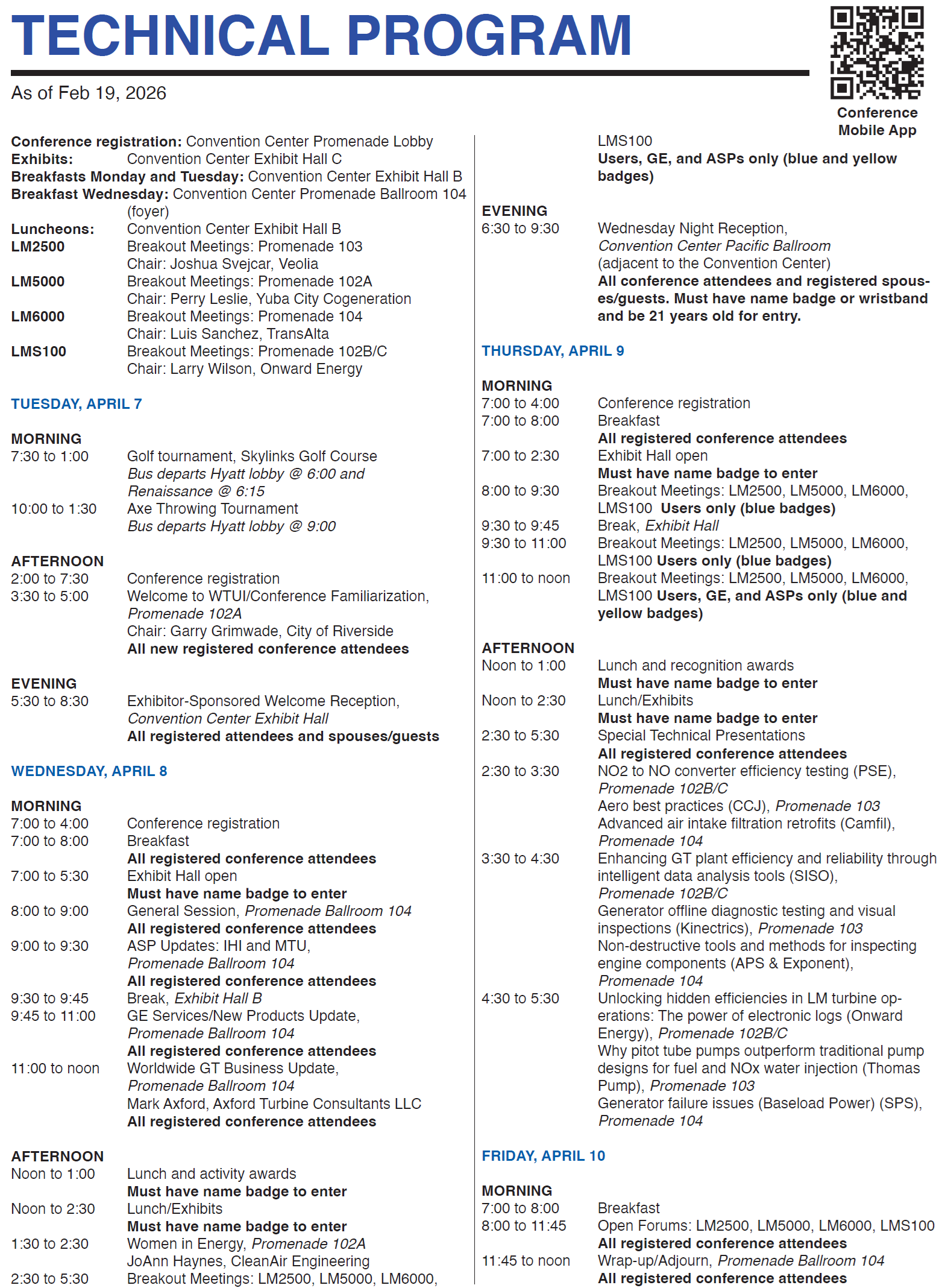
Prime examples include a golf tournament Tuesday morning at the Skylinks at Long Beach golf course (7:30 a.m. to 1 p.m.) and the new addition of an axe throwing tournament (10 a.m. to 1:30 p.m.). Plus, the vendor-sponsored Tuesday evening welcome reception, from 5:30 to 8:30 in the exhibit hall, which is your first opportunity to thank the more than 130 exhibitors and sponsors for their participation. The Wednesday night reception is in the Pacific Ballroom (adjacent to the convention center), from 6:30 to 9:30, and will feature local foods, live music, and interactive exhibits with a special theme.
Access the Conference Floorplan and Exhibitors Here
For WTUI first-timers, it’s not necessarily about connecting with colleagues, but rather meeting new people with professional needs and concerns that align with theirs. The best place to begin this process is at the Tuesday afternoon session (3:30-5:00), “Welcome to WTUI/Conference Familiarization,” in Promenade 102A.
The Tuesday session is chaired by Garry Grimwade, senior utilities generation technician, City of Riverside, who has years of experience in the design, operation, and maintenance of GE aeros, gained both on his day job and as the organizer and discussion leader of Western Turbine’s LM2500 and special technical breakout sessions.
Grimwade is a hands-on, practical instructor who will help newcomers maximize the benefits of participating proactively in the engine-specific technical sessions on Wednesday, Thursday, and Friday. Plus, he will provide valuable guidance on how to assure units under their purview operate safely and at high reliability. He’ll be joined by other members of the WTUI leadership, so bring your question and tap hundreds of years of aeroderivative expertise.
In his opening remarks on Tuesday, Grimwade will explain the conference arrangement, how to organize your participation, and how to navigate the 2026 sessions for maximum effectiveness. Then he will review the progression of the LM product line from the 2500 to the 5000, to the 6000, and finally to the LMS100. The philosophy of each turbine variant will be discussed and how the turbine/generators are arranged—for example, gear or direct drive.
The slide deck for the 2025 presentation, which will be updated for 2026, contains many very instructive drawings and photographs useful in plant-breakroom training sessions. Review it on the WTUI website to better prepare for this session.
A quick read through the technical program will remind you of WTUI’s value to your professional growth and development. Highlights include the following:
- Access to the industry’s top technical talent Tuesday evening through Friday afternoon in the vendor fair to help you solve plant problems. Think of this as free consulting.
- Special technical presentations by consultants and third-party solutions providers invited by the organization’s leadership team.
- Presentations by the OEM, select ASPs, and PROENERGY focusing on shop findings and solutions. Important to have CCJ’s acronyms webpage handy while listening to these experts because they tend to speak in shorthand—HPCR for high-pressure compressor rotor, FPI for fluorescent penetrant inspection), RPL for replaced part, etc. You don’t want to disengage from the speaker to figure out what an acronym means.
- Experience with upgrades to boost output, availability, and/or reliability, and to reduce emissions.
- Open discussions in user-only sessions that provide insights you’ll find valuable for improving the performance of your engines.
Wednesday morning
The pace of the meeting quickens after breakfast Wednesday in Exhibit Hall B of the Convention Center as all registered attendees gather at 8:00 for the General Session in Promenade Ballroom 104 for opening remarks by WTUI President Ed Jackson, plant manager of Missouri River Energy Services’ Exira Generating Station in Brayton, Iowa.
Jackson, who was elected WTUI’s leader in 2022, is only the sixth president in the organization’s more than three decades of service to the industry. His predecessors: John Hudson, 2020-2022; Chuck Casey, 2013-2020; Jon Kimble, 2008-2013; Jim Hinrichs, 1992-2008; and John Tunks, 1990-1992.
Following the introduction of officers, directors, breakout session chairs, and support staff, plus the treasurer’s financial report, badge rules, and other business matters, the conference agenda will be reviewed and appropriate acknowledgements made.
Highlights of the first morning’s presentations are the following:
- From 9:30 to 10:00, attendees welcome back to the stage two of the three service providers (a/k/a ASPs) authorized by GE to work on LM2500 and LM6000 engines, MTU and IHI, but TCT will not be participating.
- GE Services’ offerings and the OEM’s new products update in Promenade Ballroom 104 from 9:45 to 11:00.
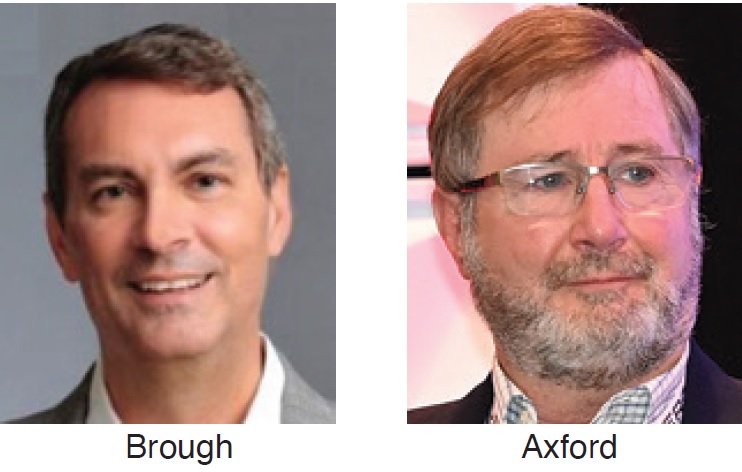
- Worldwide gas-turbine business update by Tony Brough and Mark Axford, from 11:00 to lunch at noon, also in Promenade Ballroom 104. Brough, president, Dora Partners & Company, will update the group on the state of the global gas-turbine market using engine-specific and geographic stats considered by many among the industry’s most reliable. Mark Axford, president, Axford Turbine Consultants, who has presented to this group on the state of the energy industry for two decades and a crowd favorite will use his crystal ball to help attendees prepare for the future.
Engine-specific sessions
Breakout meetings for the LM2500, LM5000, LM6000, and LMS100 gas turbines, the core of WTUI’s technical program, begin Wednesday afternoon at 2:30 and run until 5:30 (user, GEV, and ASP attendees only). Sessions continue Thursday morning for users and GE at 8:00 until a 15-minute break in the Exhibit Hall starting at 9:15. The meetings continue for users only from 9:30 until lunch at noon.
The Friday program features open-forum breakouts for all registered conference attendees from 8:00 to 11:45. Here’s where you can learn more from the experience of independent service providers like PROENERGY, Score Energy and others. In sum, that’s more than nine hours of intense information transfer from engine experts to the user community. You can’t get “training” of such high caliber anywhere else in the world.
The LM2500 program is guided by Joshua Svejcar, district manager for Ever-Green Energy in the Minneapolis area. Previously, he served in management positions at Veolia North America and Foster Wheeler. Ever-Green operates the energy systems for the University of Minnesota’s Twin Cities Campus.
The LM5000 session is chaired by Perry Leslie, who watches over the Yuba City Cogeneration Plant. His responsibilities there include I&C, mechanical maintenance, and operations. Leslie has served that facility since 2004 while also managing the now-shuttered Binghamton Cogeneration Plant for a brief period. Before Yuba City, he spent six years as a field service technician for GE in the Bakersfield area working on LM1600, LM2500, LM5000, and LM6000 engines. He began his career with a six-year stint in the US Navy as a GT systems technician (electrical).
The LM6000 program is led by newly appointed Breakout Session Chair Luis Sanchez, a gas turbine specialist at TransAlta Energy. Celebrating over two decades with the company, Sanchez provides fleet-level engineering support across generating assets with accountability spanning asset planning, maintenance and overhaul planning, capital improvements, new-build development and commissioning, performance diagnostics, and evaluation of emerging technologies. He supports both aeroderivative and large-frame units, with experience across major OEM platforms, and is responsible for developing operating processes and maintenance work scopes, monitoring fleet condition to optimize maintenance intervals, and maintaining the historical documentation used to manage the GT fleet.
The LMS100 session is guided by another newly appointed session chair, Larry Wilson, O&M manager for Diamond Generating Corp’s Sentinel Energy Center, responsible for the site’s eight LMS100 units. Prior to this, he spent over seven years at Larkspur Energy maintaining their LM6000s. Wilson was first exposed to the power and propulsion industry in the US Navy, where he served nearly 10 years as a Gas Turbine Systems Technician. The only attendees invited to LMS100 sessions are GE employees, users, and some hand-selected specialty consultants.
Special technical presentations
This Thursday afternoon at Western Turbine meetings is reserved for nine Special Technical Presentations, approved by WTUI leadership, to extend the meeting’s content beyond the four GEV aero engines on the program. The hour-long presentations (with Q&A) are arranged in three parallel sessions beginning at 2:30, 3:30, and 4:30. Slide decks are posted on the WTUI website, but access requires an email request to Webmaster Wayne Feragen.
2:30-3:30
NO2 to NO converter efficiency testing, Ryan James, CEO, and Matt Swanson, account manager, Pacific Standard Environmental.
Inconsistent NOx converter efficiency test results continue to challenge facilities that rely on continuous emissions monitoring systems (CEMS) for regulatory compliance. This presentation previews a collaborative test program designed to pinpoint where variability is introduced during NO2-to-NO conversion efficiency checks, then translate the findings into practical improvements sites can apply to better meet EPA and local air district requirements.
The work focuses on systematic, side-by-side evaluation of the key elements that influence NO2-to-NO conversion efficiency outcomes. Testing will examine multiple NO2 sources, including certified cylinders, NO2 generators, and Tedlar bag methods, along with a range of NO2-to-NO converters. It also will assess NOx measurement transducers and analyzers to understand instrument response and stability, and it will evaluate the gas transport and delivery devices used to move calibration gas from source to analyzer, where losses, adsorption, leaks, or residence-time effects can bias results.
After testing is completed, the data will be analyzed to identify which conditions and configurations most strongly correlate with unstable or non-repeatable efficiency results. The intent is to provide the industry with actionable guidance that improves repeatability, reduces avoidable failed or questionable tests, and supports more consistent compliance with EPA and local district expectations.
Attendees should come away with a clearer view of which parts of the test chain are most likely to drive variability, a comparative understanding of NO2 source and transport options and their practical risks, and recommendations that can be incorporated into site procedures for converter efficiency testing and troubleshooting. Promenade 102 B/C
Best practices, Scott Schwieger, general manager, CCJ.
Best practices submitted by aeroderivative owner operators to CCJ’s annual awards program, sponsored by CCJ and WTUI, will be reviewed in an interactive session designed to surface practical ideas that can be applied at operating sites. The discussion spans plant and fleet challenges, with examples drawn from the LM2500, LM6000, and LMS100 communities, plus open microphone sharing from attendees.
The review highlights recurring categories in the Best Practices program, such as fast starts, outage management, performance improvements, water management, plant safety procedures, predictive analytics and monitoring and diagnostic centers, and O&M improvements for generators, transformers, high voltage electrical systems, and major mechanical balance of plant equipment.
Rather than a slide heavy lecture, the format emphasizes what was done, why it was needed, how it was implemented, and what changed afterward. Participants will hear success stories that improve starting reliability, reduce forced outages, cut parasitic losses, strengthen compliance readiness, and shorten troubleshooting cycles. The open discussion invites users to share their own best practices, compare approaches across sites, and discuss what works, what does not, and what to watch for when replicating a solution. Attendees should leave with a list of ideas and contacts for follow up in their fleets. Promenade 103
Advanced air intake filtration retrofits Alexandre Gilbert, key account lead for retrofit and plant optimization, Camfil Power Systems.
The presentation will examine how air inlet filtration design can limit the output and efficiency of LM6000 aeroderivative gas turbines, especially in wet or humid service. Many installations rely on cylindrical composite filters that impose higher pressure drop, handle water poorly, and restrict filtration choices. Those constraints can accelerate compressor fouling, increase heat rate, reduce available megawatts, and drive frequent filter changeouts and online or offline compressor washes.
Reviews of retrofit alternatives that correct key shortcomings without requiring major modifications to existing intake housings will be discussed. It shares before-and-after performance data from two LM6000 sites where upgraded filtration systems were installed in as little as two weeks. Results include more than 40% lower differential pressure across the filters, improved water management, and slower fouling rates.
Operationally, the sites report fewer wash outages, reduced filter replacement activity, and improved unit availability during adverse weather. The improvements are linked to higher net power, better heat rate, and lower emissions intensity by reducing parasitic losses and stabilizing compressor condition.
Attendees will gain practical guidance on evaluating inlet losses, selecting retrofit configurations, and estimating economic value, payback, and lifecycle benefits for LM6000 fleets. With clear steps for implementation. Promenade 104
3:30-4:30
Enhancing GT plant efficiency and reliability through intelligent data analysis tools, Kellan McCarthy, CTO, and Maxwell Erwin, CEO, SISO Engineering.
Power in the Numbers explores how higher-resolution data capture and targeted analytics can improve gas-turbine plant reliability, efficiency, and troubleshooting speed beyond what standard DCS platforms typically provide. The session shows how combining open-source tools with proprietary monitoring and engineering expertise turns raw signals and network traffic into actionable findings for operators and technicians.
Three field examples anchor the discussion. In the first, a unit experienced severe fuel-flow and megawatt oscillations during liquid-fuel operation after a major outage, leading to trips and additional downtime. By capturing high-speed running data and reviewing the full fuel-control loop, the root cause was traced to a mis-tuned speed-regulator gain, and multi-load tuning restored stable operation across the load range.
The second example applies packet capture to an OT communications problem with a battery system, using a mirrored switch port and Modbus traffic review to confirm the controller side stopped requesting data; a targeted reset restored communications.
The third example provides a practical snapshot of machine learning, using exhaust temperature profile datasets to train and validate a neural-network anomaly detector for future monitoring.
Attendees will leave with concrete methods to accelerate root-cause analysis, reduce trips, support heat-rate improvement, and maintain emissions compliance with greater confidence. Promenade 102 B/C
Generator offline diagnostic testing and visual inspection, Sunny Gaidhu, P.E., senior technical advisor, Kinectrics Inc.
Gaidhu will deftly explain how planned, outage-based offline diagnostics can identify insulation degradation and core defects before they escalate into forced outages, and how to pair those results with online monitoring to improve trending and decision-making. Attendees will get a clear view of what each offline method can and cannot reveal, including IR/PI, capacitance and dissipation factor, partial discharge, TVA probe surveys, UV corona imaging, DC ramp testing, and ELCID core testing.
Two case studies, a 13.8-kV air-cooled generator and a 24-kV hydrogen-cooled generator, show how integrating partial-discharge findings with detailed visual inspections and core evaluations supports targeted corrective actions and more defensible follow-up plans. The session’s value is a practical, test-by-test framework for outage scoping and data interpretation, helping owner-operators estimate remaining insulation life, prioritize repairs, and reduce the likelihood of premature winding failures. Promenade 103
Non-destructive tools and methods for inspecting engine components, Kyle Spaulding, senior engineer, Arizona Public Service, and Blake Whitely, managing engineer, Exponent, Inc.
Non-destructive inspection methods can reveal developing damage in turbine engine components long before it forces an outage, and they can also accelerate credible root-cause findings after an event. This presentation surveys a practical toolbox of inspection and characterization techniques that turbine users can apply across the full lifecycle, from routine condition monitoring to failure analysis.
It explains what each method can and cannot detect, typical access and surface-prep requirements, and how to select the right technique for suspected mechanisms such as filtration-related contamination, foreign object damage, fatigue cracking, corrosion, clashing, and blade tip rubs.
The session walks through commonly used field methods, including detailed visual and borescope inspections, dye penetrant, eddy current, ultrasonic, magnetic particle, radiography, and acoustical and vibrational monitoring, then connects them to higher-resolution laboratory approaches such as CT X-ray, light microscopy, scanning electron microscopy, and energy-dispersive X-ray spectroscopy.
Real-world case examples from turbine operators and investigators illustrate how evidence from multiple techniques is combined to confirm damage morphology, identify initiating features, and separate symptoms from causes.
Attendees will leave with a clearer decision framework for inspection planning, improved communication with NDE and lab providers, and actionable ideas to strengthen maintenance strategies and risk mitigation across diverse fleets. Promenade 104
4:30-5:30
Unlocking hidden efficiencies in LM turbine operations: The power of electronic logs, Jon Caccamise, O&M manager, Onward Energy.
Many LM gas turbine sites still rely on paper logs, manual data transcription, and disconnected permitting tools, creating errors and consuming operator time that could be spent on reliability and performance improvement. This presentation shows how one LM6000PC combined-cycle facility modernized those workflows by adopting a unified electronic logbook that becomes the operating “hub” rather than just a digital notebook.
The session explains how automated log entries, shift-turnover summaries, and compliance reminders reduce repetitive tasks and standardize documentation. It also describes consolidating Hot Work and Confined Space permits, cold-weather readiness checklists, and other routine controls into the same platform, eliminating multiple standalone applications.
Integration with the PI historian is highlighted as a practical step-change, PI Events can automatically create entries, populate templates, and prompt follow-up actions so investigations and corrective actions are captured consistently.
Configurable, threshold-based alerts provide real-time notification when logged values drift outside limits, improving situational awareness and enabling earlier intervention. Dashboards and widgets then translate the log data into at-a-glance status views for operators and supervisors.
Attendees will take away implementation lessons, audit-friendly approaches to requirements such as NERC EOP-012, and a roadmap for extending digital logs into CMMS integration, LOTO streamlining, ROC use, and automated reporting. Promenade 102 B/C
Why pitot tube pumps outperform traditional pump designs for fuel and NOx water injection, Austin Egan, senior applications engineer, Thomas Pump.
Fuel delivery and NOx water injection systems play an outsized role in the reliability, availability, and emissions compliance of GE LM-series turbines, yet many sites still depend on pump designs that can be sensitive to changing operating conditions.
Egan will explain why commonly used high-pressure positive displacement, horizontal multistage, and end-suction centrifugal pumps may struggle with hydraulic instability, thrust events, and accelerated wear as load and flow demands vary. Typical failure modes, including cavitation damage, seal distress, and rapid bearing degradation, can drive forced maintenance and lost megawatt production.
The session makes the technical case for pitot tube pump technology as a more robust alternative for LM fuel and water injection service. It walks through how pitot tube pumps convert velocity into static pressure in a single stage and why that approach can provide a more stable hydraulic operating curve.
The discussion connects hydraulic stability to practical outcomes operators care about, including extended seal life, improved reliability, and longer maintenance intervals. Field application examples are used to illustrate measurable improvements relative to traditional pump types and to highlight where pitot tube pumps are most likely to deliver value.
Attendees will leave with selection considerations, expectations for lifecycle performance, and guidance on standardizing pump strategies to reduce unplanned outages and simplify support. Promenade 103
Generator failure issues, Robert Vandenabeele, director of business development, Baseload Power (GESA).
Generator failure modes often develop quietly, then surface as forced outages during peak demand. This presentation focuses on inspection findings and failure mechanisms that most commonly threaten long-term reliability of turbine-driven generators, with emphasis on what users can look for during planned outages and condition assessments.
The discussion reviews stator concerns such as core heating, core lamination degradation, winding faults, slot wedge migration, and localized partial discharge or vibration-related sparking, plus the role foreign object intrusion can play in initiating damage. On the rotor field side, attention is given to retaining-ring condition, turn insulation integrity, and ground insulation health, tying observable indicators to probable electrical or mechanical drivers. Additional failure themes include turn breaks, coil distortion, thermal sensitivity, and problems associated with radial lead connections, all of which can progress from minor abnormalities to major repairs if not detected early.
Attendees will hear how to interpret what inspections reveal, which observations warrant immediate action versus continued monitoring, and how documentation of findings supports trending over time. The goal is to help plant teams improve outage scope decisions, prioritize corrective work, and reduce the risk of repeat events by addressing root contributors before they escalate. Practical examples will anchor each topic. Promenade 104