
HKW Freimann Power Plant
Stadtwerke München
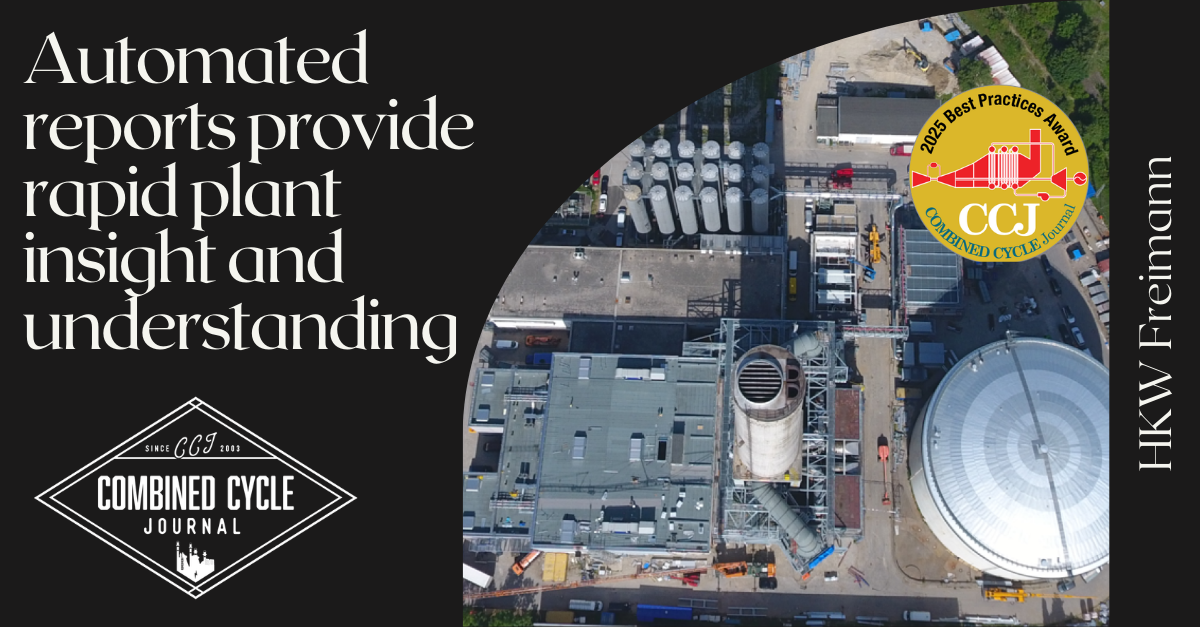
125-MW cogeneration facility powered by LM6000PF+ gas turbines located in Munich, Germany.
Plant manager: Simon Weig
Background. HKW Freimann is one of Munich’s major powerplants, supplying power and heat and incorporating district-heating assets, heat storage, and battery storage. In 2020, Stadtwerke München (SWM) refurbished the gas-turbine installation and commissioned two LM6000 PF2 units. These were the first PF2 units commissioned worldwide, and SWM’s prior operational experience primarily involved heavy-duty turbines rather than aeroderivatives.
From the start, SWM targeted operational improvement through a better understanding of unit behavior, faster detection of abnormal conditions, and more efficient planning of tuning and troubleshooting work.
Challenge. The site identified a common owner/operator barrier: having ample plant data but limited internal capability to consistently convert those data into actionable insight. The practical requirement was that insights had to arrive in a format that fit operating routines, not as an additional software burden or a one-off engineering exercise.
Key challenges included:
- Building a repeatable workflow from data collection through insight generation, rather than ad hoc analysis
- Delivering results in minutes to support daily decision-making and early anomaly detection
- Avoiding lengthy, costly trial-and-error testing by narrowing the problem space with data first
Solution. SWM implemented an automated reporting system based on centralized plant data that provided easily digestible visualizations that could be reviewed in about five minutes. Here’s how it worked.
Standardize the data workflow. The program was organized around four steps: collect data, prepare data, analyze, and convert results into insights through visualization. A foundational decision was to transfer and archive plant data into a central database alongside the control system, enabling consistent access and supporting automation.
Automate preparation and reporting. SWM used daily reporting as the primary adoption mechanism. Data were cleaned and filtered automatically, then compiled into reports that provided a comprehensive overview and could be reviewed in about five minutes. Reports were auto-generated and distributed by email, creating a predictable cadence for review.
Screen first, then deep dive. SWM paired lightweight daily screening with deeper analysis only when the screening indicated an abnormality. For deep dives, the plant implemented the analysis tool Visplore, particularly its pattern-search capability to find similar events across multiple signals and time periods.
This tiered approach delivered:
- fast, routine situational awareness through automated reports, and
- efficient troubleshooting and root-cause isolation through pattern search and signal overlays
Results. The site reported operational value in three areas: emissions oversight and tuning efficiency, abnormal-event diagnosis and mitigation planning, and improved troubleshooting of transient issues such as startups.
Emissions monitoring and threshold-exceedance tracking were a key early use case, especially during commissioning. By correlating emissions behavior with operating conditions such as compressor inlet temperature, SWM identified operating regions associated with higher NOx and used those findings to plan mapping activities more efficiently. The intended outcome was improved targeting of mapping and tuning work, reducing time and cost associated with unnecessary experimentation.
Using pattern search and signal correlation, SWM identified load rejections as events that significantly affected the generator thrust bearing and contributed to increased bearing temperature. The analysis supported follow-on monitoring actions, including more precise tracking of generator vibrations to assess long-term bearing impacts after load rejections. SWM also planned to add MetalSCAN from GasTOPS to strengthen ongoing condition monitoring.
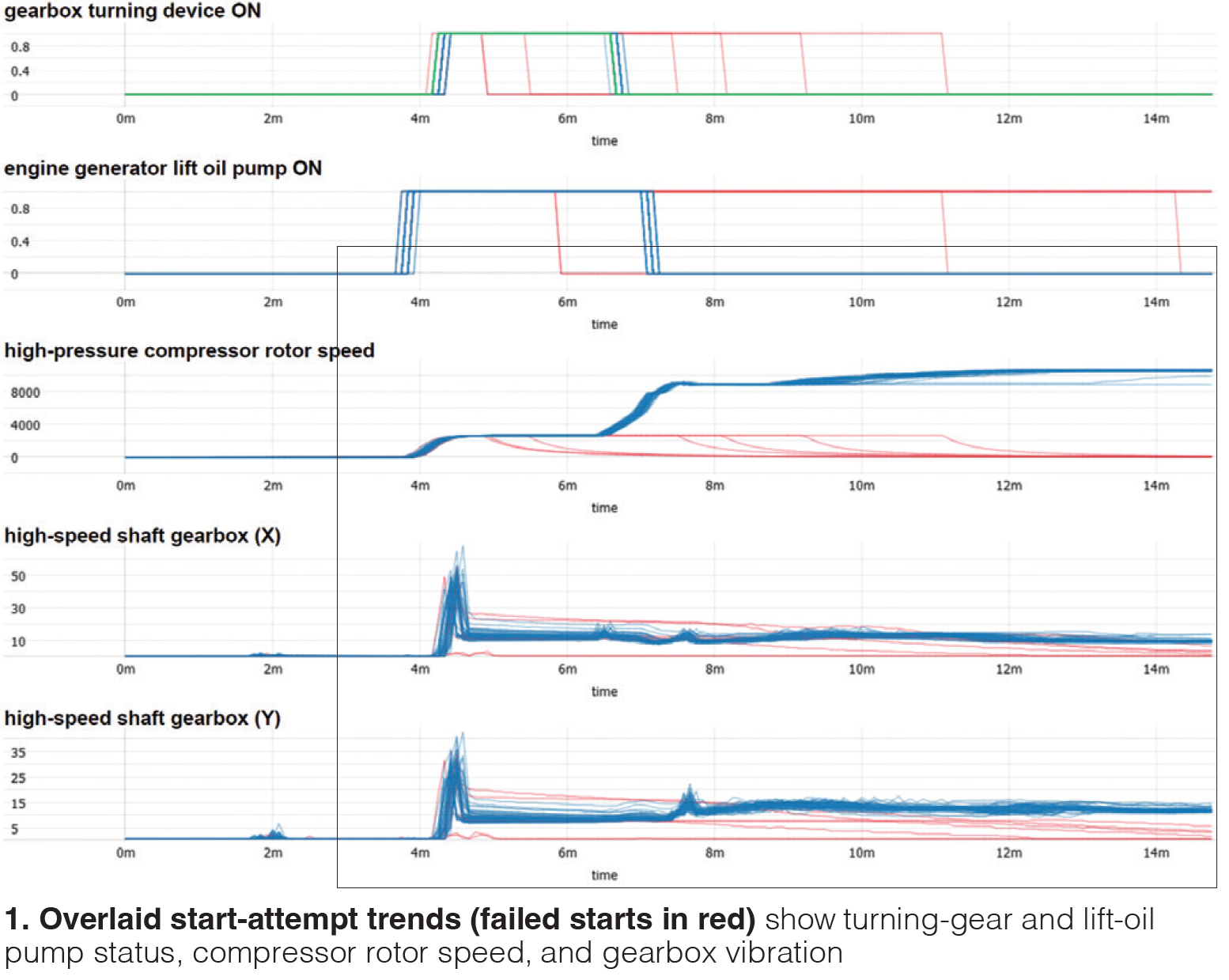
SWM also applied the same data-centric approach to intermittent false starts, described as shutdowns initiated by the turning gear at low speed, followed by successful subsequent cranks. By overlaying multiple signals across start attempts and distinguishing failed versus successful patterns, SWM identified a no-lift condition during false starts. A subsequent inspection found the jacking-oil pump degraded, enabling targeted corrective action rather than extended troubleshooting by substitution (Fig 1).
Several practices other plants could adopt with modest resources:
- Start with consumable reporting
- Centralize and standardize first
- Benchmark against your own history
- Treat deep-dive tools as escalation, not the default
- Use pattern recognition for transients