

Sentinel Energy Center
Owned by Sentinel Energy Center LLC
Operated by DGC Operations LLC
850 MW, eight unit, LMS100 simple cycle peaking facility located in North Palm Springs, Calif.
Plant manager: Dennis Johnson
Background. Large power generating facilities present hazards and layout complexities that many local responders do not encounter routinely. Sentinel Energy Center formalizes recurring first-responder awareness training to improve safety, shorten decision time, and strengthen coordination between plant staff and outside agencies.
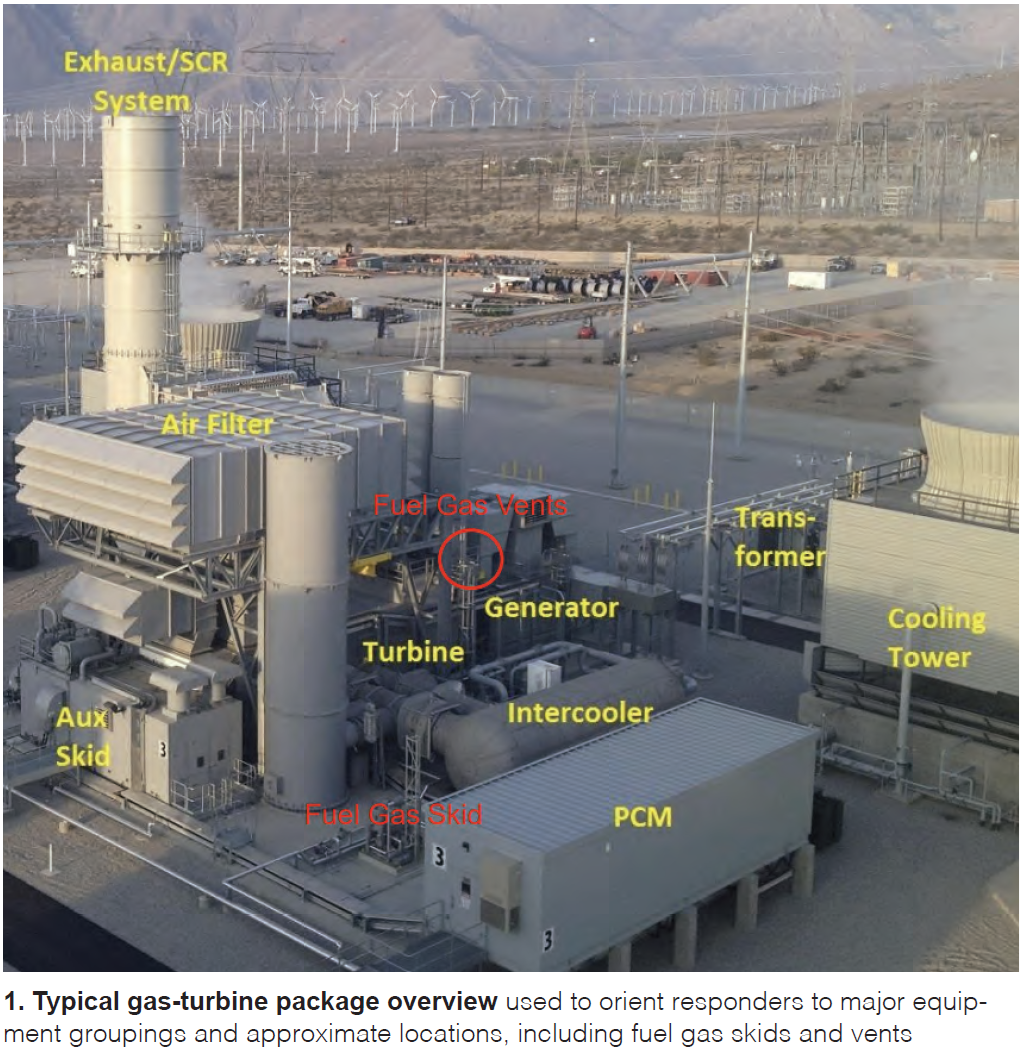
Challenge. Even well-trained emergency responders can be disadvantaged by an unfamiliar site. A gas-turbine-based facility includes high-voltage equipment and overhead lines, pressurized fuel gas systems with vents, combustible adjacent materials, and multiple chemical inventories distributed around the plant. Plant layouts also create navigation and access challenges, especially when equipment yards, switchyards, and fenced areas complicate staging and apparatus movement (Fig 1).
 The underlying issue is not responder capability, it is the time penalty imposed by uncertainty. During an emergency, responders need rapid answers to practical questions: what hazards are present, where they are located, what can be isolated, what must not be operated, and how to move safely around the site.
Solution. The training program is structured as an awareness-level introduction tailored to the specific facility. Content is built around equipment walkdowns, maps and aerial views, and scenario-driven discussions that prompt responders to ask the right questions early. Topics are organized by hazard category and by the plant systems most likely to influence incident escalation or isolation strategy.
The approach combines the following system orientation with hazard recognition:
- Fuel gas systems and vents. Review typical package locations, isolation concepts, and how to avoid unintended venting during response.
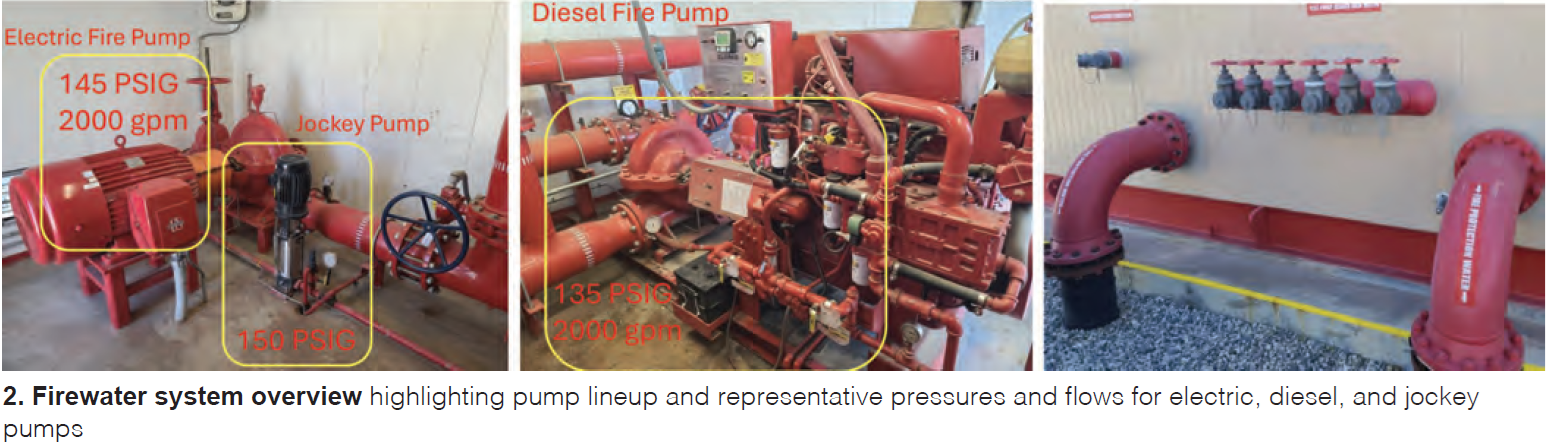
- Firewater system orientation. Identify pump types and expected pressures and flows to support hydrant and sprinkler operations (Fig 2).
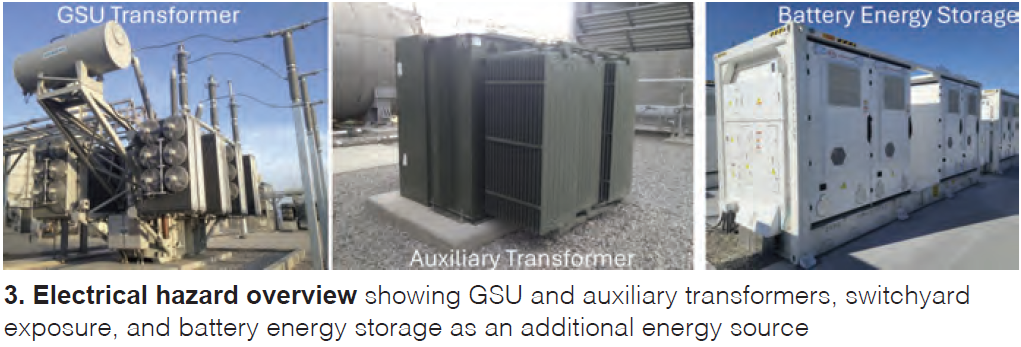
- Electrical hazards. Emphasize GSU and auxiliary transformers, switchyard exposure, and battery energy storage as additional sources of stored or backfed energy (Fig 3).
- Bulk chemicals. Provide a simple inventory and location awareness for common plant chemicals, including concentrations where applicable.
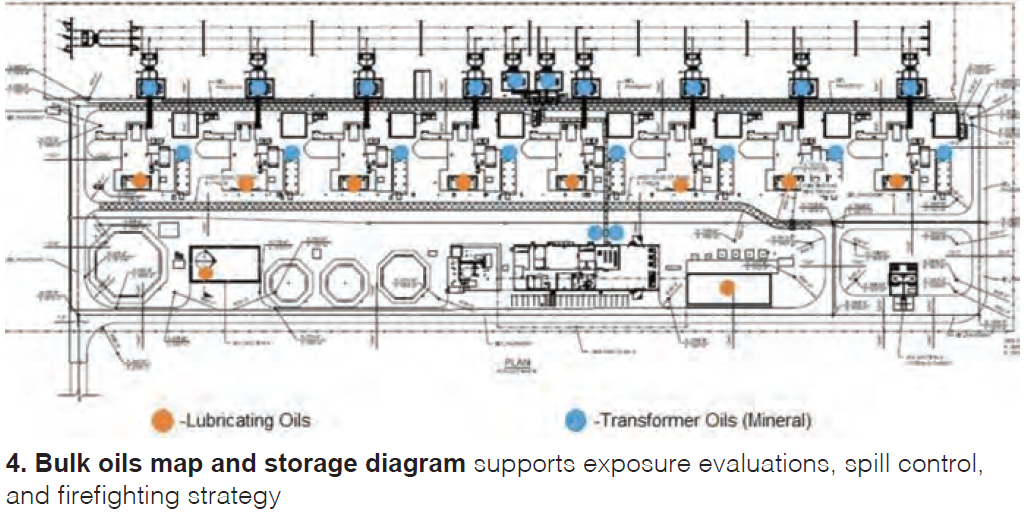
- Bulk oils. Reinforce spill and fire considerations for lubricating, transformer, fuel, and waste oils, and how adjacent tanks can change defensive priorities (Fig 4).
- Labeling and signage. Use consistent pipe labeling and signage maintenance to shorten time to isolate, identify contents, and communicate hazards.
- Combustible adjacent materials. Address how nearby combustible loading can influence fire spread and exposure protection decisions.
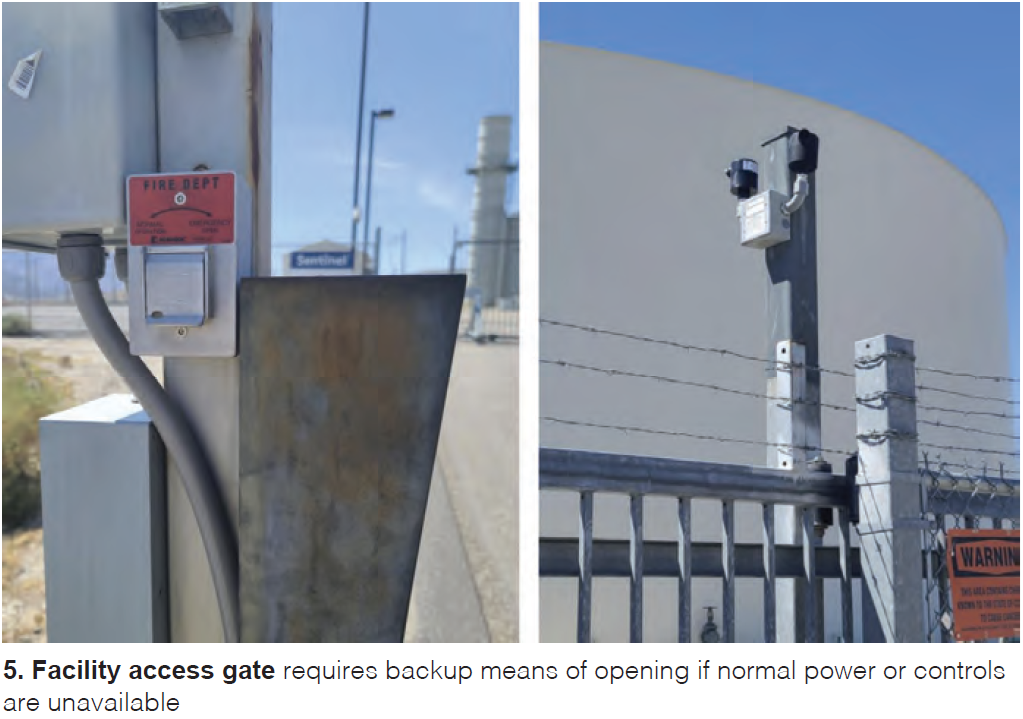
- Access and egress. Confirm which access gates need a backup means of opening if the site is de-energized and normal controls are unavailable (Fig 5).
A key element of the program is a short list of prompts responders can use to cross-check isolation and exposure risks with operations staff. Examples include:
- Electrical: What is de-energized, what remains energized nearby, and whether cooling systems and DC sources remain in service.
- Chemicals and oils: What chemicals are present, in what concentrations, and whether bulk oil tanks are adjacent to the incident area.
- Flammable gases: Whether fuel gas can be isolated without venting, whether automatic vents can be manually isolated, and where safe vent areas exist.
- General access: Whether gates can be locked or held open during de-energization, and whether load limits or unusual site features affect apparatus access.
Results. Routine awareness training as a risk-reduction measure has four expected outcomes: improved safety, more effective response, stronger collaboration, and sustained preparedness through regular refreshers. By aligning responders and plant staff on hazards, access, and isolation concepts before an incident, the plant expects fewer delays, fewer missteps, and clearer communications during an actual event.
Owner/operators looking to implement a similar program can use the following checklist:
- Maintain a responder-ready facility overview, including a one-line, site map, access points, and staging options, and refresh after major projects.
- Document and communicate chemical inventories and concentrations, including storage locations and response considerations.
- Review firewater capacity and pump configuration, and walk down hydrant and sprinkler zones with responders.
- Create a high-voltage and energy-storage awareness module that addresses transformers, switchyard, MCCs, and battery energy storage, including backfeed risks.
- Confirm fuel gas isolation philosophy and vent control options, and clarify what responders should and should not operate.
- Verify gate backup opening methods, and test them periodically.
- Establish an annual cadence and include makeup sessions to account for turnover on both sides.
Project participants: Dennis Johnson, Larry Wilson, Jesse Ballou, and David Wells.