

Exira Station
Owned by Western Minnesota Municipal Power Agency
Operated by Missouri River Energy Services
140-MW, simple-cycle peaking facility with three LM6000PC gas turbines located in Brayton, Iowa.
Plant manager: Ed Jackson
Background. Frequent cycling of the SPRINT system created a pathway for water to migrate into Exira Station’s instrument-air system, affecting multiple turbine and balance-of-plant functions. Because the instrument-air header supports critical purge and actuation needs across the plant, moisture carryover became a reliability issue, especially during cold Midwest winters. The station eliminated the problem by adding opposed solenoid drain valves to the SPRINT purge lines, a hardware-only change that required no control system modifications.
Instrument air often behaves like background infrastructure until contamination affects multiple end users. At Exira, the same instrument-air supply used for the SPRINT purge also supports:
- Bearing purge on shutdown
- CDP purge valve actuation air
- SPRINT valve actuator supply
- Other plant systems including CEMS and gas scrubbers
With a shared header serving multiple critical loads, any moisture that enters the instrument-air system can cascade into actuator issues, failed valve movements, and start reliability problems.
Challenge. The instrument-air purge solenoids were not completely watertight, allowing water to migrate past them as the SPRINT system cycled on and off. When SPRINT check valves degraded or failed, even more water migrated downstream and into the instrument-air system.
The operational impact extended beyond the SPRINT package. Exira experienced repeated problems across multiple systems that depend on instrument air, and the station attributes the condition to several forced outages. Cold-weather exposure increased the consequence: moisture in air systems can contribute to sluggish valve response, failed actuation, and freeze-related restrictions that are difficult to diagnose during short-notice peaking starts.
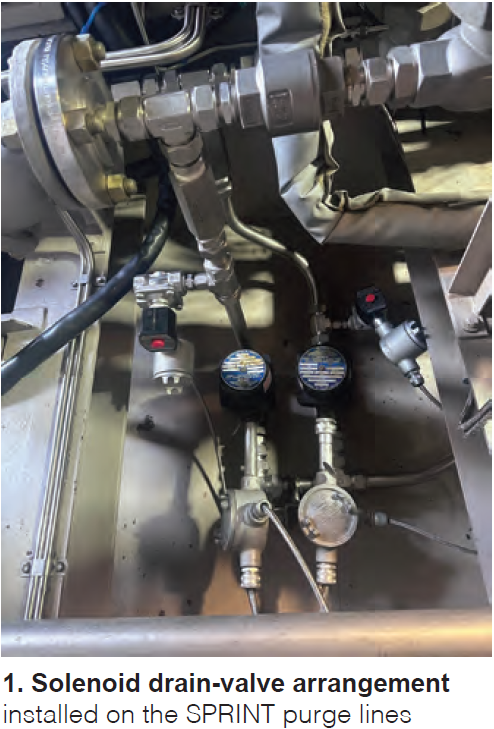
Solution. Added solenoid drains to SPRINT purge lines. Exira installed solenoid drain valves that operate in opposition to the existing instrument-air purge solenoid valves (Fig 1). The design intent is to remove water at the point of entry, before it migrates into the instrument-air header.
Key elements of the retrofit:
- No control system changes. The new drain valves are wired using the existing solenoid valve wiring.
- Opposed operation. When the purge valve is open, the drain valve is closed. When the purge valve is closed, the drain valve opens.
- Drain to package. When SPRINT is online, the SPRINT check valve should see pressure that keeps it closed. If water passes the check valve, the drain arrangement provides a path for that water to discharge into the package instead of progressing into instrument air.
The modification provides a simple visual indicator for operators and technicians. If water is observed inside the package, it suggests the associated check valve may be passing and should be inspected. That visibility helps shift the response from reactive troubleshooting of plant-wide instrument-air symptoms to targeted evaluation of the likely leakage path.
Results. After installing the drain system for the HP and LP SPRINT circuits and the SPRINT skid, Exira reports elimination of water in the instrument-air system. The station also reports a noticeable reduction in air-system-related device issues, including:
- Far fewer CDP purge valves failing to cycle
- Fewer problems with SPRINT control valves
- Little to no issues with other devices that utilize instrument air
For a simple-cycle peaking site, the improvement supports higher start readiness and reduces forced-outage risk during winter operations.
Project participants: Plant O&M technicians Devon Meyer, Greg Hauswirth, Jon Edwards, and Corey Petrie.