

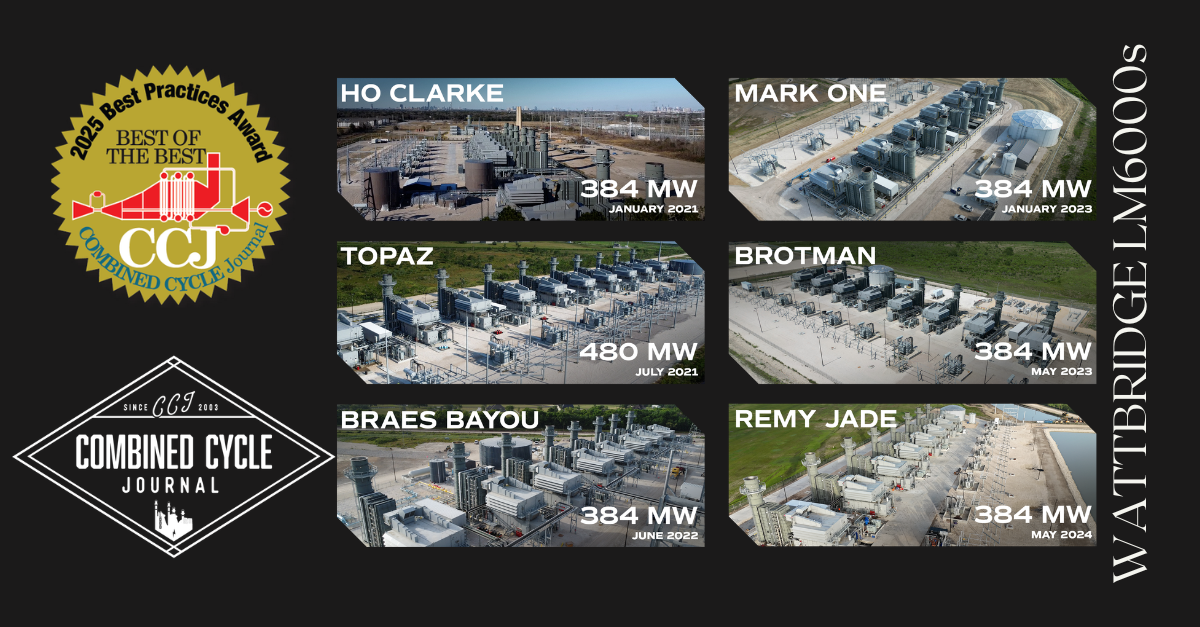
WattBridge Fleet
Owned and operated by PROENERGY through Sept. 16, 2025. At that time, four of the six sites—HO Clarke, Topaz, Mark One, and Remy Jade Generating Stations—were sold to CPS Energy.
2,400-MW simple-cycle aeroderivative fleet with 50 x LM6000PC located throughout Texas
Plant managers: Humberto Figueroa, Jaymes Martens, Eric Kuper
Advanced monitoring and predictive solutions
Challenge. Demand for dispatchable power generation continues to set records. Aeroderivative peaking plants, in particular, have logged record starts, stops, and run hours in nearly every quarter over the last three years. While that operating cadence can be profitable, it also accelerates equipment wear. Between inspections, operators often have limited visibility into actual machine condition and are forced to run until alarms or failures occur.
Tools for truly proactive peaking-asset operation have remained difficult to implement. Traditional remote monitoring and diagnostics (RM&D), though effective in many applications, often identifies issues only after they have developed. At the same time, supply-chain constraints have worsened the consequences of delayed detection. Critical parts and spares can require a year or more to procure, and depot turn times remain extended. Those delays conflict directly with the record utilization many plants are now seeing.
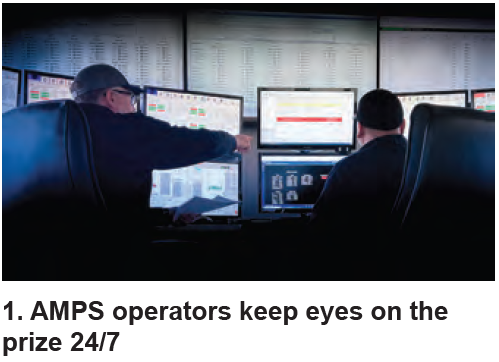
Solution. PROENERGY developed Advanced Monitoring & Predictive Solutions (AMPS), a dedicated in-house 24/7 monitoring center designed to deliver timely, actionable insights beyond conventional M&D (Fig 1). The platform combines automated alerts, predictive tools, and direct engineering support to identify developing problems and recommend mitigation steps before failures occur. This approach allows plant and fleet operators, including the PROENERGY WattBridge fleet, to plan outages and procure parts on their schedules.
AMPS includes two core functions:
- Advanced Monitoring. This function tracks real-time performance and issues automated operational and trip advisories when preset thresholds are reached. Advisories are generated with minimal manual processing to reduce delays, improve awareness of critical issues, and support a proactive operating culture. Each advisory includes triggering data, AMPS diagnostic context, and clear online and offline recommendations for site response. Trip advisories include root-event data, AMPS analysis, and immediate guidance to support rapid troubleshooting. All advisories also include a real-time feedback channel that supports direct collaboration between site personnel and AMPS engineers.
- Predictive Solutions. This function identifies potential failures months, weeks, or days in advance to improve long-term reliability. The system uses machine learning and Advanced Pattern Recognition (APR) to establish a benchmark for each unit’s unique operating profile. It then compares incoming sensor data, including speed, vibration, temperature, load, and other parameters, against expected performance to detect subtle deviations. This enables AMPS to identify emerging issues before alarms are triggered, allowing operators to intervene early and avoid unplanned downtime.
AMPS helps operators move from reactive, manual processes to a streamlined, insight-driven model supported by a lean remote team. By applying standard operating procedures, business rules, advanced analytics, and artificial intelligence (AI), the system prioritizes the most urgent alerts and helps teams make faster, better-informed decisions. Over time, users gain stronger situational awareness, reduce risk, and improve resource allocation through data-backed planning and continuous monitoring.
A key differentiator is the human expertise behind each advisory. Recommendations are developed by former plant managers, project leaders, and experienced operators with more than 120 years of combined aeroderivative experience. That depth of knowledge turns complex data into prescriptive guidance that accelerates issue resolution, minimizes downtime, and supports performance recovery.
AMPS represents more than an incremental improvement to traditional M&D. It is a step change in capability. By combining real-time automation, predictive intelligence, and hands-on engineering insight, it delivers the speed, accuracy, and foresight required to support a modern, fast-growing fleet. The result is a scalable toolset for proactive maintenance, streamlined operations, and more strategic outage management, with measurable gains in efficiency, uptime, and long-term asset performance.
Results. PROENERGY developed, tested, and successfully applied AMPS across the six-facility WattBridge peaking portfolio. Representative case studies from WattBridge and a third-party user follow:
Case study 1: $2.5M saved by averting catastrophic event. AMPS alerted WattBridge to escalating vibration across multiple sensors, a potential warning sign of high-pressure compressor (HPC) and midshaft damage, allowing the operator to avoid turbine HPC damage valued at $2.5 million. After the unit tripped twice, AMPS observed rising vibration levels, performed a playback study, and issued an advisory identifying high turbine vibration. A borescope inspection later confirmed damage to multiple blades and the HPC, along with an oil leak.
Case study 2: $600K in damages and delays avoided with early warnings and guidance. A PROENERGY customer’s LM6000 site avoided a bearing failure that would have cost an estimated $600,000 and delayed operations by at least three to four months. AMPS identified three performance deviations before alarms occurred and predicted an impending scavenge-pump failure. The issue was mitigated in less than a week, enabling the facility to provide reliable power during an ERCOT weather watch tied to two winter storms.
Case study 3: $937K in downtime and damages avoided through expert analysis. AMPS helped a WattBridge facility avoid approximately $937,000 in potential equipment damage and unplanned downtime by detecting early signs of HPC damage across stages 3 through 14. After AMPS observed a steady rise in vibration, the site was alerted and the unit tripped shortly afterward. Playback analysis indicated possible internal damage, which a borescope inspection confirmed. Findings included rotor blades with heavy rub indications and blade wear beyond acceptable limits, conditions that could have led to major repairs and extended outages during a period of elevated energy-alert risk. Timely action returned the unit to service ahead of peak demand and demonstrated the value of early detection, expert diagnostics, and coordinated site support.
Fuel flowmeter certification
Challenge. Fuel flowmeters are a critical component of continuous emissions monitoring systems (CEMS), and their recertification can create significant labor, downtime, and cost. Certification is required for natural-gas-fired turbines subject to Title 40 of the Code of Federal Regulations (CFR) Part 75. Appendix D of 40 CFR Part 75 requires fuel flowmeters to be recertified at least every 20 calendar quarters from the initial installation date or the date of the most recent accuracy test.
A common approach is to purchase a replacement flowmeter, schedule an outage and labor, swap the meter, and send the original unit to a lab for recertification. That process can take one to two days and adds avoidable cost.
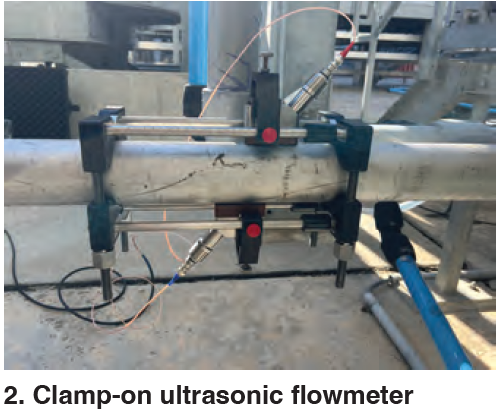
Solution. PROENERGY uses a non-invasive clamp-on ultrasonic flowmeter to measure natural-gas flow while the unit remains online, providing a faster, lower-cost recertification option (Fig. 2). The method can be completed in hours rather than days, avoids unit downtime, and minimizes cost. When paired with a Relative Accuracy Test Audit (RATA), it also requires no additional testing days.
By leveraging the technical capabilities of the PROENERGY Environmental Services team, the company provides EPA-required compliance while maintaining full commercial availability.
Results. The recertification approach preserved EPA compliance while protecting operating performance. Efficiency gains for WattBridge and a third-party client are summarized below:
Case study 1: Zero-downtime EPA compliance. PROENERGY helped a WattBridge facility maintain EPA compliance with zero downtime by completing two required tasks during a single mobilization. The site faced the same deadline for its annual CEMS RATA and the 20-calendar-quarter fuel flowmeter certification requirement for each unit. PROENERGY combined the RATA and fuel flowmeter certification work using an ultrasonic flowmeter to measure fuel flow, saving up to four days of combined downtime.
Case study 2: Out-of-compliance avoidance. For a third-party client, the PROENERGY Environmental Services team arrived onsite and completed the required certification the same day, preserving EPA compliance with zero downtime. The client had initially planned to purchase new flowmeters and swap them out ahead of the compliance deadline for two natural-gas-turbine fuel flowmeters. That plan became impractical because of supply-chain constraints and limited lab availability for certifying existing meters. The PROENERGY approach saved up to two days of downtime while avoiding delays tied to parts and lab access.
Fogging water reclamation
Challenge. Water is critical to aeroderivative performance. WattBridge, described as the world’s largest LM6000 commercial fleet, uses water both to reduce emissions and to maximize power output in hot climates. The fleet includes 50 LM6000PC engines operating in Texas at about a 15% capacity factor and fogging eight months per year, resulting in significant water demand. Fogging can consume up to 12,000 liters per hour by cooling intake air to increase output and reduce NOx emissions.
PROENERGY O&M operated an existing fogging system that generated process-water runoff requiring capture and disposition. A reclamation system became necessary because about 25% of inlet fogging water was being lost, average water cost was approximately $0.35/gal, and the system operated roughly 67% of the year. Because runoff quality remained relatively good, discharge offered little value. The water volume was large enough to make reuse a clear priority.
Solution. Vanessa Garcia, fleet engineer, led the development of a fogging-water reclamation system by leveraging plant personnel knowledge and using as much existing infrastructure as possible. With summer approaching and limited time for design, procurement, and installation, Garcia coordinated an effort that combined in-house engineering resources with a third-party vendor.
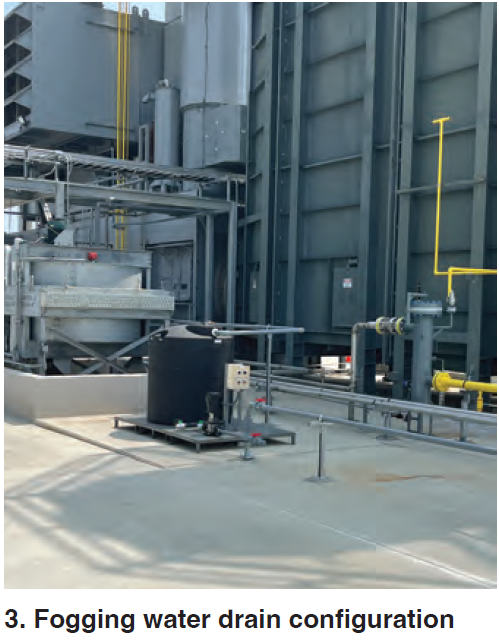
Within months, the team designed and installed a modified fogging system that reclaimed runoff and improved water use across the WattBridge peaking fleet. The system captured runoff water, pumped it to a temporary tank, and returned it to the raw-water storage tank for reuse. The drain-collection arrangement included pump skids, piping, and a tank (Fig 3).
Results. The team’s zero-tolerance approach to unauthorized process-water discharge, combined with a focus on reusing high water volumes, met environmental requirements and reduced water costs by approximately $2.2 million. Those savings were achieved even while using well-water assets to produce demineralized water.