

The first annual HRSG Forum América Latina was held September 22-24, 2025, at Blue Tree Premium Morumbi, São Paulo, Brazil under the guidance of the newly formed steering committee consisting of:
- Júlio Paulin, Petróleo Brasileiro S.A
- Luiz Cortez, Âmbar Energia
- Willians Nunes, Eneva
- Luiz Felippe, ENPERA Assessoria Empresarial Ltda
This inaugural event focused on issues and concerns related to heat recovery steam generators, gas and steam turbines and combined-cycle system operations. More than 100 registrants attended representing 10 countries and included owner/operators, international technical consultants, and premier OEM and equipment service providers.
Presenting sponsors included Alutal, Arnold Group, Dekomte, GE Vernova, HRST, NEM Energy, Precision Iceblast, Tuff Tube Transition, ValvTechnologies and Vogt Power.
Bob Anderson (Competitive Power) and Barry Dooley (Structural Integrity) moderated the event.
This Latin America event, conducted in English, is now part of the annual user group HRSG conferences and technical discussions that take place globally:
- HRSG Forum (US).
- European HRSG Forum.
- Australasian Boiler and HRSG Forum.
- HRSG Forum América Latina.
Brazil
The Federative Republic of Brazil is the largest country in South America with a population of more than 200 million. São Paulo is the most populous city. Brazil’s monthly grid load has increased steadily and in February 2025, exceeded 106 GW.
Generation capacity, explained by Julio Paulin, Petrobras, is a mix of approximately 56 percent hydroelectric, 17 percent wind, 17 percent thermal, 9 percent solar, and 1 percent nuclear.
Paulin was on hand to address Flexible operation impacts on HRSGs and boilers.
“With this capacity mix, operating outside the thermal optimal point is becoming routine,” he said. “Our big question is, what is the cumulative impact on the lifespan of HRSGs and boilers” and “are we sacrificing reliability in the name of flexibility?” Operating many plants originally designed for base load, Brazil is sharing in these global industry concerns.
“Thermal cycling and fatigue are the hidden costs of this flexibility,” he explained. “Frequent startups and shutdowns increase the impacts on equipment integrity and raise questions about current maintenance models,” he stated.
Brazil’s Ministry of Mines and Energy has programs in place to enhance overall grid stability and integrate renewables. Paulin said, “The new Regulatory Dispatch Capacity Reserve Auction [in Brazil] demands fast and flexible response” which might not align with the physical limits of these HRSGs. So the questions become: “Is there room for dialogue between engineering and regulation,” and “can we bring technical evidence to influence energy policy decisions?”
His discussion again raised global industry concerns with existing equipment, adapting assets without compromising safety and performance and implementing retrofit solutions for the long term. Participant thoughts and comments amongst stakeholders, solutions providers, OEMs, and consultants followed as the importance of this collaboration became apparent.
COMMON GLOBAL ISSUES
Luiz Fernando Cortez, Ȃmbar Energia (Brazil), presented Long- and short-term layup for flexible operations. His case study was the 470 MW Araucária combined cycle power plant with two Siemens SGT6-5000F 160 MW gas turbines, two Aalborg HP-LP HRSGs and one Alstom DKZ2 steam turbine.
He covered corrosion rates and estimated tube wall loss under both dehumidified and non-dehumidified scenarios. He also explained preservation strategies and shutdown preparation for both dry and wet layup. In addition, he explained a currently-used gas-side dehumidification system, and a steam turbine and condenser dehumidification system in detail.
The current preservation strategies, he continued, have both advantages and disadvantages. While the strategies maintain equipment in ready-to-start condition and reduce corrosion risks, nitrogen and water leakages affect preservation quality. Disadvantages also include the high cost of bulk liquid nitrogen, electric power consumption for dehumidification, and the general safety risks of using nitrogen.
He ended with a look at alternative preservation methods including chemical treatment during long-term layup (oxygen scavenger), dry preservation with compressed air, use of vapor-phase corrosion inhibitors, and an ongoing evaluation of film-forming substances.
Oxides: In an earlier presentation, Cortez discussed Oxide growth and exfoliation in HRSGs He repeated the global issues of base-load-designed units being forced into cycling and fast load changes.
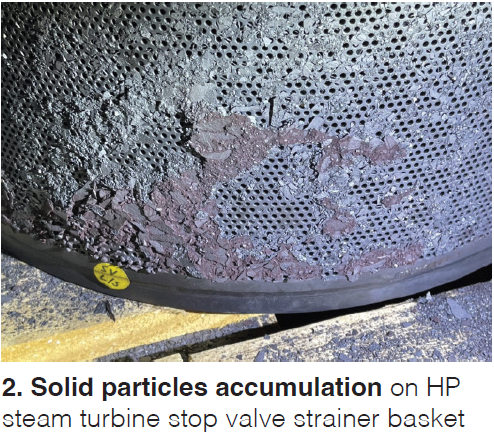
Cortez offered historical reviews and current understandings of oxide growth and exfoliation (OGE) for both HRSGs and steam turbines (Figs 1 and 2).
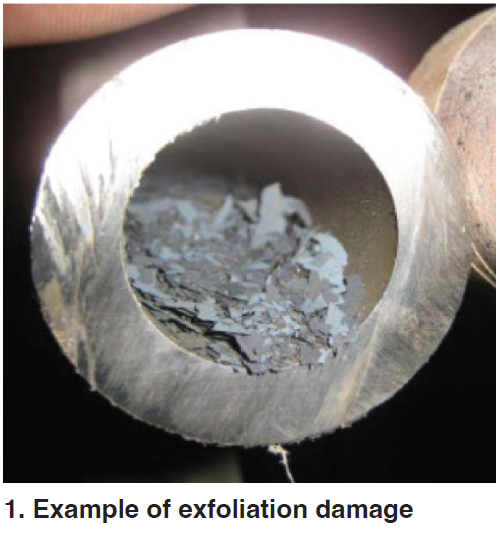
He offered a six-point overview:
- Oxide formation: Long-term high temperature plus dissolved oxygen lead to growth of multiple layers of magnetite and hematite.
- Thermal impact: Each oxide has a distinct thermal expansion coefficient, and repeated heating/cooling create thermal stresses.
- Microcrack initiation: Stresses accumulate and break oxide/metal interfaces. The oxide layer gradually loses adhesion.
- Detachment and transport: Fragments break off and are carried by steam flow. Particles travel through the main steam lines.
- System consequences: Impacts include tube and drain blockages, deposition and wear on valves, and erosion of HP/IP turbine blades.
- Progressive degradation: Fresh metal surfaces are exposed to new oxidation. Repetition accelerates failures and reduces system reliability.
He offered a detailed review of the three oxides association with OGE:
- Magnetite (Fe3O4).
- Hematite (Fe2O3).
- Iron-chromium spinel [(Fe, Cr, Ni)3O4].
Ivan Jimenez, Orygen (Peru), offered a Case study of hydrogen damage and under-deposit corrosion for the 480 MW Ventanilla Combined Cycle Power Plant in Lima, Peru. The plant features two Siemens SGT6-4000F gas turbines, two Vogt/NEM HRSGs and one Siemens steam turbine, operational since 2006.
In 2016, increases in makeup water were detected and inspections revealed widespread tube failures in an HRSG HP evaporator.
The area was in the first module of the evaporator, consisting of two rows of tubes, 92 tubes in each row. Two-thirds of the failures were in the lower section of the HRSG (elevations below 2.5 m/8 ft).
Tubes were removed and laboratory root cause analysis began (Fig 3).
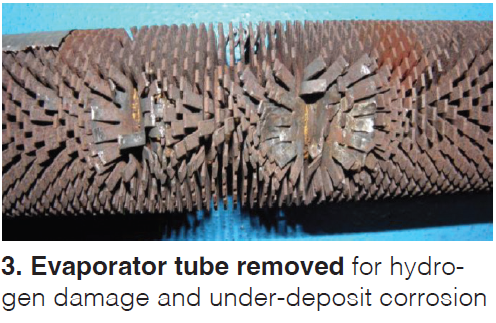
As Jimenez explained, “Hydrogen damage represents one of the characteristic mechanisms of under-deposit corrosion.” “The second factor,” he continued, “is the presence of chlorides within the internal deposits.”
He then discussed chemical cleaning and installation of a new evaporator module.
He ended with seven recommendations:
- Duct burner use is a critical factor. It is essential to verify burner condition and performance.
- Install and maintain reliable temperature monitoring systems; watch for thermal peaks and temperature differentials at critical locations.
- Thermal load limits: Thermal overloading significantly increases the risk of failures. Strictly comply with OEM-defined limitations.
- Apply cycle chemistry guidelines without exception, including monitoring.
- Adopt proven methods for layup.
- Plan for cleaning. Action is required before a problem escalates.
- Periodic and predictive monitoring should include wall thickness measurements in critical piping. Anticipate failures.
Julio Paulin returned to discuss Issues with vertical HRSGs He first compared vertical and horizontal gas path designs.
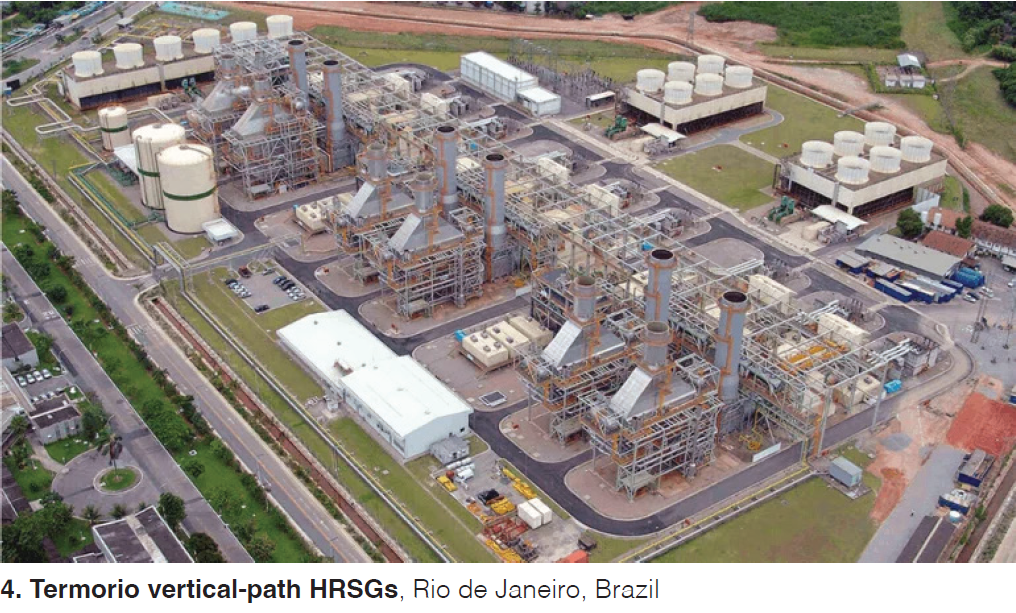
For vertical, he discussed two power plants: Termobahia and Termorio, both commissioned in 2004 with John Cockerill/CMI HRSGs designed for base load (Fig 4).
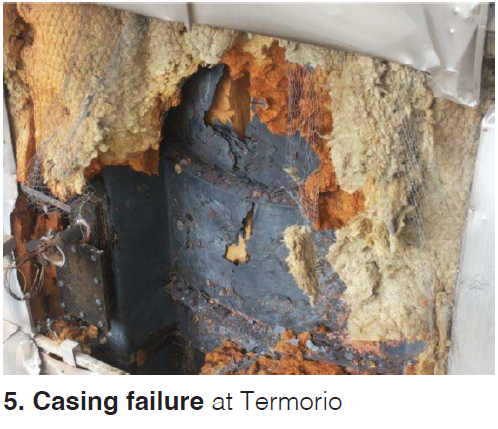
Casing failures (Fig 5) became apparent in 2014.
The inlet duct insulation also suffered multiple failures. He also discussed possible duct burner influences.
His final thoughts included:
- There are fewer studies and publications available for vertical HRSGs.
- John Cockerill/CMI has an active support team and is currently conducting remaining life assessments on the HRSGs.
- Burner issues were considered to have a minor influence on casing failures.
- Night-shift thermography remains the most effective method for detecting flue gas leaks.
Daniel Kadylak, Vogt Power, presented a HP drum replacement project in Chile in late 2024, reviewing startup and shutdown thermal gradient and stress data. Drum nozzle crack depths were reviewed in detail, leading to a discussion of stronger materials and thinner drums. The drum had been in service since 1997 (27 years).
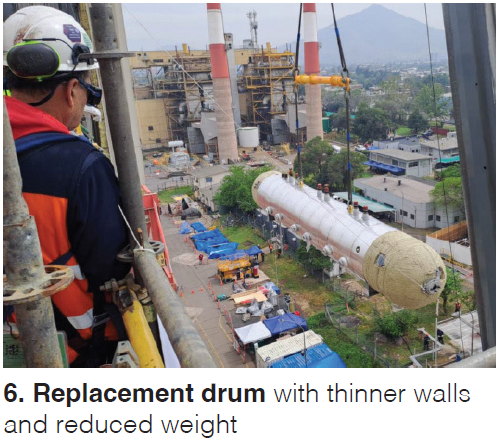
In this replacement case, for example, drum wall thickness changed from 5 in. to 3.5 in. and drum weight changed from 265,000 lb to 170,000 lb. See Fig. 6. Nozzle connections were also improved.
ASME Section 1 Code requirements (2025 vs. 1995) were reviewed.
Leandro de Souza Schiara, Petrobras/Unesp (Brazil), discussed Remaining life assessment of HRSGs operating in cycle conditions: thermal fatigue
He discussed a cooperative analysis by Petrobras and São Paulo State University that targets “quantitative remaining life assessment of some critical components of a three-pressure horizontal gas path HRSG in an attempt to withstand many start/stop cycles, reviewing the main damage mechanisms in cyclic operation. Numerous modeling specifics were presented for all critical components. He ended with a note that “life management must consider a holistic approach including operation, maintenance, inspection, and specific calculations.”
Luiz Felippe, ENPERA Assessoria Empresarial (Brazil), offered The practical application of FMEA (failure mode and effects analysis) for boilers
As he explained, FMEA is “a key step in implementing Reliability Centered Maintenance.” It is a “simple tool to quantify what you know and assemble it in a logical manner.” By doing so, owner/operators can be proactive, and can develop “dramatic improvements in maintenance plans” and ensure proper plan execution.
He offered specific examples based on boiler tube failure histories leading to discussions of thermal fatigue, flow-accelerated corrosion, and overheating with a strong focus on safety.
Willians Nunes, Eneva (Brazil), highlighted HRSG performance issues on commissioning which showed how quickly HRSG thermal and flow imbalances can damage pressure parts (Fig 7).
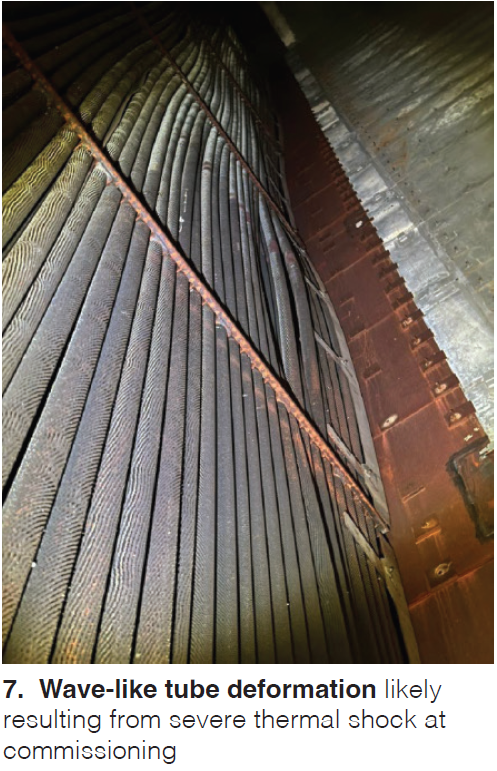
Sharing experience, Nunes discussed commissioning issues of a 1 x 1 plant with GE 7FA.04 gas turbine, operational since 2013, converted to combined cycle with Nooter/Eriksen HRSG and Siemens SST-600, operational in early 2025. HRSG performance issues on commissioning were discussed in detail.
Barry Dooley reviewed Optimum cycle chemistry control for HRSGs and fossil plants
A key feature was a specific review of Repeat Cycle Chemistry Situations (RCCS), addressed in detail by both Dooley and Anderson during the event.
Primary RCCS are:
- Corrosion products.
- HRSG HP evaporator and boiler waterwall deposition.
- Contaminant ingress.
- Drum carryover.
- Lack of shutdown protection.
- Inadequate on-line, alarmed instrumentation.
- Non-optimum chemical cleaning.
- High levels of air in-leakage.
- Not challenging the status quo.
Dooley ended with a complete list of Technical Guidance Documents available without charge from www.IAPWS.org.
Bob Anderson case studies highlighting the Importance of reheater isolation and avoiding HP superheater loop seal formation during layup
Key takeaways:
- A large quantity of condensate will form in the reheater if it is pressurized during layup. If not detected and drained prior to startup, water hammer, damaging thermal transients to pipe work and steam turbine water induction have occurred.
- Condensation normally occurs in the HP superheater during hot layup. If accumulated condensate floods lower superheater piping and/or headers a loop seal will form, isolating the HP drum from the superheater modules and steam pipework downstream of the loop seal. Further condensation in the isolated downstream superheater modules and pipework result in HP superheater outlet pressure decreasing below HP drum pressure, resulting in water carryover “over the top” into downstream superheater modules with resultant undesirable thermal transients. If not discovered and drained prior to startup, damaging thermal transients in HP superheater pressure parts and steam pipework result.
- The easy solution is to monitor for pressurization of the reheater and differential pressure between the HP superheater outlet and HP steam drum during layups and drain the offending water prior to startup.
SOLUTIONS
Tube failures, especially at the tube-to-header connection, plague owner/operators the world over, and with increased utilization of CCGT and conventional fossil units in South America, Marcus Hutchinson of Tuff Tube Transition (TTT) generated significant interest with Boiler and HRSG tube repairs revolutionized
A testimony from EDF’s Guillaume Grognet was the driving force behind the value proposition. A short outage window at EDF’s advanced-class Bouchain CCGT prompted a shift away from conventional tube-to-header repair practices. The site opted for TTT’s Tuff Tube Header Connection (TTHC) hardware and installation support to address recurring HP economizer tube leaks while minimizing inspection burden and weld complexity (Fig 8).
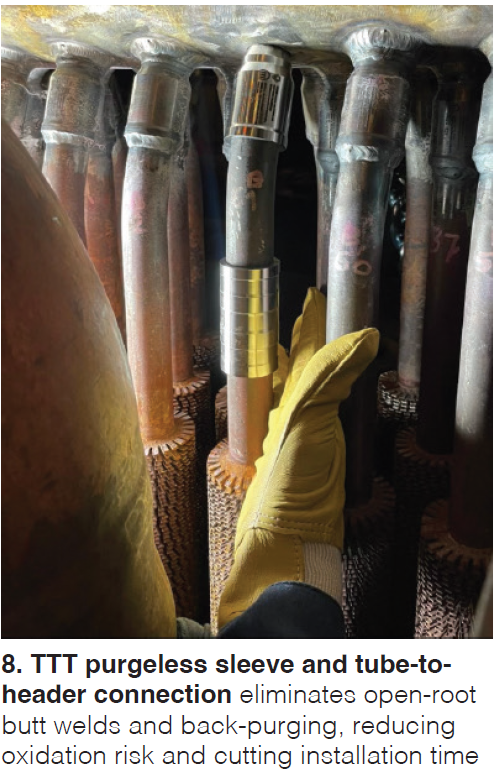
Grognet, the site’s maintenance engineer, reported that 60 tube connections were completed in roughly two and a half shifts, with visual inspection replacing radiography, and with finite-element analysis (FEA) used to justify expected lifetime. Needless to say, the repairs were completed within the outage timeframe and no additional failures have been reported.
Jake Waterhouse, Dekomte de Temple, detailed Expansion joint developments for plant reliability He focused on practical design and monitoring advances that improve combined-cycle reliability by addressing two chronic leak-and-heat sources: gas-turbine exhaust expansion joints (EJs) and HRSG penetration seals.
Case studies highlight “hot-to-cold” transitions and fast outage installs where EJs delivered with internal insulation reduced outage duration. The presentation then shifted to penetration seals, outlining how metallic bellows and packed glands can be costly, maintenance-intensive, and not always gas tight. The Dekomte retrofit approach emphasizes fabric-based seals and bellow-to-fabric conversions (often split designs) that avoid post-weld NDT/heat treatment, install quickly, and better manage casing insulation integrity. A newer multi-nozzle “combination” concept staggers penetrations to control temperatures and prevent fabric-to-fabric contact; a thermal survey after one year of operation is cited as meeting expectations.
Sergio Xavier, Alutal Industrial Controls (Brazil), offered Excellence in online water/steam cycle analysis systems (SWAS) for power plants
Xavier walked through many topics including the value of online monitoring, the variety of international guidelines (IAPWS, VGB, EPRI and ASTM) including Safe Operating Limits, specific sampling points, the critical parameter monitors, and a look at advanced measurement technologies.
His summary: “By controlling chemistry, you control plant reliability and profitability. A proper steam and water analysis system,” he noted, “is an insurance policy.”
Laura Mikovich, ValvTechnologies, “zeroed in” on zero-leakage isolation as essential in HRSG applications and how metal-seated ball valves mitigate chronic leakage seen with globe valves. With globe designs, line pressure raises unseating force and small leaks can escalate into steam cutting, wire drawing, erosion, flashing, and cavitation, hurting heat rate, reliability, and commissioning schedules while creating warranty and penalty exposure for OEMs/EPCs.
The company’s quarter-turn ball valve offers a straight-through flow path, higher seating force, protected sealing surfaces, and higher Cv. RiTech HVOF hardfacing plus extended lapping deliver durable, self-repairing, metal-to-metal sealing and long cycle life, lowering total cost of ownership for operators.
Daniel Acosta and Cesar Moreno, HRST, discussed Maximizing HRSG reliability in a cycling world through inspection of covered piping systems (CPS) and other neglected areas Editor’s Note: “Covered” here means included in ASME Code, not physically covered.
Acosta’s purpose was to discuss what is “covered” by Code, looking at lessons learned since the 1980s, beginning with coal-fired units. His relevance to the conference was to look at the many high-pressure, high-temperature HRSGs that are approaching 15 to 20 years in age.
These units, he discussed, are subjected to many cycles, contain questionable material properties, can have uncertain OEM designs, and are constantly undergoing changing operating profiles. Piping system repairs are normally large, expensive projects with long lead-time components.
Common problem areas also include bypass valves, attemperator piping, and others.
This detailed presentation on piping systems reviewed a range of information encompassing:
- ASME B31.1 Piping Code requirements including maintenance and operation.
- Often overlooked code requirements including:
- Written operation and maintenance procedures that cover topics mandated by the code.
- Review of any dynamic events since the last condition assessment.
- Water/steam hammer.
- Thermal hydraulic events.
- Record keeping: procedures, drawings, material history and failure analysis.
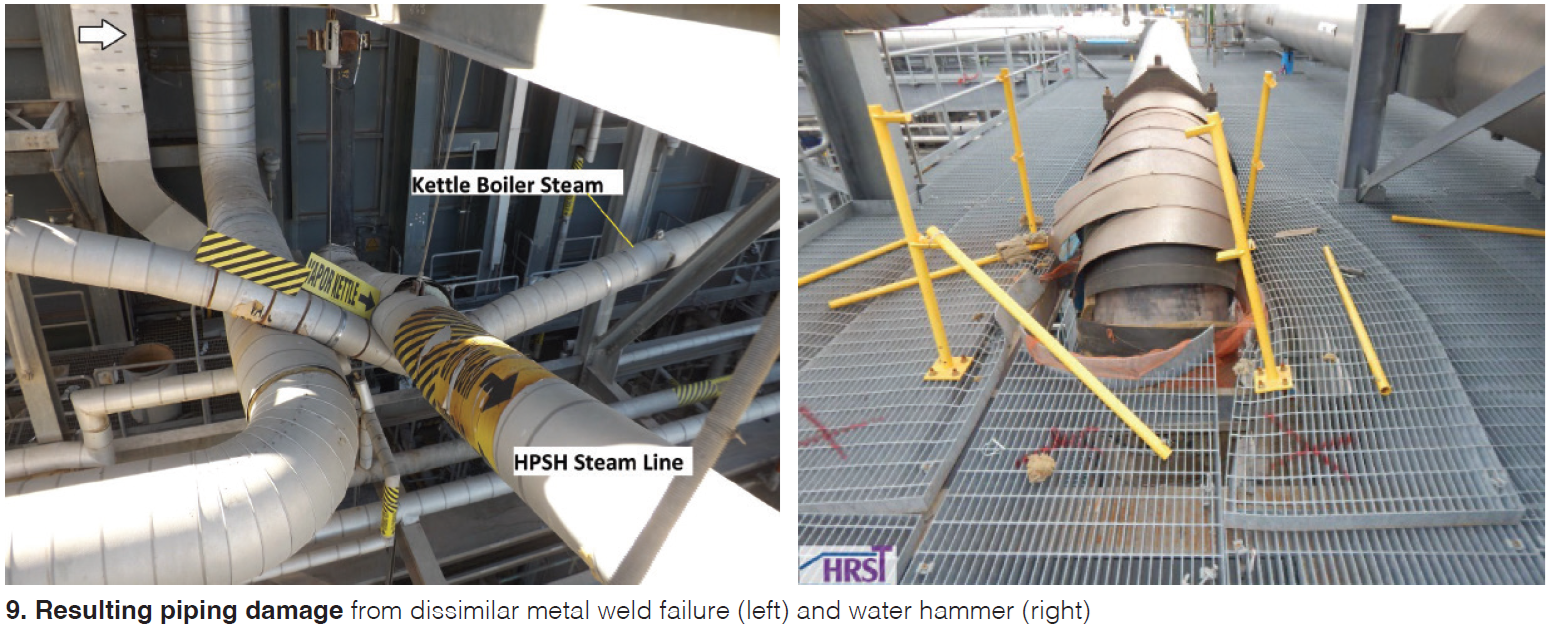
He included case studies on dissimilar metal welds and water hammer (Fig 9).
Acosta recommended piping system walkdowns as part of condition assessment to look for the common problem areas: areas that undergo significant thermal stress, areas at risk of creep damage, attemperator spools, bypass valves, piping support/constraint issues, large valve bodies, branch welds, dissimilar metal welds, undrainable low points, and transition areas from HRSG OEM scope to piping OEM scope.
Pierre Ansmann and Norm Gagnon of Eugen Arnold GmbH dove deep into upgrading gas- and steam-turbine insulation to reduce heat losses, eliminate hot spots, improve safety, and recover heat-rate performance. Typical field problems are burned fabrics, gaps, sagging blankets, fiber/dust hazards, overheated auxiliaries, high enclosure temperatures, excessive ventilation demand, and outage rework.
The Arnold solution is a 3D, single-layer blanket system with 45° interlocking edges and stepped interfaces to prevent leakage paths during thermal expansion, plus a permanent stainless-steel substructure (no pins) that locks each blanket into a dedicated position for repeatable fit and faster access during outages.
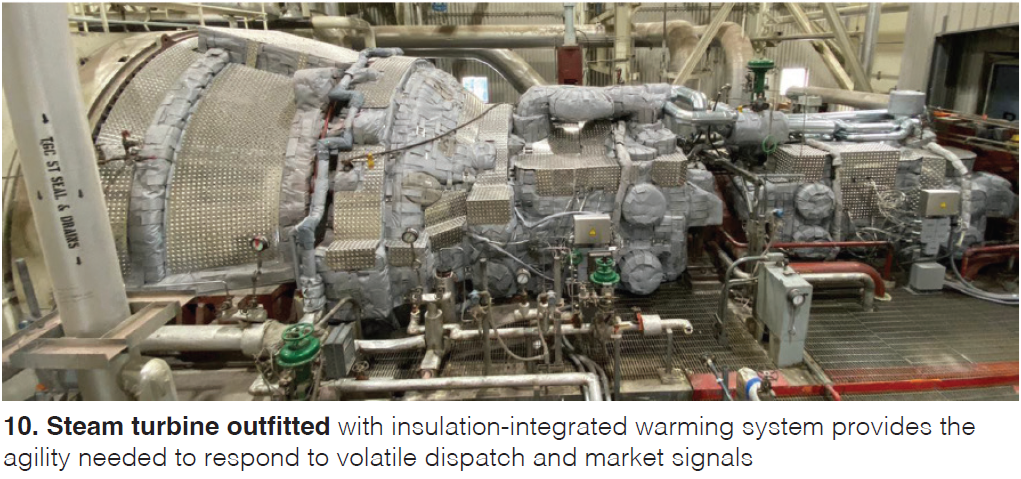
The design targets an insulation surface temperature no more than ~15°C above ambient, with step-protection panels to extend life and enable safer walkways. Case studies show materially lower surface/enclosure temperatures and a reported heat-rate improvement on a 501F unit attributed largely to the insulation upgrade.
The duo also highlighted integrated steam-turbine and HRSG warming concepts, citing faster starts, reduced fatigue, lower startup fuel/emissions, and quantified parasitic loads and install timelines (Fig 10).
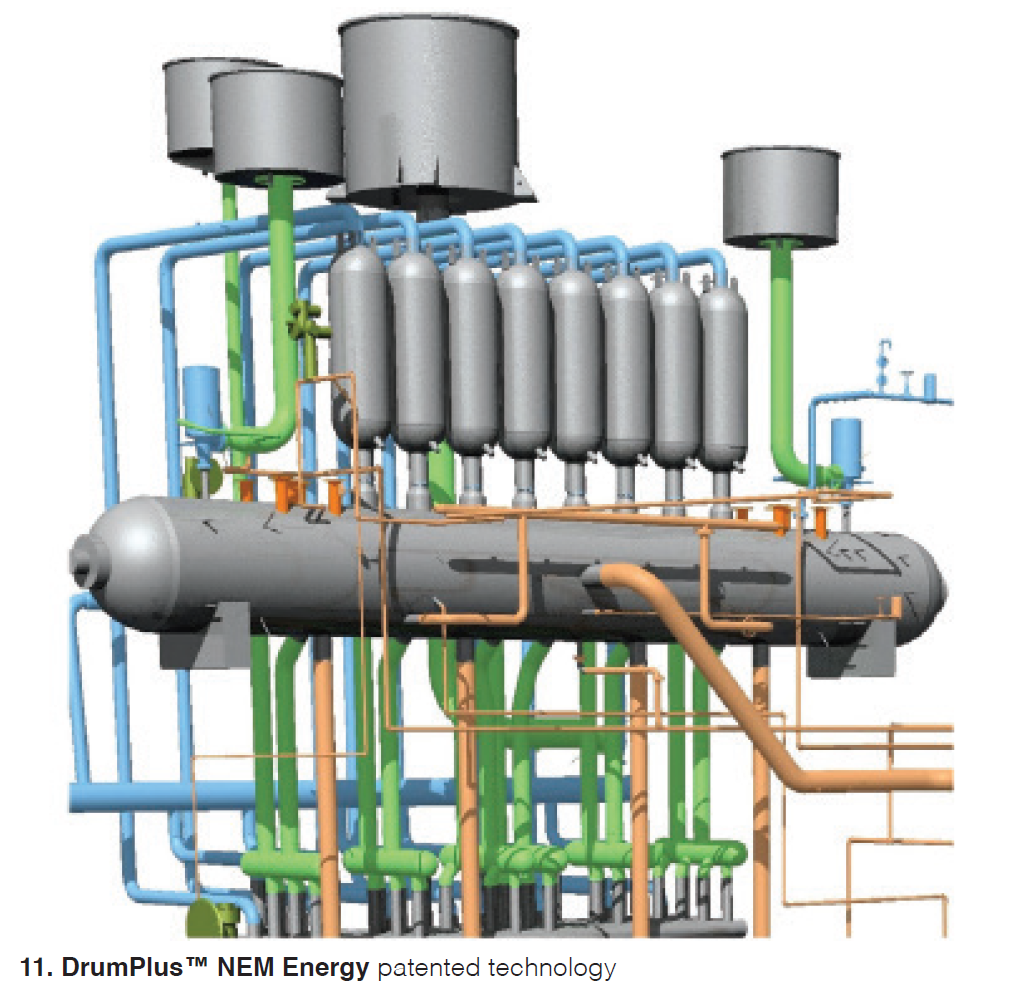
Noelia Acero Terrés, NEM Energy, offered Enhancing CCGT flexibility with DrumPlus™ and diverter damper technology
The drum design (Fig 11) features:
- Separator bottles (small vessels) as secondary water-steam separator.
- Minimized nozzle sizes.
- Enhanced flexibility with multiple downcomers.
Terrés presented a case study of an installation in Argentina, in operation since 2020. This plant at Genelba is two units, each featuring a 198 MW gas turbine and two-pressure DrumPlus HRSG, operational since 2020.
“Enhancing flexibility” means lower fatigue damage to the HP drum during start/stop so that the HP drum is no longer the limiting factor in how fast the unit can be started.
Kenneth Hutchison and Markus Heitzmann of GE Vernova connected water/steam chemistry discipline with HRSG reliability upgrades and lifetime extension. The speakers stress a simple premise: HRSG design (materials, pressure, temperature) dictates the chemistry program, and chemistry quality determines whether the unit meets its design potential or “actively dismantles” itself through corrosion and deposition.
Several field examples show that many failures are rooted in miscommunication among OEM, EPC, and operator: oversized chemical dosing lines create long transport delays that make stable control impossible; removing key analyzers (such as sodium) to save CAPEX can leave the plant blind to condenser leaks and drive rapid corrosion; poorly maintained analyzers are worse than none because they create false confidence; and misunderstanding system architecture (for example, an LP drum functioning as a feedwater tank) can lead to wrong chemical dosing and carryover into HP circuits and the steam turbine.
The deck also calls out improper blowdown quench practices that can cause flashing, scaling, and thermal shock damage, and it recommends quenching in downstream piping instead of the atmospheric tank.
For mitigation, GEV highlights continuous online monitoring to validate instrument health, flag out-of-spec excursions, diagnose root causes (dosing errors, air ingress), and track cumulative time out of limits. For long-term management, it outlines HRSG upgrade pathways and planning windows tied to GT outages, including desuperheater and safety-valve resizing and major pressure-part replacements (often with material upgrades to address FAC) to restore reliability as cycling accelerates life consumption.
Ron Preston of Precision Iceblast presented HRSG performance rejuvenation with deep cleaning technology The patented service for CCGT plants is built on 30+ years of experience and more than 1,800 HRSG units cleaned worldwide. The approach targets 80–95% of heating-surface area using specialized wands and alignment methods to clean both upstream and downstream tube faces, even in staggered bundles, with customized plans based on HRSG drawings and tube-stress calculations.
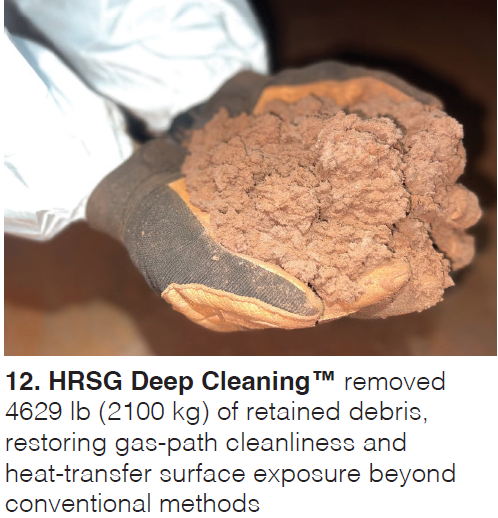
Case studies from Spain and Italy show major debris removal (Fig 12), improved cleanliness verified by borescope inspections, and operational benefits tied to backpressure restoration, including lower stack temperature, higher GT/ST output, and improved heat rate.
The full conference
HRSG Forum América Latina was comprehensive and detail oriented and only selected highlights are presented above. Attendees enjoyed inclusive and wide-ranging topics and informative discussions that included the following, which can be further researched at the CCJ website:
- Bob Anderson, Competitive Power, 16 years of HRSG thermal transient assessment results
- Eugene Eagle, EPRI, HRSG offline internal inspections
- Barry Dooley, Flow-accelerated corrosion: science and approach
- Barry Dooley, Latest film-forming substance (FFS) application results and direction
- Eugene Eagle, EPRI, Integrated life management of tee intersections in high-temperature high-energy piping systems
- Eugene Eagle, EPRI, Gas turbine upgrades and HRSG assessments
2027
The second HRSG América Latina conference will be held in Brazil in September 2027. Information will be available at hrsgamericalatina.com.