

Water-cooled stator windings have been in commercial service since the early 1960s and remain common on large machines, generally those above about 400 MW. Dr. Robert Svoboda, speaking in the May 26 IAPWS Power Cycle Chemistry webinar on generator cooling-water chemistry, put the installed base at roughly 2000 water-cooled stators outside Russia and China, about 800 in Russia, and more than 1200 in China.
The practical audience questions, from 115 registrants, clustered around layup, startup after outage, conductivity trips, leaks, stainless-steel conductors, and cleaning. Access to the full presentation recording follows.
Water removes heat well, allows high generator outputs in a compact machine, and lowers stator-winding temperature compared with air or hydrogen cooling alone. The exposure is just as direct. When the cooling path is through small hollow conductors in copper stator bars, corrosion products can restrict flow. Loss of cooling can accelerate insulation aging, drive local overheating, or in the worst case melt a stator bar.
Svoboda, an honorary fellow of IAPWS with long field experience in generator chemistry and cleaning, kept the webinar centered on that main failure path: corrosion and plugging of copper hollow conductors. The companion PPChem overview he cited describes this as the most common and severe corrosion-and-deposit problem in generator water cooling. It estimates that 10% to 20% of approximately 2000 water-cooled generators outside Russia and China suffer related flow restrictions sooner or later within the first 25 years of operation.
Dig deeper
R.Svoboda, W.D.Blecken. Corrosion and Deposits in Water-Cooled Generator Stator Windings: Overview of Water Cooling of Generators. Power Plant Chemistry 20 (2018) 5, pg 290-294
R.Svoboda. Corrosion and Deposits in Water-Cooled Generator Stator Windings: Part 1: Behaviour of Copper. Power Plant Chemistry 20 (2018) 5, pg 297-309
How copper plugging develops
The plugging mechanism is a four-step sequence: oxidation of the copper surface, release of oxidized copper, migration with the cooling water, and re-deposition where the system can least tolerate it. Copper metal itself does not release meaningful copper into non-oxidizing aqueous media. The oxide layer is the material that dissolves, flakes, travels, and plates out downstream.
Generator deposits typically contain both cuprous oxide, Cu2O, and cupric oxide, CuO, often with metallic copper mixed in. The oxygen regime shifts the balance. High-oxygen chemistry tends toward more CuO. Low-oxygen chemistry tends toward more Cu2O. Svoboda stressed one operating point for low-oxygen units: all oxygen entering the generator is consumed by the coil. Every gram of oxygen ingress can form about 9 grams of Cu2O or about 5 grams of CuO, independent of the nominal chemistry program.
Copper-oxide release is governed less by a single bulk-water number than by local mass transfer. Flow velocity, turbulence, geometry, temperature, and the solubility of the cooper oxide affect how much oxidized copper leaves the surface. pH matters because copper oxide solubility drops as pH rises. That is the basis for alkaline treatment in selected systems.
Design is part of the chemistry problem. Flow geometry, turbulence, and temperature can predispose a unit to release or deposition. Stainless-steel hollow conductors avoid the copper-oxide problem, but most operating units still depend on copper conductors. Mixed-bed and mechanical-filter performance also belong in the first line of defense. Svoboda noted cases where operators shut off side-stream mixed beds and later found plugged generators.
Important specifications
The webinar sorted generator water treatment into low-oxygen neutral, low-oxygen alkaline, high-oxygen neutral, high-oxygen alkaline, and cationic purification. The first four are operating regimes. Cationic purification was presented only for completeness and as a temporary soft-cleaning approach, not a standing chemistry program. Svoboda was blunt in the Q&A: do not use it as normal operation. The utility that developed this method, he said, abandoned the approach after acidic operation produced important wall-loss concerns in hollow conductors.
For high-oxygen chemistry, conductivity at 25°C should be no more than 0.2 μS/cm for neutral treatment, with troubleshooting beginning above 0.15 μS/cm and short-term action above 10 μS/cm. Alkaline treatment allows higher conductivity, for example up to 2 μS/cm with sodium hydroxide. Oxygen should be at least 2000 ppb; below 1000 ppb, the oxide layer can move out of the intended CuO regime and become unstable when high oxygen returns.
For low-oxygen chemistry, the same 0.2 μS/cm normal conductivity limit applies. Oxygen should be below 20 ppb, with action when it rises more than about 10 ppb above normal.
With stainless-steel hollow conductors there are no requirements regarding oxygen in the water. The main specification presented for them was conductivity below 0.3 μS/cm during operation and, if the stator is left filled or before draining, during shutdown.
Conductivity has two jobs. At low levels it limits pH excursions in high-purity water. At higher levels it limits electric current through the water in insulating hoses. Svoboda cautioned against treating every plant limit as universal. The common 10-μS/cm upper limit is conservative, while the true limit depends on voltage, water flow, and hose geometry. The operating risk is boiling in the hose, with the possible consequences of loss of cooling, and then arcing if a steam-filled section creates a gas path.
Recommended monitoring was practical: continuous conductivity, continuous oxygen where the regime requires it, periodic copper analysis, and periodic analysis of additives such as sodium in alkaline treatment. Electrochemical potential has promise as an oxide-condition indicator, but Svoboda called the specification tentative because field experience remains limited. He discouraged routine pH measurement in high-purity water because it often produces more false questions than useful answers.
Layup choices carry consequences
Layup was the strongest operating lesson in the webinar. For copper hollow conductors, leaving the system running is the safest short-term layup, provided staff can supervise it and the risk of water leakage into the stator is managed. Shutting the pumps and leaving the system filled is simple and may be acceptable for short periods, but chemistry becomes uncontrolled. Svoboda treated about three days as a practical dividing line, not an absolute rule.
For long-term layup, the recommended path is drain and dry. The process starts by replacing water with nitrogen, valving out the stator from the cooling-water system, and using a series of hard compressed-air blows. Vacuum drying may follow, and pressure should be pulled below the vapor pressure of water at the coldest point. If the coil is dry, it can be left on air. If it cannot be dried fully, return to nitrogen conservation.
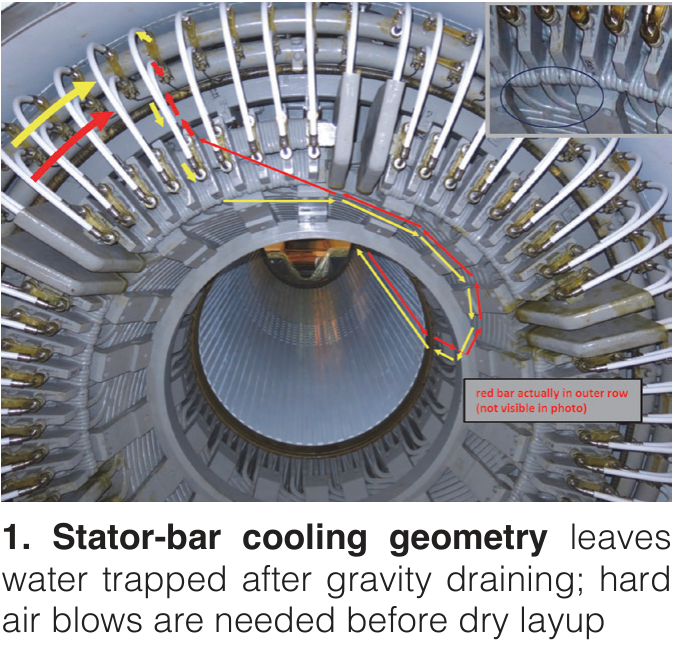
Gravity draining is not enough. Fig 1 shows why: the geometry of the stator-bar cooling path can leave water trapped in lower bends. Svoboda put the retained volume in a typical generator at about 500 liters. Vacuum drying after gravity draining will not remove that much water in any reasonable time. The water must be pushed out with hard air blows.
High-oxygen units do not get a free pass on layup. Air entry can lower the pH of the water film through carbon dioxide and upset oxide stability. A unit with an out-of-specification history, including periods of low oxygen, may mobilize oxides rapidly at restart when exposed to air. In practice, shutdown chemistry history is part of startup risk.
Field examples and Q&A takeaways
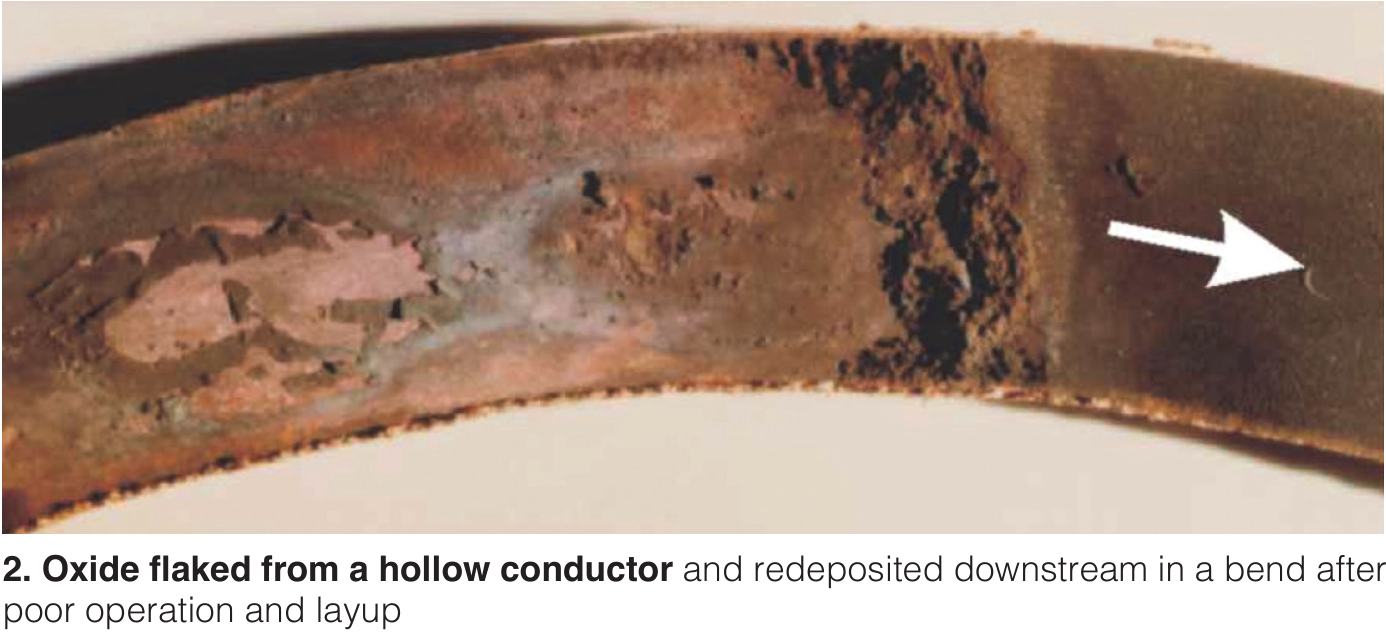
The clearest failure example involved a low-oxygen system that was actually running at 100 to 200 ppb oxygen during normal operation. The unit was drained and left idle in air for two weeks. At restart, after no proper layup, oxide flaked from a hollow conductor and redeposited downstream in a bend (Fig 2). The result was a melted stator bar and a shutdown that took months to recover from.
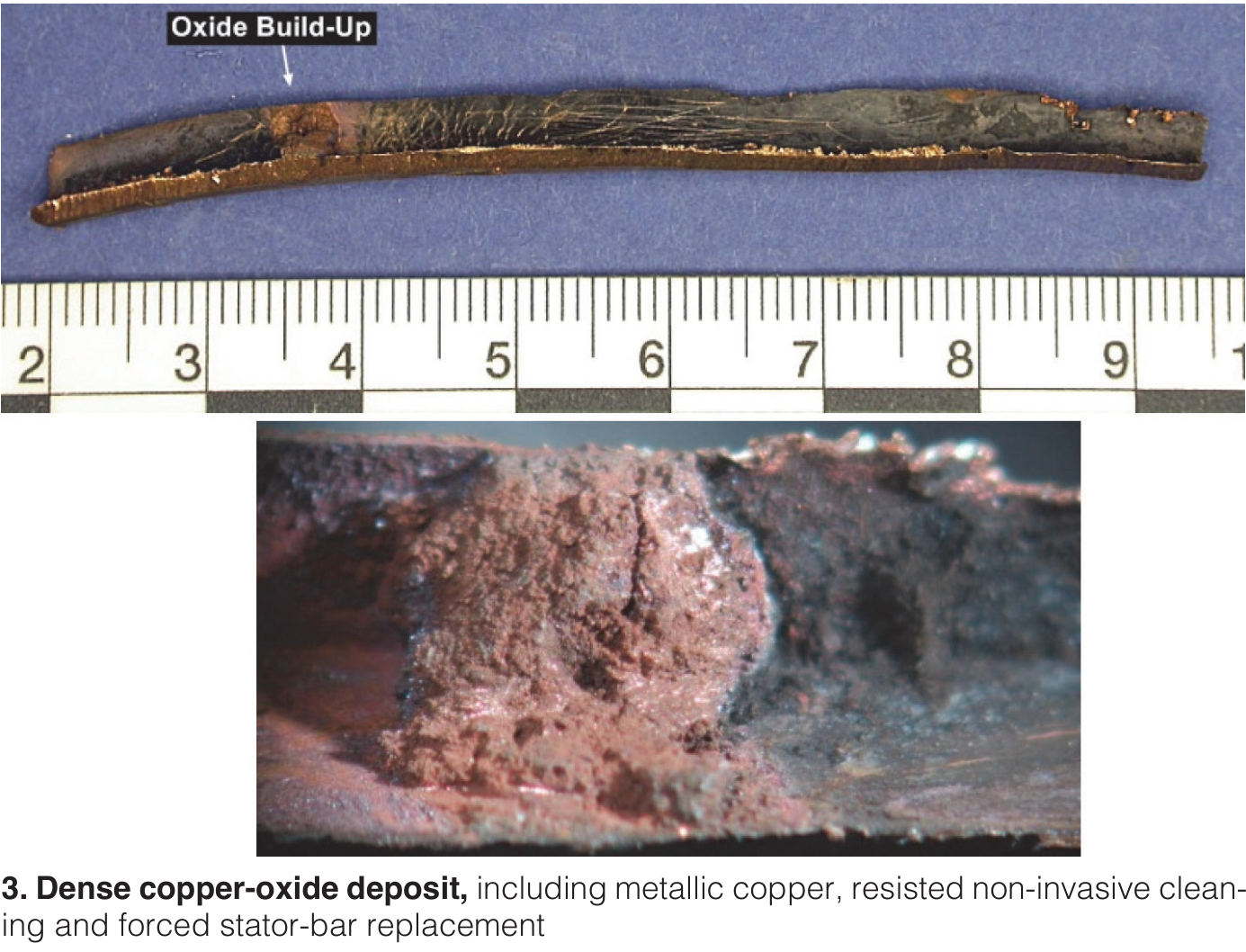
If deposits are already present, the choices narrow. Mechanical cleaning can include scraping, blasting, or brushing. Chemical cleaning can use acids or complexants such as EDTA, although Svoboda did not present acid as the preferred route. In the Q&A he said online cleaning with complexants has been performed about 150 times and is a proven method, but it is soft cleaning. Dense plugs may require combined chemical and mechanical work. In some cases replacement is the only practical answer (Fig 3).
Svoboda also separated reactive cleaning from planned maintenance. Some proactive cleanings produced better flows and lower temperatures than expected, meaning the deposits were already affecting performance. He did not support proactive cleaning intervals shorter than 10 years as a general policy. Starting around 10 to 20 years may be reasonable, depending on condition data and operating history.
On early detection, he pointed operators to flow and pressure drop across the generator, outlet temperature of individual stator-bar hoses, and slot temperatures, with hose outlet temperatures usually more sensitive. He also added a warning that operators should respect: clean indicators do not prove the unit is safe. Oxides can accumulate quietly and then move during a chemistry excursion, poor layup, or restart.
Asked where oxygen ingress often comes from in low-oxygen neutral systems, Svoboda named excessive makeup water first. He gave the example of a large hydroelectric plant in which makeup water was intentionally made difficult to obtain, a design discipline meant to prevent casual addition. Other sources include pump seals that suck air into the system and hydrogen leaks into the stator water when the hydrogen is not pure. In one case involving a cracked compensator, he said, a generator plugged within a couple of days.
Follow-up actions
Treat generator cooling-water chemistry as a stator-bar cooling issue, not as a lab-only specification. Confirm the intended oxygen regime, check whether actual oxygen is living in outside of the transition zone, and know which conductivity limits are chemistry controls and which are electrical-current controls. Verify that mixed beds and mechanical filters are operating as designed.
Review layup procedures before the next outage. If the unit has copper hollow conductors and will be down beyond a short interval, gravity draining is not a dry layup. The procedure needs hard air blows, a dry verification path, and either dry air exposure or nitrogen conservation. Restart risk should include the unit’s recent oxygen history, makeup-water additions, leakage history, and any trend in flow, pressure drop, or hose outlet temperatures. CCJ