

By Christopher Schroeder and Daniel Michels, Vogt Power International
Preface
The ability to operate combined cycle power plants to efficiently meet a variety of power demands continues to drive change within the power industry. Combustion turbines (CTs) are central to this flexibility, with low load operation providing greater operating range. Heat Recovery Steam Generators (HRSGs) experience the downstream effects of these low load conditions. This article explores the impacts that low load CT operation may have on HRSG units.
Background
Low load operation is defined as operating the CT at a reduced output, often 60% capacity or below. Some modern CTs allow for operation at as low as 20% maximum capacity. This flexibility is increasingly important as grid variability grows with renewable sources such as wind and solar. If the CT can be operated at very low loads, it allows the plant to be “parked” at a low output level with relatively few ill effects. Subsequently, the plant can ramp up quickly when needed with lesser fatigue life consumption compared to a start-up. Low load ramp up is quicker than any “fast-start” since the steam turbine is already dispatched and synched.
Effects of Low Load Operation on the HRSG
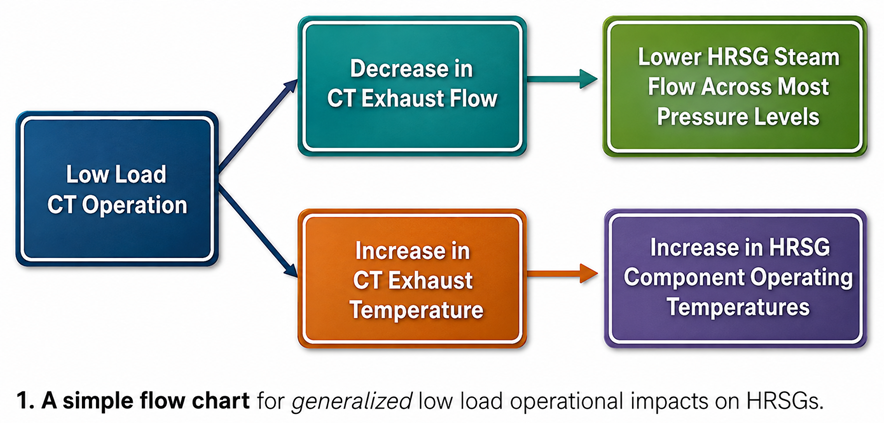
The general effects of low load CT operation on existing HRSG units can be grouped into two main categories as shown in Figure 1 below.
The conditions in Figure 1 are general guidelines rather than definitive outcomes for all low load operation. A combination of lower steam flow rates and higher exhaust gas temperatures can have impacts on fluid operating temperatures, flow rates, and velocities.
This article is organized in two parts. First, it discusses how low load operation affects HRSG heating surface systems, including Economizers and Superheaters/Reheaters. Second, it examines impacts on other major HRSG components, including attemperators, catalysts, and valves.
Economizers
Economizers heat boiler feedwater close to saturation temperature. This difference between the saturation temperature in the drum and the temperature of the feedwater entering the drum is defined as the approach temperature. The approach temperature is closely monitored to ensure that no steaming occurs within the system. Low load operation may decrease the approach temperature since there is less feedwater flow through the Economizer system. Additionally, a lower operating pressure during low loads also reduces the saturation temperature within the drum. Economizer bypass systems allow the operator to control approach temperatures, but a large increase in required bypass flow to prevent steaming may exceed the maximum allowable flow of the control valve. Without the ability to control temperature effectively, low load operation can cause steaming within the Economizers, which could have detrimental effects.
Low load operation can also affect flow within Economizer sections. At reduced feedwater flow, water velocities through the tubes are lower, allowing buoyancy forces to have a greater influence on flow. As the water approaches saturation temperature, density differences increase. This tends to cause warmer, less dense water to rise. This can oppose the intended flow direction in downward-flowing Economizer tubes causing unstable flow. The velocities through the Economizer should be analyzed to determine if they are high enough to prevent any buoyancy related issue.
Water distribution within the Economizer headers should also be evaluated at low load conditions. At lower feedwater flow rates, the pressure drop available to distribute flow uniformly across the header and into each tube is reduced. As a result, tubes located farther from the inlet connection may receive less flow than other tubes. If this maldistribution becomes significant, affected tubes may be more susceptible to intermittent steaming, elevated metal temperatures, or thermal cycling. Therefore, low load evaluations should consider not only total Economizer flow, but also the ability of the header and tube arrangement to maintain adequate flow distribution.
Superheaters and Reheaters
As depicted in Figure 1, low load operation typically results in higher CT exhaust temperatures and lower steam flow rates. The resulting effects increase the operating temperatures within the HP Superheater and Reheater systems. When incorporating new low load operating conditions, a thermal analysis can be performed to ensure that the Superheater and Reheater systems are operating within the original design conditions. Component re-rates or other mitigation steps can be taken into consideration to ensure component design temperatures are not exceeded.
Attemperators
Attemperator systems also require specific consideration during low load operation. Due to the increase in CT exhaust temperatures and a reduction in steam flow, the required attemperator spray flow at low loads are often substantially higher than baseload operation. Subsequently, the minimum distance requirements for the downstream instrumentation and pipe bends may also need to be higher at low loads due to an increase in spray flow. Ensuring that the spray water is fully atomized by the time the flow reaches temperature measurement devices and pipe bends is crucial for the health and accuracy of the system.
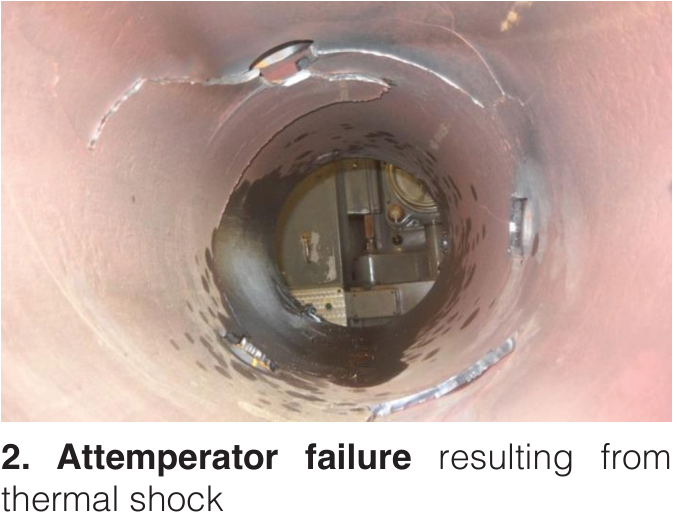
During low load operation, the attemperator spray water temperature and the steam-side pressure commonly decrease. This results in the temperature of the steam flow downstream of the spray point approaching saturation conditions which can result in incomplete vaporization of the spray flow and subsequently quenching. An example of a failure resulting from quenching is shown in Figure 2.
SCR/CO
SCR and CO catalysts are commonly designed to operate at minimum temperatures of 525°F and 600°F respectively. Low load operation results in lower HP steam pressures within the drum that correlates to a lower HP saturation temperature. Since the catalysts are typically located downstream of Evaporator sections in a HRSG, lower HP saturation temperatures during low load operation could result in lower catalyst operating temperatures. This could affect their ability to achieve the stipulated emissions requirements. Verifying catalyst operating temperatures during low load operation is therefore essential.
Valves
Low load operation can push HRSG-rated equipment beyond required maximum or minimum limits. For example, attemperator control valves may see greater volumetric flow than during normal operation. This increase in flow must remain within valve limits. Similarly, reduced steam production can cause non-return valve flow to fall below minimum design requirements, leading to chattering. This vibration can affect valve integrity as well as surrounding equipment.
Conclusion
While some low-load operating conditions are typically considered during the original design, industry demands are requiring combined cycle units to operate at even lower loads for longer periods of time. The maintenance and performance concerns discussed in this article demonstrate the importance of performing a thorough HRSG analysis prior to low-load operation. Such analysis typically starts with a thermal model to establish flow conditions and then evaluates pertinent HRSG components for suitability of operation. HRSGs are durable and flexible assets, but low-load operation should be reviewed carefully so the HRSG avoids any preventable issues in the future. CCJ