



Centralized relay data management (DMA) was the topic presented by a specialist from a Florida utility along with engineers from Schweitzer Engineering Laboratories Inc. Objectives were cybersecurity-, physical-security-, and operations improvements. End results reported are managed and monitored Intelligent electronic device (IED) passwords, active device setting monitoring, and improved time from an IED event to diagnosis and recovery. Slides cover basic architecture, one feature of which is inserting Schweitzer’s “Blueframe” device between relays in the plant and the DMA box.
“Turbine Controls Reliability Assessment a.k.a. Health Check,”
Abel Rochwarger (and others), AP4 Group
Slides go beyond “typical” reliability assessment (RA) activities (inspect, clean turbine control panel, check voltages and other parameters, resolve alarms, and inspect junction boxes) to more value-add ones like addressing unstable GT exhaust temperature, calibrating valve stroke position feedback, investigating battery failure, and resolving start permissives associated with the inlet filter house.
“Calibration Program”
You have to be grateful to a user who puts together a ~50 slide deck to help the CC user community understand and manage instrument calibration, the importance of which cannot be overstated as plant staffing continues to shrink and plants approach remote, unattended operation through automation (ultimately based on instrument measurements). To emphasize this point, the slide deck reviews several infamous plant failures rooted in poor calibration. Significant segment of the presentation covers modern calibration management software.
Key best practices listed in the last slide include establishing a fixed calibration schedule for every instrument based on whether it is critical, required by regulation or standard, or non-critical; deploy management software to track history and schedules; ensure calibration traceability to recognized standards; document results and analyze trends; and train technicians on safe operating procedures.
“ABB AlarmInsight™,”
Tom Maczuzak, ABB
Speaker asks the question, “how do you ensure the alarm system is effective?” Then he answers it, first reviewing what causes ineffective alarming and official technical documents (EEMUA191, ISA-18.2, and IEC 62682 1.0) for rationalizing alarm systems, then presenting company’s lifecycle alarm management system (AMS) concept. Important note: It is easy to get to 80% alarm rationalization; the last 20% is difficult. Key step is making sure the AMS is properly integrated into the DCS.
“Consistent and Optimal Combined Cycle Operations,”
James Nyenhuis, Emerson
While we wait for AI to make us all smarter, or at least richer from the buildout, digital intelligence and analytical tools built into the plant’s control system can be harnessed immediately. Nyenhuis gives eight practical examples of how to “marry the experience of the specific plant with modeling and theory.”
- Tracking cycling variability (e.g., shift-to-shift differences in fuel use for an overnight hot start).
- Model-predictive steam temperature control (to maximize ramp rates and reduce stresses from starts and ramping)
- Advanced steam bypass control management
- Duct burner optimization (reducing time to get duct burners on-line from around 75 minutes to 20 min with full automation)
- HRSG drum level pressure control
- Advanced pump protection
- Rotor stress management and optimal steam turbine startup.
- Procedural optimization/integration (analyzing operator actions).
These jam-packed slides are not for the faint of heart, but there’s a gold mine of operational improvements and cost savings embedded in them.
“Exposed Alarm Management,”
Benjamin Poskie, Emerson
The gap between “where [the industry] has been versus where [the industry] needs to be” vis a vis control room displays results from an overall lack of understanding of what to do and how to do it, non-existent or non-specific standards, disorganized graphics, excessive alarms, and workspaces which do not support human ergonomics or cognitive conditions.
This slide deck focuses on the alarm management piece. First step is analysis of the current situation, a baseline alarm report with performance scores in critical areas such as alarms per hour, chattering, top flood events, etc. Next is to apply software tools, including (in Ovation) an alarm health advisor and AgileOps. Example: Instead of allowing operators to retain alarms while in outage as reminders for startup checklists, create a separate startup checklist graphic. Tips for alarm suppression are also included.
“Enhancing LM6000 Engine Performance Through Data-Driven Solutions: A Snapshot of Success,”
Maxwell Erwin and Kellan McCarthy, [SISO] Engineering
Proprietary software-as-a-solution (SaaS) automation and analytics platform (trade name “Snapshot”) is presented through an aero-engine case study, addressing (1) power output constraints caused by the max fuel limiter activating when it shouldn’t, (2) N44 speed probe failure (which could have led to an unplanned outage), and (3) NOx water flow tuning. In all three events, troubleshooting was conducted quickly and precisely by leveraging insights from company’s remote experts and, in the case of NOx, quickly building a model and applying it to determine a new target water flow.
“Understanding Isolated Phase Bus Requirements for Transformer Change-outs,”
Mohsen Tarassoly, Electrical Builders Ind
Transformers are critical assets typically with no redundancy and long lead times for replacement. Presenter explains the change-out process (for system uprate, aging components, or failure), the critical path, steps to ensure success, contingency plans, and spare parts. Perhaps most importantly, overlooked areas like inspection of the connecting isolated phase bus are addressed.
Two case studies are included. One involves a change to the LV bushing design spec to accommodate increased power output, a change not communicated to the onsite team. Existing conductor mating surfaces were reconfigured to match the new design and EBI provided replacement copper adapter plates and aluminum connection shunts with expedited fabrication and shipping.
In case study 2, EBI addressed cracks in the conductor flex laminates during installation of three new single-phase GSU transformers. EBI sourced and installed the new conductor flex assemblies without affecting the outage duration.
“What Plant Instruments Can and Cannot Tell You About Your SCR,”
Dan Ott, Environex Inc
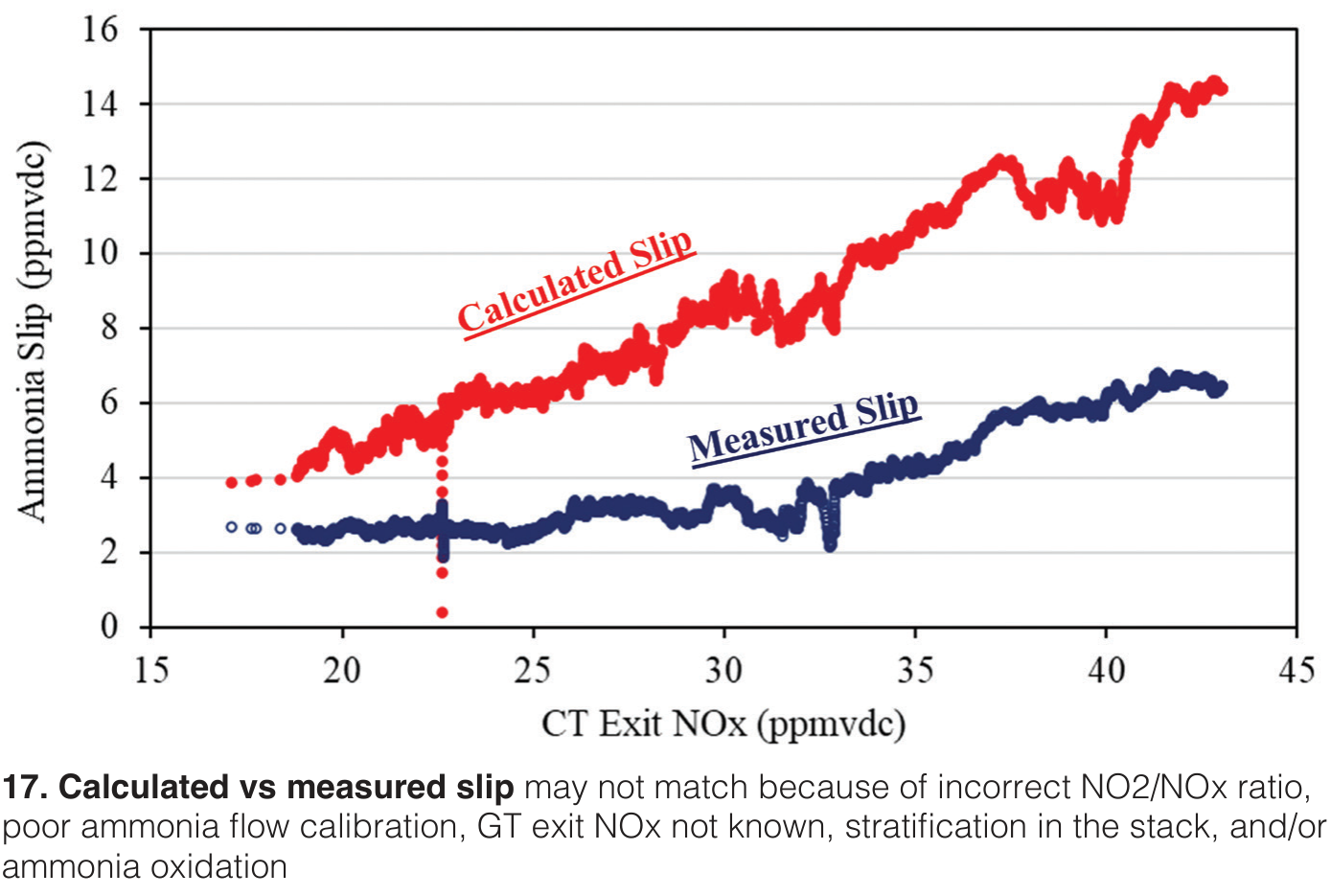
Slides begin with listing what data (and instruments) are available from the ammonia skid and why, for example, your calculated ammonia slip may be substantially different from your measured slip (Fig 17). Later slides explain why certain readings are trending in one direction or another, and offer good design practice for transmitters, sample lines, valves, etc. Pay attention to the little things, like keeping the header pressure gage in good working order, repipe and calibrate catalyst dP transmitters, and inspect the SCR regularly.
“Non-optical Flame Detectors,”
Paul Mitchell, GE Vernova
Now “standard on the 7F fleet,” non-optical flame detectors (NOFD) are a supplement to existing flame scanners or can replace them. Idea is to monitor individual combustor cans for global flame detection using an algorithm based on exhaust temperature, combustion dynamics, speed, and compressor discharge pressure (CPD). Once the NOFD is operable, the scanners can be ignored or removed, avoiding the associated O&M costs and issues.
New F and H units are now being shipped NOFD-only. There are modifications required, such as a Gen IV CDM (combustion dynamics monitor) and new CPD sensors. Official documents GEK121822 and TILs 2426 and 2433 (issued 2023) provide guidance. CCJ