

2025 POWER USERS COMBINED CONFERENCE RECAPS
- Combined Cycle Users Group
- Steam Turbine Users Group
- Generator Users Group
- Power Plant Controls Users Group
Future electricity demand growth accelerates. Supply chain constraints intensify. Carbon emissions rules ease. Existing combined cycle (CC) major equipment from the last boom (1997-2003) closes in on original end-of-life dates. Construction of hyper-scale data centers, with their seemingly insatiable electricity needs, takes on a life of its own while AI (artificial intelligence) takes up permanent residence in the public’s consciousness.
Gas-fired power plants are back!
Natural gas, a “bridge” fuel (to the renewable era) a few short years ago, is now being characterized as a “foundation” fuel. Even coal units, once slated for retirement, are being pressed back into service. There’s even talk of a new wave of nuclear power units.
For the powerplant community, whether the AI boom, with its powerplant “supercycle” build out, materializes is less important than the fact that everyone thinks it’s going to happen. That puts enormous pressure on the supply chain for at least the next several years.
Collaboration and creativity will both be essential, and one of the best places for both is the Power Users Combined Conference, comprising the Combined Cycle Users Group (CCUG), Generator Users Group (GUG), Steam Turbine Users Group (STUG), Power Plant Controls Users Group (PPCUG), and the Low Carbon Peer Group (LCPG).
As you’ll read in this report from the 2025 mega-event in Washington DC (most supporting slide decks available to end users registered at www.powerusers.org), bread and butter sessions and roundtables on user-driven O&M experiences, failure causes and recovery, and vendor solutions and new technologies, help the entire community learn and do better.
Keep in mind that in-person attendance is more critical than ever as liability risks from disclosures make everyone wary of an indelible record lurking in a storage bank somewhere ready to be mis-interpreted. And in keeping with recent practice, the GE and Siemens slide decks are not available at the Power Users site. As lead times for critical components enter the realm of the absurd, and even “stock” items get difficult to procure, your “supplier” may be the friend you just made at a user conference.
Several of the industry level presentations, repeated for each user group, along with a few presentations which apply across the board, are summarized first, before diving into the parallel conference sessions.
Cyber threat landscape
In “Physical and Cyber Security of Power Plant Locations in the United States,” after reviewing the “threat environment,” representatives from the Federal Cybersecurity and Infrastructure Security Agency advised attendees to make sure to test backup digital systems quarterly or at the very least annually. Common vulnerabilities in power plant systems include outdated software, lack of encryption, insufficient access controls, and lack of IT/OT segmentation, adding that OT systems use specialized protocols that are often “insecure by default.”
Slide 14 will be of particular interest as it lists a plethora of voluntary and no-cost cybersecurity offerings from the agency.
The third energy bubble
In a presentation titled “Energy’s Great Awakening,” two industry veterans called the coming landscape for gas turbines (2025-2040) the “third energy bubble,” the first being 1965-1975 when utilities purchased hundreds of GTs for peaking plants, and the second being 1995-2005 after natural gas was fully deregulated and the power industry ordered and installed several hundred thousand megawatts of gas-fired GT capacity. The presenters claim that this supercycle (Fig 1) will resemble the post-WWII build out of the U.S. power grid more than the second US bubble.
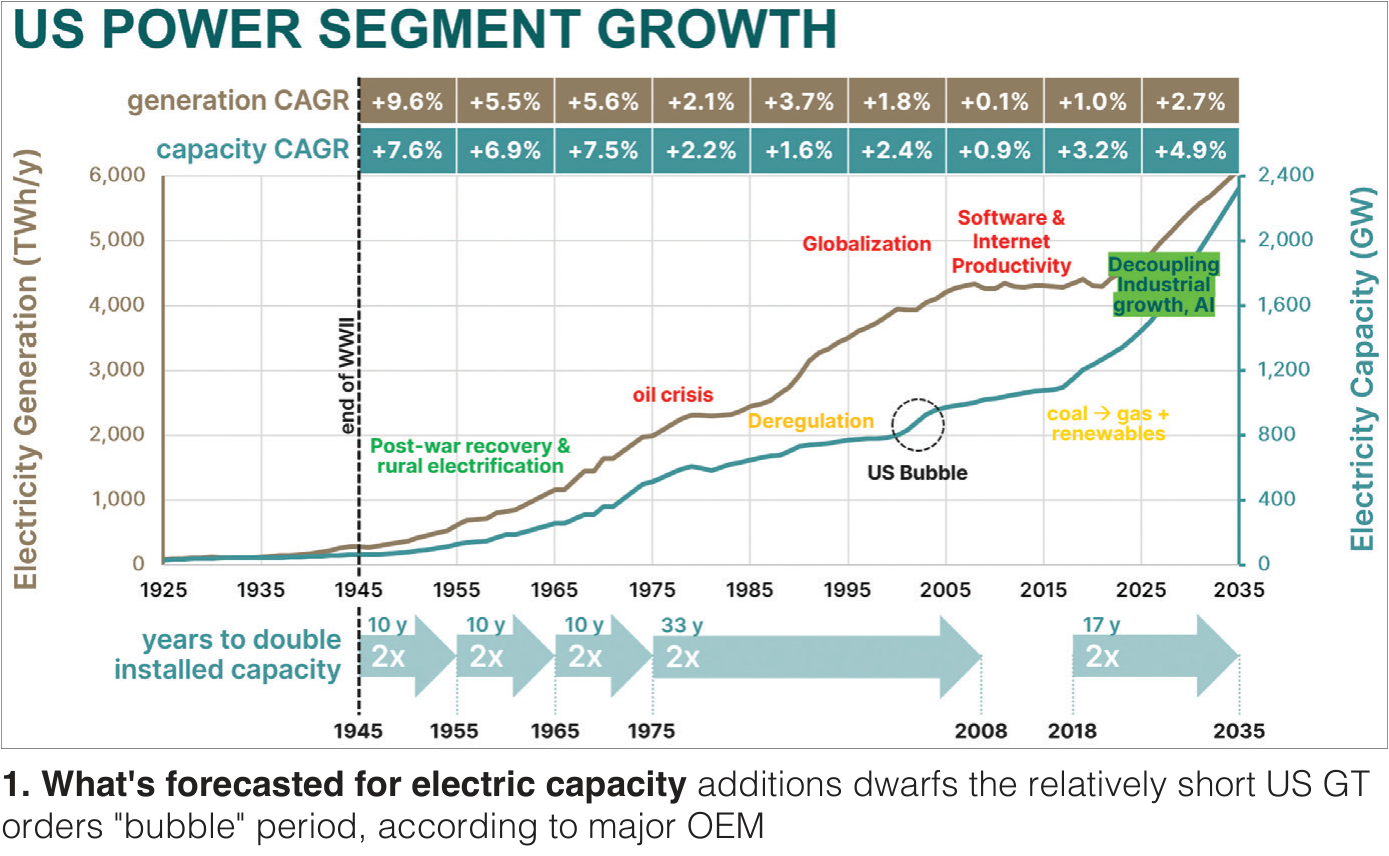
New build, existing asset refurbishment and replacement, and demand from heavy industry are “three streams converging to squeeze the supply chain”– the same raw materials suppliers, the same casting and forging houses, and the same install and craft expertise – with a “tropical storm named data center stalled over the top.” As one example of the trajectory, global GT orders in 2025 doubled over the 2023 level.
Fans of the Ford F-150 truck will enjoy slide 12: What type of truck owner are you?
Luster of natural gas restored
“Gas is a foundational fuel,” argues the presenter of “The Future of the Combined Cycle Power Plant.” It better be. The Energy Information Agency’s (EIA) US electricity demand forecast has shifted from a modest 0.9% growth to 2.0% annually in just two years. Large industrial loads account for 75% of the expected demand, as electric vehicle demand declines precipitously. At time of presentation, CCs were expected to average 70% capacity factor in 2025, a significant change from the 40% level in 2008.
Perhaps the most eye-opening chart is the one showing price indices for power plant components, e.g., if you need a transformer, you better be prepared to sacrifice your first-born. If you order an HRSG today, be prepared to shell out 50-100% more than you did in 2023. While COVID brought much manufacturing back to the US, even with tariffs, HRSGs are still less expensive to source overseas. Holding two balls in the air–the expected build-out and the average age of the HRSG fleet (~27 years)–should get your mind right about the coming nightmare in sourcing.
Model-based Controls
While we wait for AI to make us all smarter, or at least richer from the buildout, digital intelligence and analytical tools built into the plant’s control system can be harnessed immediately. The presenter of “Consistent and Optimal Combined Cycle Operations” gives eight practical examples of how to “marry the experience of the specific plant with modeling and theory.”
- Tracking cycling variability (e.g., shift-to-shift differences in fuel use for an overnight hot start).
- Model-predictive steam temperature control (to maximize ramp rates and reduce stresses from starts and ramping)
- Advanced steam bypass control management
- Duct burner optimization (reducing time to get duct burners on-line from around 75 minutes to 20 min with full automation)
- HRSG drum level pressure control
- Advanced pump protection
- Rotor stress management and optimal steam turbine startup.
- Procedural optimization/integration (analyzing operator actions).
These jam-packed slides are not for the faint of heart, but there’s a gold mine of operational improvements and cost savings embedded in them.
Safety wake-up call
In an era when legal and liability risks prevent disclosures to wider audiences, user groups are to be especially commended for their forthright dedication to sharing on critical safety events.
A plant manager reviewed an incident during which a contractor was discovered in shock on the steam turbine/generator (ST/G) mezzanine deck. Contractors needed to remove current transformers for testing and were trying to pry open an access door which wouldn’t move pulling on the handle. Even with its 22 bolts removed, it wouldn’t budge. While they looked for a crowbar, the door blew open with 8800 lbs of force. Within minutes, fire and EMS personnel arrived on-site, followed by a local news reporter, police, and OSHA personnel.
The slides (not available at the Power Users site) review the plant response and OSHA interactions. But the post-mortem review points are most important:
- LOTO (lockout/tag out) only included electrical components, not the generator’s hydrogen cooling system.
- Pre-project brief did not specify that H2-carrying components were behind the access door.
- Contractors did not contact their plant sponsors before starting work after the scope changed.
- Contractors unbolted the door to gain access, rather than seeking a hold point to gather other specialists to determine the proper course of action. CCJ