


Cutsforth recently held two technical webinars, one on brush failures and another on generator field monitoring. Taken together, they made a point many plants already know in their bones: generator-side trouble usually does not arrive out of nowhere. More often it builds in the gaps between inspections, in spots that are hard to see, awkward to reach, or easy to dismiss until the damage is no longer small.
The brush discussion stayed close to the collector. The field-monitoring session moved outward into shaft grounding and rotor flux. Different hardware, different language, same underlying problem. Plants are still trying to catch developing trouble before it turns into a forced outage, a ring fire, a bearing event, or a larger generator repair. For more on these topics and others, access a plethora of information-dense presentations on demand at www.cutsforth.com.
Contact problems still sit near the top of the list
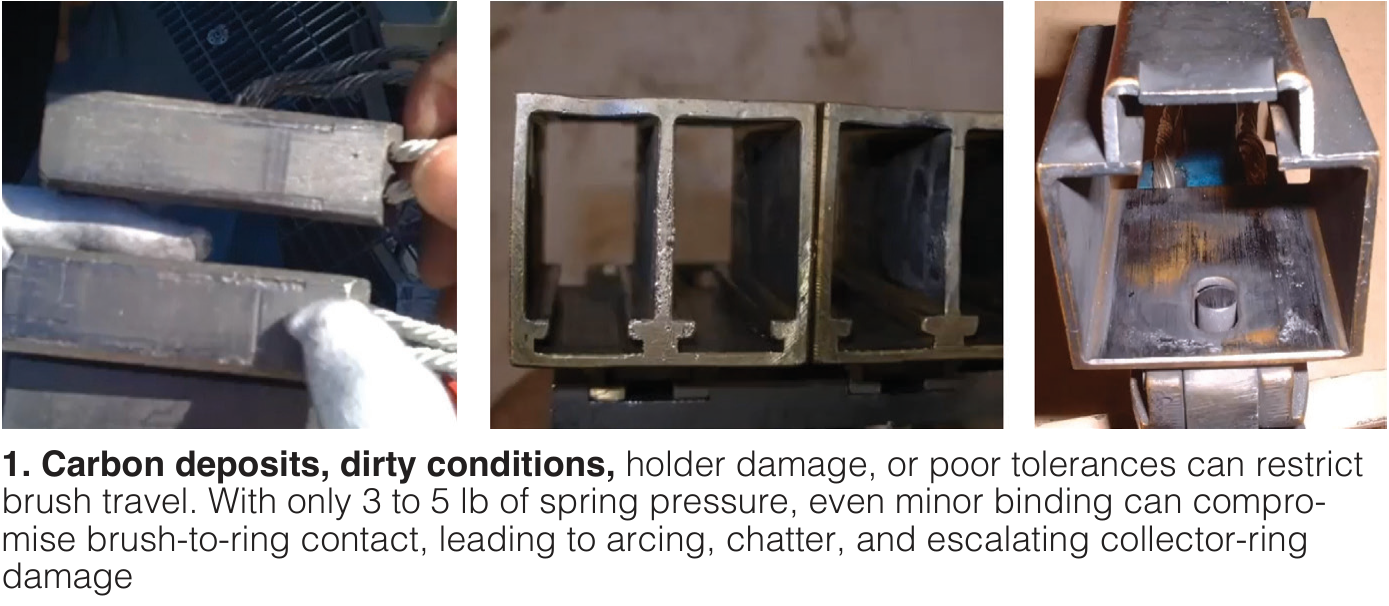
On the brush-rigging side, the most familiar problem was also presented as the most common: restriction in the brush box. Carbon deposits, rough internal surfaces, damaged holders, and bad tolerances all can interfere with brush travel. Because spring pressure is only a few pounds, it does not take much restriction to upset the brush-to-ring connection. Once that connection starts to degrade, arcing is not far behind.
That would be manageable if every problem announced itself clearly and stayed put until the next inspection. It does not work that way. A brush row may be hidden under the collector ring. Lighting may be poor. Access may be cramped. The point made in the webinar was not that plants are inattentive. It was that a disciplined visual inspection program can still miss a problem that develops quickly or in the wrong location.
Ring condition compounds the trouble. Roughness, ghosting, photographing, discoloration, and streaking can lead to chatter, brush damage, and still more arcing. Once the ring surface is degraded, the machine starts helping the problem along. In the source session, the recommended correction for ghosting and photographing was online truing at speed and under load, on the logic that the ring should be corrected in the condition where it actually operates.
Good field practice still matters, but it has limits
None of this is an argument against traditional brush-rigging practice. Strobe-light inspection, vibration probes, amp checks, and routine walkdowns still belong in the toolbox. Experienced technicians are not being replaced by a screen.
What the webinars argued, more quietly but more convincingly, is that periodic inspection by itself leaves blind spots. Technicians are not there every minute. Measurements can vary by who takes them and how. Some warning signs are not really about a single number anyway. They show up in the duration of an event, the shape of a waveform, or the fact that the same odd behavior keeps appearing at the same point in shaft rotation.
That is where the condition-monitoring case gets stronger. It is not inspection or monitoring. It is inspection plus monitoring, with the latter covering the hours when nobody is standing at the machine and catching the kinds of signatures that do not lend themselves to a quick spot check.
The holder matters, but the bigger issue is visibility
Cutsforth used the brush webinar to make a case for an integrated setup: improved holder design plus wireless monitoring. The holder side of the argument was practical enough. Tight tolerances, smooth internal finish, full-length brush support, and one-at-a-time replacement all aim at the same end, which is fewer opportunities for the brush to hang up and easier maintenance when intervention is needed.
The more consequential part of the presentation was the monitoring layer. Instead of relying on isolated observations, the system described in the webinar tracks brush vibration, temperature, wear behavior, and remaining life by position. The local display gives a technician a whole-rigging view. Historian integration extends that into a broader plant view, where condition data can be folded into maintenance planning.
That changes the conversation. One short brush is a replacement task. A pattern of elevated vibration and temperature across a path of brushes is something else. That begins to look like a ring-surface issue or another broader condition that deserves attention before the unit makes the decision for you.
Shaft grounding shows why waveform detail matters
The generator field-monitoring webinar made a related argument on a more analytical plane. The central point in the shaft-grounding discussion was not that one grounding method is perfect. It was that plants need to know whether the grounding path is actually doing its job.
The presenters emphasized waveform behavior over threshold-only thinking. A healthy system is not necessarily the one with the smallest peak. It is the one in which voltage is bled off properly instead of lingering away from zero for a meaningful part of the rotation. That is a more useful way to think about grounding performance, especially across machines that do not all behave the same.
The discussion got more interesting when waveform examples were tied to other machine conditions. One case linked a missing current signature to a bearing problem that disappeared after repair. Another associated dense voltage behavior and load-dependent current features with possible stator-related trouble. In other words, the grounding monitor was not just watching the grounding hardware. It was also showing traces of what the generator itself might be doing.
That is where separate maintenance domains begin to blur. Brushes, shaft grounding, rotor flux, and historian data are often handled as separate concerns. Continuous monitoring starts to stitch them together. When two signals tell the same story, diagnosis gets firmer and response gets faster.
Rotor flux points in the same direction
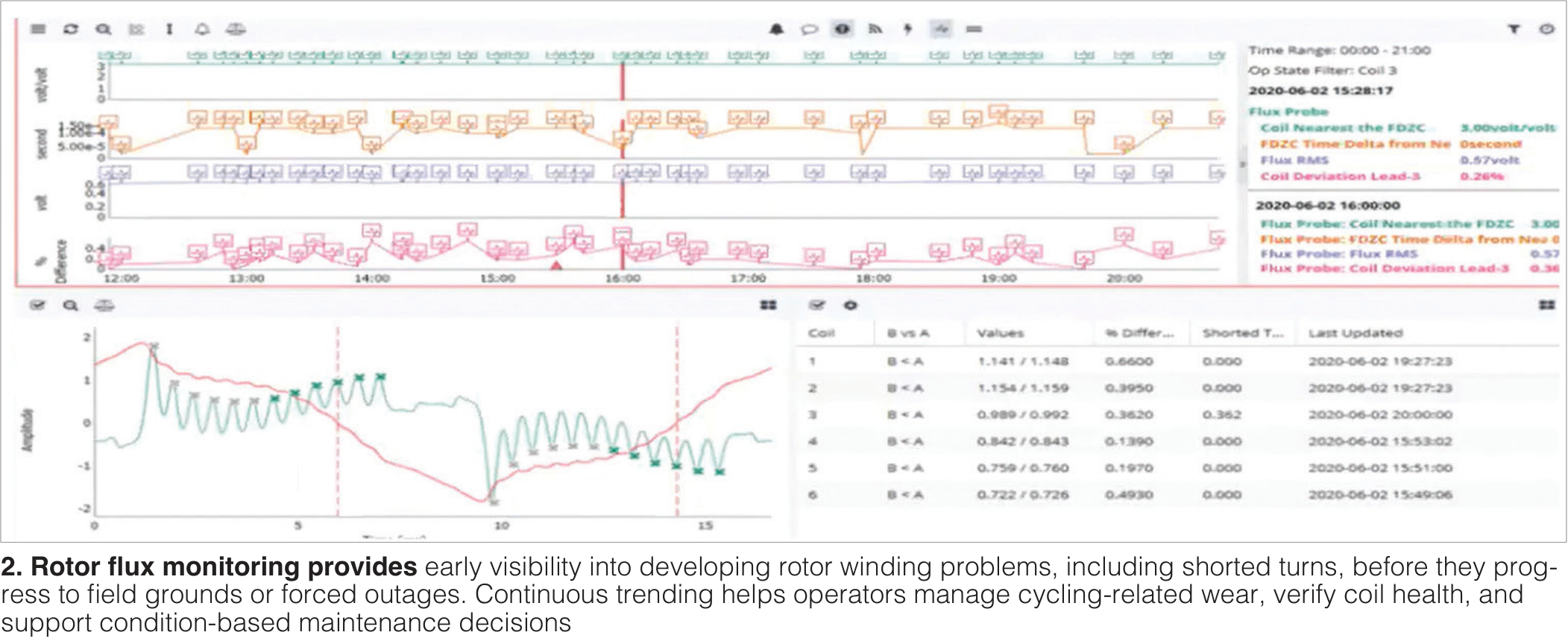
Rotor flux monitoring, as described in the source webinar, follows the same basic philosophy. By tracking coil-pair behavior, zero-cross references, RMS values, and calculated shorted-turn deviations while the unit is online, the system is meant to show whether rotor condition is drifting before that drift becomes a larger event.
That kind of trending matters more in a fleet that cycles harder than it used to. Many units now live with load swings and thermal patterns that were not part of the old baseload expectation. If machine duty changes, monitoring practice has to change with it. A periodic reading may satisfy a procedure. It may not provide much warning.
What is really changing
The most useful takeaway from the two webinars was not the product pitch, although there was plenty of vendor detail. It was the operating logic beneath it. Collector systems and field circuits are still vulnerable to the same old problems: poor contact, contamination, rough surfaces, hidden degradation, and limited visibility into changing condition. What has changed is the plant’s ability to see those problems earlier, compare signals across systems, and turn them into planned work instead of emergency work.
That leaves owner/operators with a fairly plain question. Routine walkdowns and skilled technicians are still necessary. Nobody made a serious case otherwise. But are they enough by themselves for units expected to cycle, recover, and stay available under tighter operating demands? The answer suggested by both presentations was no. Plants still need the human eye and the human judgment. They also need a better way to know what the machine is doing between inspections.
That may be the real dividing line here. There is a difference between maintaining a generator and actually seeing it. The distance between those two conditions has been wider than many plants would care to admit. Continuous monitoring does not close that gap completely. It does narrow it, sometimes enough to keep a collector problem from becoming a fire, or an odd grounding signature from turning into a much more expensive lesson. CCJ