

The AI infrastructure market has stopped paying for promises. It is paying for completed megawatts, turbine positions, energized substations, interconnection rights, and the people who can put all of them together before the next model release. If you own or operate a gas-fired plant, that shift is no longer a side story from Silicon Valley. It is changing who buys power, how projects get financed, and what existing generating assets may be worth.
Here are the market signals worth watching.
Speed has become the product
Anthropic agreed to take the full compute capacity available at SpaceX’s Colossus 1 facility near Memphis: More than 300 MW and 220,000-plus NVIDIA GPUs. The noteworthy number was not the ultimate size of Anthropic’s other announced commitments. It was the delivery time. Colossus capacity was available within weeks.
Google followed with an agreement to pay SpaceX up to $30.4 billion for access to about 110,000 GPUs. Full payments reportedly reach $920 million a month from October 2026 through June 2029. Anthropic’s disclosed arrangement runs about $1.25 billion a month. Together, the two contracts represent roughly $26 billion in annualized compute revenue.
The spec position paid. SpaceX and xAI bought turbines, transformers, and chips before conventional project-finance underwriting would have blessed the revenue stream. That looked reckless to a market trained to require contracted offtake before ordering equipment. It now looks like inventory purchased before a shortage.
Plant people understand this better than most. When the critical spare is already in the warehouse, the discussion is different. In this case, the spare was hundreds of megawatts of operating compute. The customers that waited became renters, and the owner of the ready capacity named the price.
Capital is moving down the stack
Coatue Management offers another useful signal. The technology investor launched Next Frontier to acquire land near large power sources and convert it into AI data-center sites. Its first reported major project with Fluidstack is a 430-MW campus in New Lebanon, Ind, financed in part by a $5.7-billion junk-bond offering.
That is growth capital underwriting dirt, steel, and a substation. It is happening because AI can reduce the scarcity value of some software, but it cannot write code that produces a turbine slot, a 500-kV interconnection, a gas lateral, water rights, or community consent.
Powered land is no longer just real estate. A permitted site beside firm generation has become an option on future compute demand. Traditional infrastructure funds may still value it as a long-duration asset. Technology investors are looking at the same parcel and seeing venture-style scarcity. If you control a viable site, know which conversation you are having before you price it.
Houston shows the demand-and-price disconnect
CenterPoint told investors it has line of sight to 12.2 GW of firmly committed new load in the Houston area. About 3.5 GW is under construction, and 8 GW is expected to be energized by 2029. The pipeline covers 20 projects and roughly a dozen customers, with 90% of the projects at 500 MW or less. This is not one oversized campus that can quietly disappear. It is a portfolio.
Yet Houston Zone forward prices softened. The conventional model still starts with gas price, heat rate, forecast reserves, and an assumption that high prices eventually suppress demand. AI compute does not behave like a typical price-sensitive industrial load. Hans Royal’s Compute Heat Rate framework puts the blended value at roughly $6,350/MWh, or 127 times a conventional gas-heat-rate benchmark. Frontier inference can tolerate still more.
Meanwhile, the Texas Energy Fund has not produced the expected supply response. More than 70 applications representing over 38 GW were submitted, and 17 projects totaling 9.7 GW advanced to due diligence. By early November, at least eight projects representing about 35% of the selected capacity had withdrawn. Several projects that closed loans were already under development before the program existed.
Watch what developers do, not only what the strip says. Rockland Capital told Texas regulators that forward prices had not kept pace with costs and would not support a final investment decision for its 340-MW New Gulf project. A low forward curve does not build a plant when turbine, EPC, and financing costs say otherwise.
The clock is driving siting and equipment decisions
The xAI dispute near Memphis made power supply a national-security issue. The Department of Justice asked a federal court to dismiss a Clean Air Act suit after the EPA closed the exemption xAI had used for trailer-mounted turbines. DOJ’s argument was that Grok supports classified military work and that interrupting its electricity presented a defense risk.
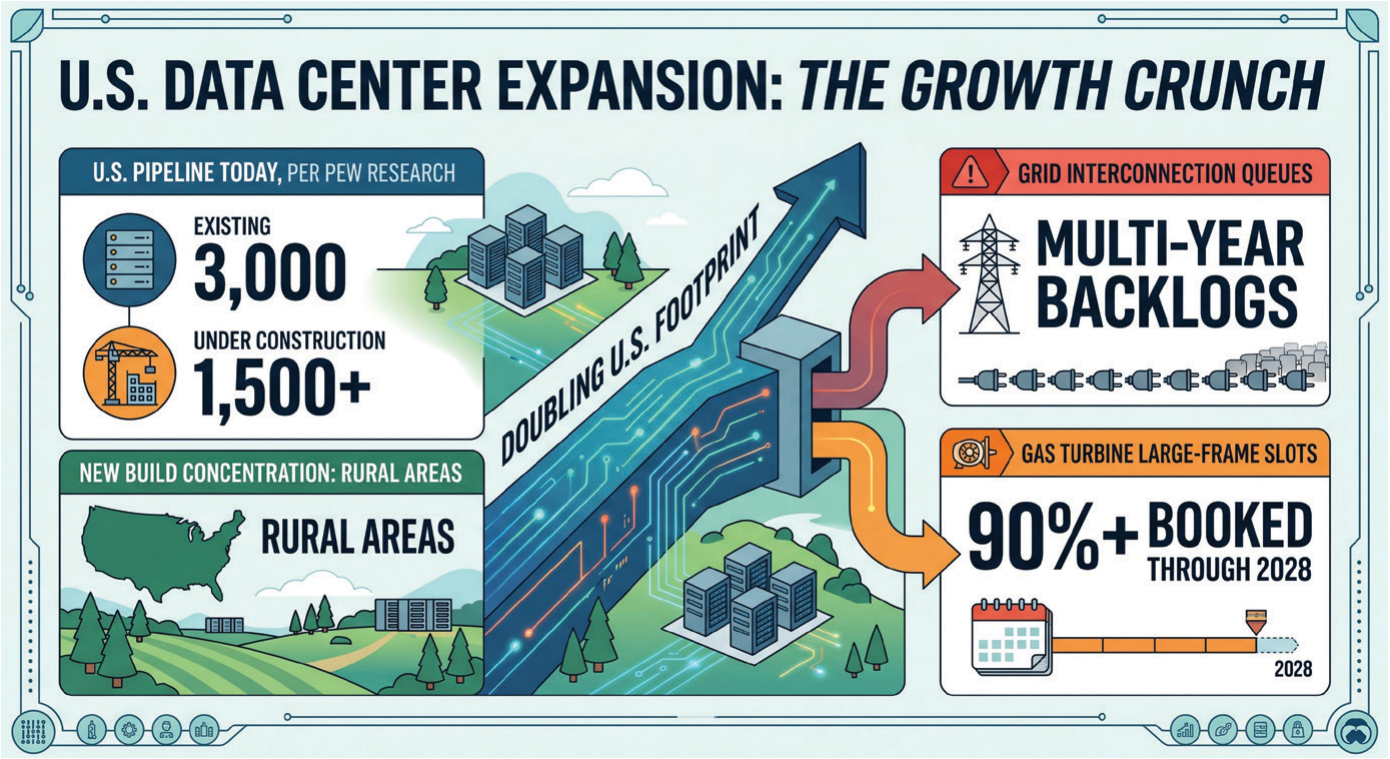
Whatever you think about the politics, the operating lesson is plain. xAI energized 100,000 GPUs in 19 days using a temporary generation bridge. A conventional greenfield plant ordered now may not enter service until about 2032. Heavy-frame order books extend into 2029, combined-cycle schedules run five to seven years, and reported costs moved from about $2,000 to $3,000/kW in six months.
Permitting, interconnection, and equipment procurement are now site-selection criteria, not administrative follow-up. Texas demonstrated the point when its large-load queue grew from about 63 GW in December 2024 to more than 200 GW a year later. Capital goes where it believes somebody can reach a decision.
More competition is coming to the turbine market
Hanwha Power Systems and PSM are unifying as Hanwha Power, giving the independent aftermarket supplier access to the manufacturing reach and balance sheet of a major South Korean industrial group.
PSM supports GE 6B, 7E/EA, 7F, 9E, and 9F machines, plus Siemens/MHI 501Fs. Its FlameSheet and LEC III combustion systems have been installed in more than 350 gas turbines across over 30 countries.
Doosan Enerbility is attacking from the new-unit side. It has secured orders for 12 turbines from U.S. buyers, including five 380-MW machines for xAI and seven more for an unnamed U.S. technology company.
For an owner facing an outage or LTSA renewal, this is the practical part: Get more than one qualified party into the conversation. Backlogs and annual price increases have favored the established OEMs. Korean capital entering both the new-build and aftermarket sides gives buyers another source of equipment, technology, and negotiating leverage.
Models are becoming interchangeable inputs. The Palantir and NVIDIA sovereign-AI agreement points in the same direction. Government and critical-infrastructure customers can deploy NVIDIA’s open Nemotron models through Palantir’s software inside classified or air-gapped environments, tune them on their own operating data, and retain control of the resulting weights.
The model can change. The secure facility, compute hardware, and power supply cannot. For generation investors, that reduces one important risk: You do not have to pick the winning AI lab to believe the load will grow.
The model companies will change places. The demand for silicon and electrons will remain. Every token still requires kilowatt-hours, and the durable value is collecting around the assets that cannot be copied or energized overnight. That is what is driving the industry right now.
For the deal structures, financing analysis, and market developments behind these signals, read Perri’s PowerSignal, including its subscriber-only editions.
 About the author
Peter Perri is the author of PowerSignal and an energy investor with more than 20 years of experience building and financing power infrastructure. He is deploying approximately 3 GW and scaling toward 10 GW of AI-ready dispatchable generation. No schedule. He writes about deals that matter. Signal, no noise. CCJ