


ISO has published the first turbomachinery-specific standards for air intake filters. ISO 29461-1, ISO 29461-2 and ISO 29461-3 establish uniform test methods for efficiency and dust holding capacity, performance in fog and mist, and mechanical integrity at high pressure. While this is not breaking news, the combination of the three standards is a powerful decision-making tool. Camfil’s turbomachinery filtration experts prompted this recap for CCJ readers directly involved in plant O&M, to clarify how the standards should be applied on the deck plates.
Gas turbines, especially in the advanced class, are highly sensitive to particulate and moisture ingress. Filters span a wide efficiency range, from coarse pre-filters to ultra-fine finals that keep compressors and hot-gas paths clean. Until now, plants relied on standards created for other industries, including EN779, ASHRAE 52.2, ISO 16890 and ISO 29463/EN1822, and then tried to map those results to turbine service. ISO 29461 closes that gap by aligning laboratory methods with field realities and by providing a single classification approach that covers the full filter range.
Efficiency and dust loading
ISO 29461-1 is the first international test standard dedicated to reporting mechanical filtration efficiency and dust holding capacity for turbomachinery air inlet filters, from pre-filters to HEPA grades.
Key points for plants:
- One classification system. It replaces the need to cross-reference EN779, ASHRAE 52.2, ISO 16890 and ISO 29463/EN1822 when specifying turbine filters, reducing ambiguity for buyers and engineers.
- Electrostatic effects excluded. Reported efficiency reflects mechanical capture, not transient electrostatic charge that dissipates early in service and can overstate field performance.
- Standardized dust loading. All filters are dust-loaded under a single procedure, enabling comparable dust holding capacity and life estimates. This is the first standard that dust loads HEPA-class elements for lifecycle comparison.
Implications: Specifications and bids now can be evaluated on equal footing. Plants can optimize pre-filter and final-filter pairings based on verified loading curves and pressure-drop development, not marketing equivalencies.
Fog, mist and hydrophobicity
ISO 29461-2 addresses wet operation by assessing endurance in fog and mist and resistance to water penetration across the entire filter element, not just media swatches.
Why it matters:
- Controls contaminant migration in wet conditions. Without hydrophobic features, water can dissolve salts or push fine particles through the media to the clean side, leading to fouling, erosion and corrosion downstream.
- Replaces disparate in-house tests. Prior practice varied by supplier, from no hydrophobicity testing to media-only tests under EN20811/ISO811 or AATCC 127. ISO 29461-2 standardizes methods and parameters for the complete filter.
- Objective pass/hydrophobic rating. The 3-hour test requires: pressure drop under 1000 Pa, no measurable downstream water, and, for a “hydrophobic” label, a water-dye confirmation of zero bypass.
Specifying guidance: For sites with frequent fog, sea spray or high humidity, prioritize filters that meet desired efficiency per ISO 29461-1 and achieve a hydrophobic rating with low, stable pressure drop per ISO 29461-2.
Mechanical integrity at high pressure
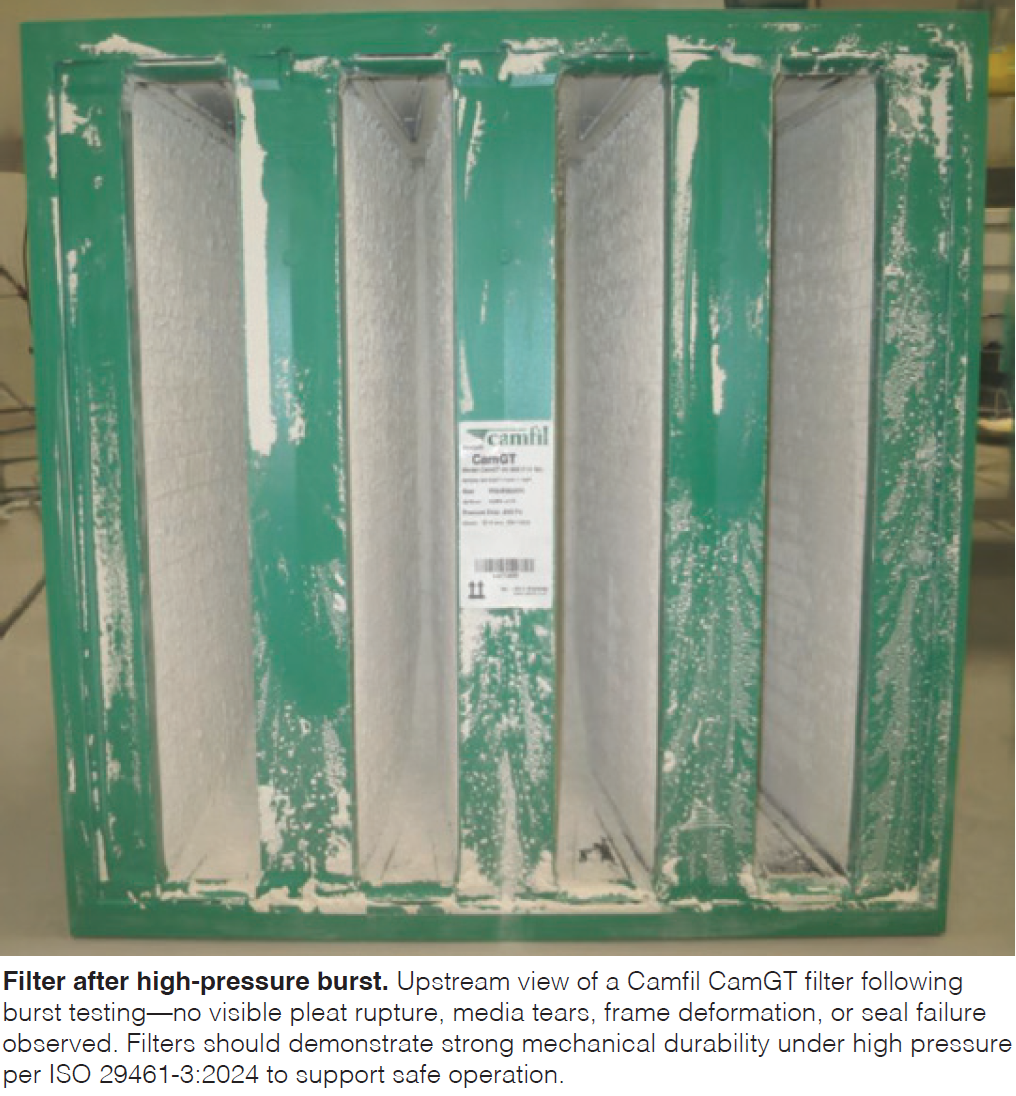
ISO 29461-3 introduces a rigorous wet burst protocol to verify the mechanical robustness of turbomachinery filters under high differential pressure, including moisture-laden loading.
Plant-relevant outcomes:
- FOD risk mitigation. The burst test confirms no parts break loose or release downstream at elevated pressure differentials, protecting compressor blading and seals.
- Durability under cyclic duty. Methods address continuous and cyclical pressure loads, aligning with fast-start and peaking profiles common in modern fleets.
- Post-burst efficiency check. After wet burst exposure up to about 25 in. w.g. (approximately 6250 Pa), the standard assesses damage and any drop in particulate efficiency. A filter rated T10 in new condition, for example, might degrade to T8 if the media has torn or structurally yielded in service. ISO 29461-3 measures and reports that change.
Three-step method: Confirm initial efficiency per ISO 29461-1, perform the wet burst to the specified pressure, then verify no loose pieces, no sudden pressure-drop reductions indicative of tears, and measure any efficiency reduction.
Applying the trio in procurement and operations
For robust filter strategies, consider the standards together:
- Efficiency and life, via ISO 29461-1, to balance compressor cleanliness against pressure-drop penalties over a full loading cycle.
- Wet-weather resilience, via ISO 29461-2, to prevent water bypass and contaminant migration in fog or mist.
- Structural safety margin, via ISO 29461-3, to avoid catastrophic failures during high ∆P events and to understand post-event efficiency.
A practical selection path for wet sites is to specify final filters that are high efficiency, for example T10 or higher in ISO 29461-1 classifications, with documented hydrophobic performance under ISO 29461-2, and demonstrated burst resilience per ISO 29461-3.
Takeaways for owner-operators
- Expect clearer apples-to-apples comparisons across vendors. Require suppliers to provide ISO 29461-1 reports with loading curves and end-of-life criteria, ISO 29461-2 fog-and-mist results with pass or hydrophobic ratings, and ISO 29461-3 burst integrity evidence with post-test efficiency.
- Align maintenance triggers with standardized dust-loading behavior and pressure-drop evolution rather than calendar intervals alone.
- For coastal, industrial or high-humidity sites, move hydrophobicity from a “nice to have” to a minimum requirement to control salt and fine contaminant transport under wet conditions.
Bottom line. ISO 29461-1, -2 and -3 provide a coherent, turbomachinery-focused basis for specifying, evaluating and operating inlet filters. Plants can now ground decisions in standardized, turbine-relevant data on efficiency, wet performance and mechanical integrity, improving protection of high-value assets while optimizing pressure-drop and lifecycle cost.