

In a demand-heavy, renewables-rich grid, the fastest and lowest-risk capacity gain often comes from assets already on the pad. A recent GE Vernova webinar discusses practical ways to uncover incremental output and reliability by treating the combined cycle as a single system. The session was moderated by Matt Foreman, and featured technical perspectives from Jason Bowers and Joe D’Amato, moving step-by-step from the HRSG to the steam turbine and, finally, the generator that must carry those gains to the bus.
Walk the cycle: start at the HRSG
Any gas turbine performance change shows up first in the HRSG. Foreman stressed the value of a structured impact study, starting with desktop engineering and progressing to on-site validation, often supported by 3-D scanning. The goal is to confirm what the boiler will actually see after a GT upgrade and to map scope to risk and return.
Depending on condition and operating margin, outcomes can range from no changes required, to targeted modifications, to major replacements. Common paths include:
- Valve and attemperator resizing to protect code limits and maintain steam conditions.
- Pressure-part replacements, such as superheater or reheater harp replacements, to eliminate bottlenecks, support uprates, and reset life on critical components.
A recent turnkey example points out the execution side of the equation. Rigging plans, clearance checks, and piping reroutes were locked down early, keeping a complex harp replacement on schedule and incident-free. That level of pre-planning becomes essential when HRSG scope is coupled to a GT outage window.
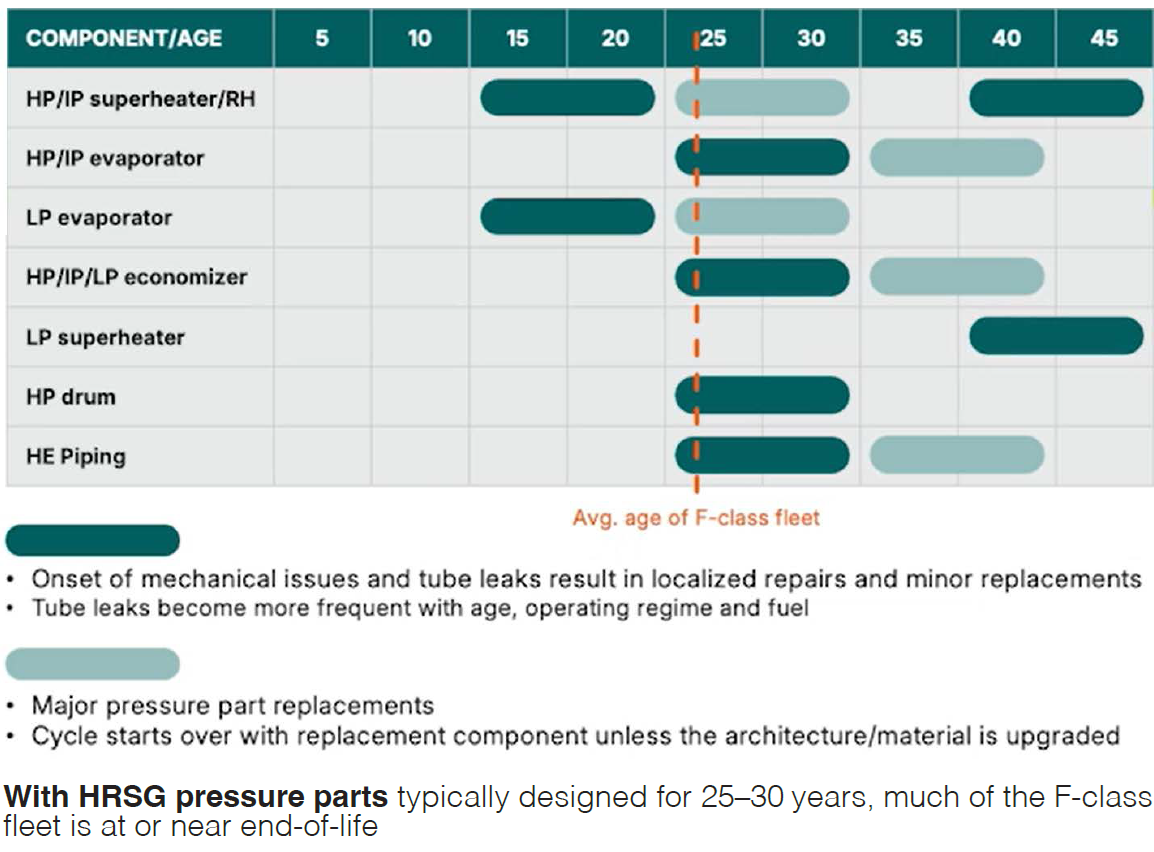
Why the urgency? Much of the F-class HRSG fleet is now past 20 years, and many units are entering a repair cycle characterized by more tube leaks, header cracking, and forced derates. When leak frequency and tube plugging begin to accelerate, owner/operators should evaluate whether continued repair-and-plug approaches still make sense versus scoped replacements that remove chronic pain and align the HRSG with planned or potential uprates.
Resize steam path to “swallow” more steam
Once incremental exhaust energy is converted into steam, the steam turbine has to take it. Bowers framed Advanced Steam Path upgrades as more than a reliability refresh. The intent is to deliberately resize buckets, diaphragms, and clearances, typically in the HP and IP sections, to increase swallowing capacity and convert additional steam flow into delivered power.
Construction type and basic design differences matter less than selecting the right steam path package to match new conditions and constraints. In output-driven applications, advanced steam path work can deliver meaningful gains, but where LP or casing limits exist, the upgrade package must expand accordingly.
Two case examples illustrated the system effect:
- 2×1 CCGT with a D11-class steam turbine: approximately 20 MW from the two GTs and roughly 19 MW from the resized steam path, showing near one-for-one follow-through when the HRSG and steam turbine are not limiting
- 3×1 CCGT with a larger D11-class unit: approximately 143 MW from three GT upgrades and about 33 MW from the steam turbine once LP limits were addressed in scope. Larger GT steps can drive proportionally larger steam turbine scope, but the payoff scales with the uprate
Generator is often the limiter
Plants frequently discover they are generator-limited only after the GT or steam turbine has been upgraded. D’Amato emphasized looking beyond traditional rotor or stator rewinds and thinking in integrated packages that move generator capability in step with prime-mover increases.
Examples discussed included:
- Higher cooler flow and hydrogen pressure changes to improve thermal headroom
- Gas-cooled high-voltage bushings and electrical path upgrades
- Connection-ring and flex-lead improvements to reduce thermal-mechanical stress under cycling duty
- Rotor upgrades, including seal design improvements that reduce hydrogen losses and improve durability
For schedule and risk reduction, refurbished exchange fields, balanced and tested, can compress outage exposure and avoid shop surprises on aging rotors. The throughline was clear: match generator scope to the upgrade trajectory of the GT and steam turbine so capacity, durability, and outage plans move together.
Agility, inspections, life extension
The group also addressed how to capture value without trading it for accelerated wear:
- Faster starts without added life consumption. Agility packages and warming systems can reduce cold-start durations dramatically while maintaining life usage, a strong fit for markets that reward faster ramping and lower start emissions
- Right-sized inspection cadence. HRSG minor and major inspection intervals should reflect duty cycle and what trending reveals. Rising leak rates and tube-plug counts are actionable signals to shift from reactive repair toward replacement planning
- Resetting the clock where it counts. Advanced steam path upgrades fit within existing shells, effectively zeroing life on replaced internals while retained casings remain on condition-based management
What drives payback. No single payback number applies across sites. Capacity-driven markets can show faster returns, while reliability-anchored scopes justify themselves through avoided forced outages, fewer repeat repairs, and shorter critical-path work. The panel recommended a site-specific model that includes duct-firing interactions, HRSG margins, steam turbine constraints, and generator headroom so capital is applied first to the tightest constraints.