



Mariposa Energy Project
Owned by Diamond Generating Corp
Operated by DGC Operations
200 MW, gas-fired 4 × 0 LM6000PC-powered (Sprint equipped) peaking plant, located in Alameda County, Calif
Plant manager: Justin Crook
Background. Mariposa Energy Project is a 200-MW peaking facility in northern California with four LM6000 units. Plant fuel supply is delivered from the utility header, then reduced through a letdown station feeding the compressor building and CTG fuel headers.
Challenge. On average, PG&E fuel-gas supply to the plant fluctuates from about 620 to 860 psig. The letdown station uses two parallel regulators set to limit supply to roughly 680 psig. From there, gas flows to a lead compressor intended to start when inlet pressure drops below about 640 psig, with a lag compressor starting at high lead loading. Once running, compressors are programmed to cycle off when inlet pressure is above about 660 psig for 20 minutes.
The team reports this arrangement created three recurring problems:
- Slow pressure-control response during normal cycling. The online letdown PCV responded slowly to supply-pressure swings and CTG load changes, leading to premature starts of the lead and lag fuel-gas compressors, even when upstream pressure remained well above 700 psig.
- Header pressure spikes after a CTG trip. The letdown skid did not react quickly enough to abrupt demand loss, allowing the fuel header pressure to rise close to a reported 720-psia limit and trigger fuel-system shutdown events on remaining units.
- Mechanical positioner limitations. The legacy Fisher mechanical valve positioners required manual tuning, often with the valve out of service for extended periods. They also offered no remote access, no straightforward integration into modern monitoring, and less precise response than digital positioners.
Solution. The site implemented a set of coordinated fixes spanning hardware, controls logic, and instrumentation.
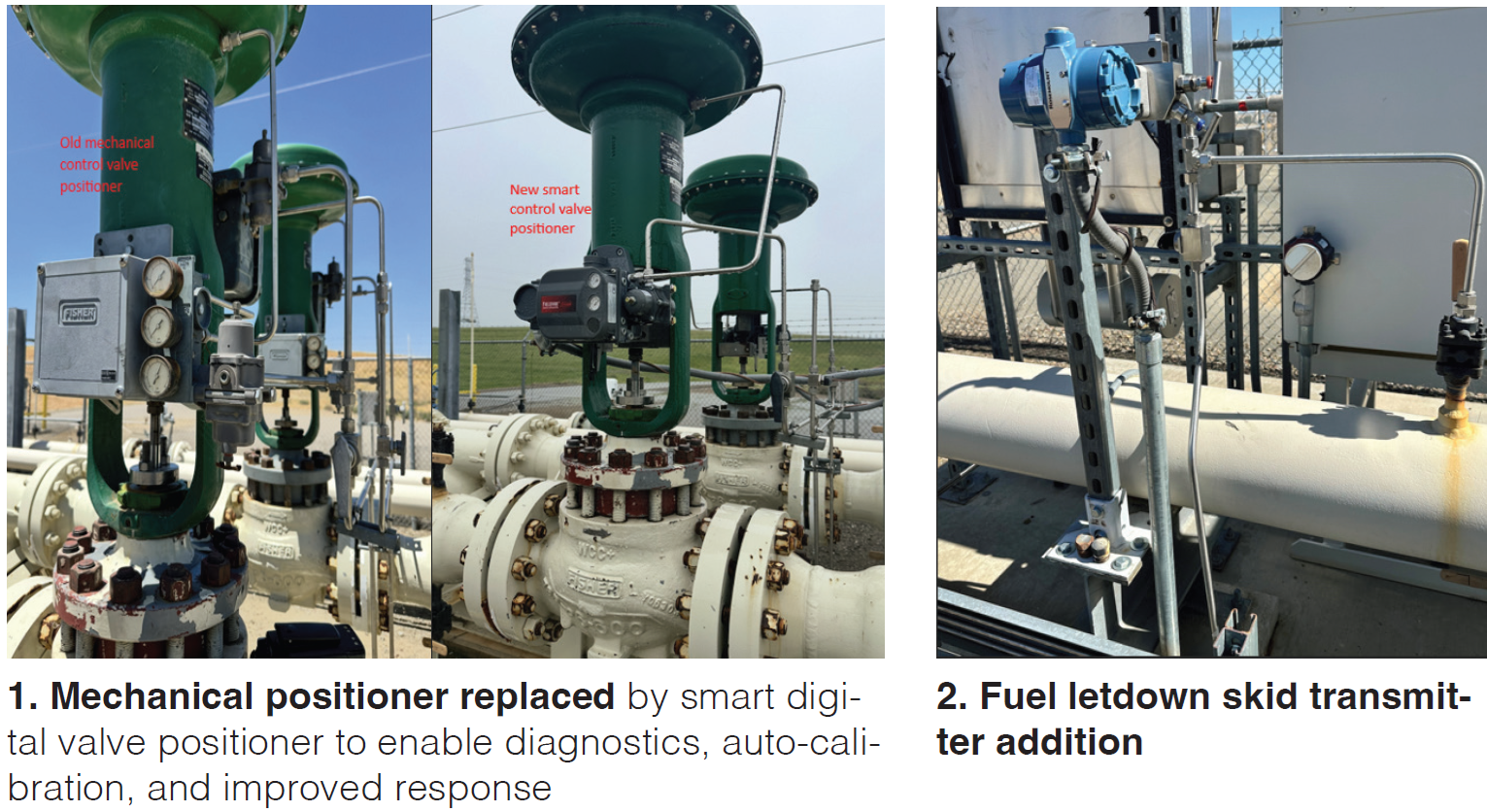
The team replaced the Fisher mechanical valve controller/positioner with a Fisher FIELDVUE DVC6200 Series smart digital valve positioner (Fig 1). Three practical benefits result:
- Faster, repeatable tuning and auto-calibration, reducing time the valve must be removed from service
- Built-in diagnostics to support troubleshooting and maintenance planning
- Ability to capture valve and process behavior in a historian for condition monitoring, including response time and travel deviation
The controls changes leverage Ovation DCS capabilities to tighten pressure control and improve response during rapid fuel-demand changes. Some highlights include:
- Closed-loop PID control with valve position feedback
- Dual outlet pressure transmitter feedback (redundancy)
- Auto/manual mode setpoint tracking to reduce bumps during mode changes
- Additional safety logic intended to mitigate over-pressurization risk during abrupt CTG load reductions and trips
A second pressure transmitter was added at the fuel letdown skid outlet to support redundant control and alarming (Fig 2). Dual-transmitter function block logic and HMI faceplates were implemented in the plant BOP Ovation DCS for monitoring and alarms.
Results. After project completion, the team reports the letdown skid discharge pressure stays within about ±5 psig of setpoint despite utility supply fluctuations. More notably, the plant’s fuel-gas compressors reportedly have not started for five months following the upgrade, reducing auxiliary load and associated maintenance demand.
Project participants:
Justin Crook, plant manager
Fred Yarcho, O&M manager
Oliver Caoili ICE tech