

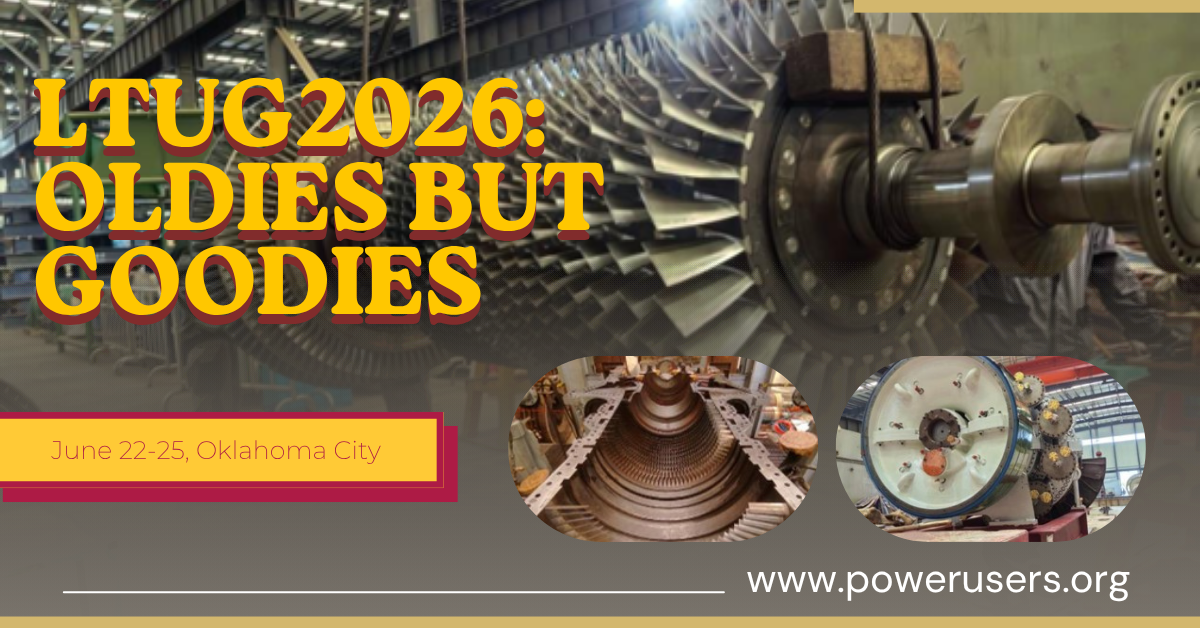
The 2026 Legacy Turbine Users Group Annual Conference will be held June 22–25 at the Omni Oklahoma City Hotel, with the 7EA Users Group, Frame 6B Users Group, and Frame 5 Users Group sharing one conference platform. The agenda continues its focus on how to keep mature gas-turbine fleets reliable, where outage dollars should be spent, and how to compare OEM guidance, independent repair options, and user experience before the next inspection or life-extension decision.
LTUG was formed by Power Users to bring the 7EA, Frame 6B, and Frame 5 communities together while maintaining independent steering committees and user forums. The model gives companies with mixed fleets the benefit of multiple meetings in one trip.
Program opens with short courses, OEM updates, and vendor fair
The technical program opens with a GT Intro Short Course, applicable for all users, led by John F D Peterson, PE. The afternoon includes a GT “Next Level Course,” a Baker Hughes session, and 7EA-focused presentations on predictive maintenance using AI and data and component life extension through advanced repairs and upgrades. Monday closes with the vendor fair.
The first-day structure is useful for both first-time and returning attendees. Newer users can level-set on fundamentals. Experienced users can move into asset-health, component-repair, and OEM-alternative discussions. Plant personnel can match conference topics to outage, maintenance, and capital-planning questions.
7EA track emphasizes inspection, exhaust frames, generators
The 7EA program reflects the shift from general aging-fleet concern to specific life-cycle decisions. Tuesday sessions include key maintenance practices to avoid downtime, outage-efficiency support from owner’s engineers, compressor bleed valves, root-cause-analysis case studies, in-situ 7A6 generator stator core replacement, legacy turbine exhaust-frame assemblies, borescope-inspection findings and associated risk, generator protection relaying, and critical-bus maintenance mitigation.
Those subjects follow issues highlighted at LTUG 2025, including exhaust-section degradation, inspection quality, controls health, generator condition, diffuser cracking, flex-seal distress, torque-converter starting problems, flame-monitoring behavior, and selective lifecycle spending.
The 2026 agenda gives users another opportunity to test those concerns against case histories and peer discussion. A generator stator-core case study, exhaust-frame presentation, and borescope-risk session should help plant managers evaluate where continued repair is defensible and where larger replacement, refurbishment, or life-extension planning may be required.
Frame 5 and 6B users join forces
Frame 5 and 6B users have dedicated user-only and OEM-participation sessions. Tuesday’s Frame 5 content includes an open roundtable, a rotor in-situ aft compressor-case removal presentation, and a Sulzer roundtable on Frame 5-specific repairs. GE Vernova and Baker Hughes breakout sessions cover rotor repair and life extension, advanced gas path for extended intervals, component repairs, controls hardware, auxiliary systems, balance-of-plant equipment, hot-gas-path configuration, generators, diesel starting, torque converters, outage planning, and core asset rejuvenation.
Wednesday adds peaker/emergency-use maintenance, predictive maintenance and on-site rotor solutions, inlet and compressor roundtables, combustion roundtables, effects of peaker cycling on generators, exhaust-frame assemblies, controls, reliability practices, and gearbox operation and maintenance. Thursday closes with roundtables on turbine, generator, safety, and maintenance planning.
OEM participation remains central
GE Vernova and Baker Hughes have substantial roles in the 2026 agenda. Baker Hughes has a Monday session covering fleet updates, counters, product features, engine and auxiliary options, case studies, technical bulletins, and the repair network. GE Vernova participates in Tuesday Frame 5/6B sessions and leads Wednesday 7EA sessions on industry status, current 7E status, new-unit and services trends, AI impact, TILs and RCA updates, combustion capability, new DLN1+ configurations, hydrogen projects, radial diffuser development, reliability recommendations, and LNG breakouts.
Cycling, peaking, and AI
The 2026 program reflects how legacy-frame operation continues to change. Predictive-maintenance sessions address AI and data. Peaker and emergency-use roundtables focus on operations and maintenance. Generator sessions address cycling effects on generator life extension. Breakouts include trip-reduction programs, availability improvements, startup issues, combined-cycle applications, and maintenance-interval questions.
Many legacy units no longer operate under the assumptions that shaped their original maintenance programs. Starts, load changes, standby duty, seasonal peaking, fuel flexibility, emissions requirements, and staffing constraints now influence how failures develop. The better question is whether today’s operating profile has made an old assumption unsafe, uneconomic, or unsupported.
For more, take a look at the 2025 conference recap: Legacy users compare notes on cycling duty, exhaust distress, and repair strategy
LTUG Steering Committees
7EA Users Group
- Co-Chair: Tony Ostlund, Puget Sound Energy
- Co-Chair: Mike Vonallmen, Clarksdale Public Utilities
- Dale Anderson, East Kentucky Power Cooperative
- Tracy Dreymala, EthosEnergy
- Matthew McCafferty, Golden Pass LNG
- Shane Rouse, East Texas Electric Coop
- Walt Steimel, Shell Project and Engineering Services
- Lane Watson, FM
Frame 6B Users Group
- Chair: Michael Adix, Motiva Enterprises
- Kevin Campbell, Chevron
- Robert Chapman, Chevron
- Jonathan LaGrone, Formosa Plastics Corporation
- Brandon Nofio, Dairyland Power Coop
- Matthew Pazanski, ExxonMobil
- David Shifflet, Motiva Enterprises
Frame 6B Advisors
- Jeff Gillis, retired, ExxonMobil
- John F D Peterson, retired, BASF
- Zahi Youwakim, retired, Indorama
Frame 5 Users Group
- Chair: Shannon Lau, PE, Syncrude
- Alex Berta, Associated Electric Coop
- Aaron Beadle, Calpine Corp
- Michael Maris, ExxonMobil, Baytown Refinery
- Kyle Miller, Fayetteville Public Works
- Brian Worthington, Fayetteville Public Works