

















…And other things that can keep a plant manager up at night
By Joseph Harmes, consulting editor
The U.S. is undergoing a transformational shift in how energy is used and generated as demand rises at its fastest rate in 20 years, spurred by electric vehicles and a proliferation of energy hungry data centers. The nation’s 12,500 utility-scale power plants, meanwhile, struggle just to satisfy mounting residential consumption while the U.S. Department of Energy estimates data centers will absorb 12-percent of the nation’s electricity by 2028.
Concurrently, the energy industry isn’t in great shape. The recently released Infrastructure Report Card 2025 compiled by the American Society of Civil Engineers (ASCE) graded it a D+, a decline from C- in 2021. The obstacles to boosting the ranking are formidable: Growth is constrained by aging assets needing to be replaced or modernized while the work force shrinks and experienced employees retire.
And those, says Tim Jackson, power plant manager at the Treasure Coast Energy Center (TCEC) in Ft. Pierce, FL, are among “some of the things that keep me up at night.”
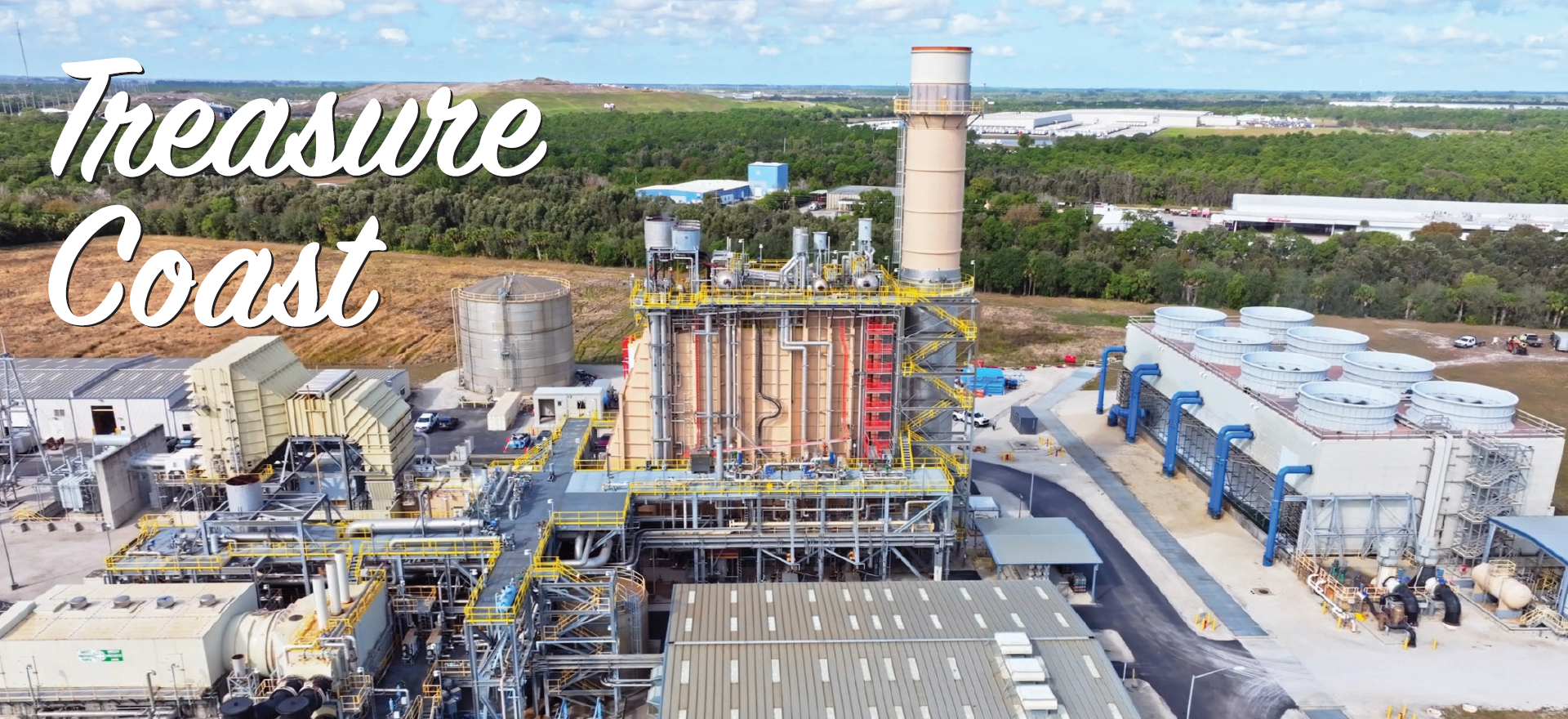
The 69-acre TCEC is owned by Florida Municipal Power Agency (FMPA), a wholesale power supplier for 13 municipal electric utilities (FMPA owns six power plants) located primarily on the state’s Atlantic seaboard, from Jacksonville Beach to Key West.
“FMPA was created so its owner-customers could jointly own generation, buy low-cost fuel and manage power supply more economically and reliably than each could alone,” says Jackson, who has worked at FMPA for 19 years. “At FMPA, reliability, economics, efficiency and availability are the key aspects to what makes this a fantastic deal for our member-owner customers, that they get to have the benefit of this low-cost power.”
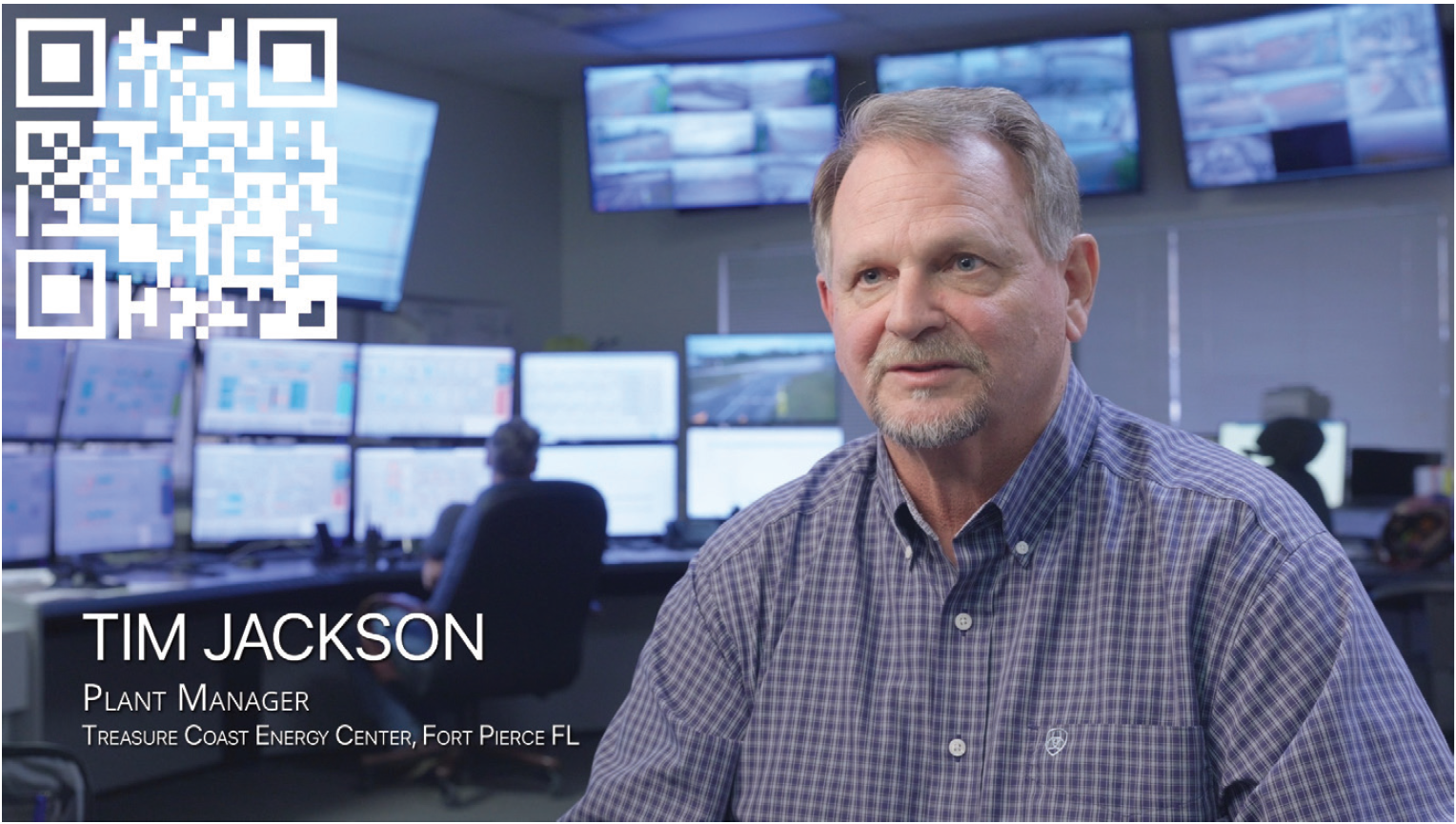
1. Treasure Coast Energy Center plant manager, Tim Jackson, describes their remote generator-purge upgrade that improved safety, simplified operations, and cut purge time from six to eight hours down to about one. Part 1 shows why this project mattered for reliability, flexibility, and operator protection
Generating Power–and Ideas
The TCEC unit is often called an economical and reliable “workhorse” in FMPA’s generation fleet. The 300-megawatt natural gas-fired plant went commercial in 2008 and annually operates for over 8,000 hours and produces about two million MWh with two hydrogen-cooled generators, each with about 142,000 operating hours (at the time of this study).
“It’s called a one-on-one combined cycle plant, and it makes approximately 160 megawatts from the gas turbine, and then the rest from the steam turbine, and we get that extra power to the steam turbine utilizing a duct burner that’s inside the HRSG (heat recovery steam generator) which greatly improves the usefulness of it and the output,” Jackson says. “This results in higher steam flow, increased steam turbine output, increased total plant megawatts. By adding the HRSG steam turbine combination we take that efficiency from 10,500 BTU down to about a 7,000 BTU per kilowatt rate.”
And in today’s landscape, every kWH and MWh count. A tsunami of demand might soon engulf St. Lucie County. Although developers hit pause at the end of February pending new legislation in the state capitol, plans remain active for Project Jarvis, officially known as the Sentinel Grove Technology Park, not far from TCEC. The $13.5 billion hyperscale data center will be one of the largest in the world. It’s designed to consume one gigawatt of power, capable of supplying electricity for up to one million households, or 2.5 million people, notable as the entire Treasure Coast region has a population of just over 721,000.
Jackson leans heavily on his staff of 16 people who operate and maintain the plant, buttressed by FMPA engineers. “Some of the things that keep me up at night are how am I affecting people? People are probably my biggest concern, but it’s also how I get things done. I’m not the expert of everything. I rely totally on my people to do what I need to have done.”
Defining-and Refining–the Project
“As part of what we’re doing here, we were looking at ways to make this plant more efficient, more reliable,” Jackson explains on a “hard hat” walkdown of recent TCEC equipment retrofits and upgrades. “Some of the equipment is to that age where it needs to be replaced, upgraded. One of the things that we looked at was to install a process to purge the steam turbine generator remotely, since it can’t be remotely degassed from H2 to CO2.”
“As we were looking at that process and the equipment involved, one of the operators was like, ‘Hey, why are we just doing the steam turbine? The gas turbine is so much harder, and it’s nowhere near as safe to degas as the steam. The steam turbine is much easier. It’s just not remotely operated’,” Jackson says.
“I was the first one to receive the call saying they needed help with a Dual Hydrogen Control Panel (DHCP),” says Rafael Lemus, an account representative for Classic Controls which represents roughly 40 different companies. “I told him that we could get the upgrades he needed and get the unit back up to spec, but that it was better off upgrading the unit and other systems as well.”
Lemus, in turn, contacted Environment One Corporation‘s (E/One) Utility Systems Business in Niskayuna, NY, an internationally recognized pioneer in the sector which designed the first field prototypes of its Generator Condition Monitor for General Electric in the early 1970s and introduced generator gas purity monitoring for hydrogen-cooled generators and overheat monitoring for air-cooled generators.
“This was a combination of upgraded equipment and retrofitting of automation equipment and software,” says Mark Williams, business development manager for E/One’s Utility Systems Business (USB). “The part that I like most is putting all the pieces together. Evaluating what the customer has, what the customer’s needs are, and how we can best put together a solution that’s going to make their plant more efficient and safer.”
The project became a turnkey mechanical and electrical installation with E/One site supervision, startup and training. The checklist included:
- A 7F automated purge kit (the components needed to modify the 7F manifold for automated purge processes).
- DHCP Enhanced Purge Software/Electronics Package (providing the ability to remotely change and monitor the gas being used during the purge process displayed on the DCS purge screen. Uses circuit boards and embedded enhanced purge software only available from E/One).
- Ambient vaporizers (a critical part of the system to meet the faster purge times from H2 to CO2 in 60-90 minutes).
- An operator-initiated automated purge system (for emergency and maintenance processes).
- Remote Actuators (enable the generator automated-degas system) and remote actuator panel (used on existing manifolds that are in good condition with H2 rated manual valves).
- Remote Operator Initiated Purge Panels (Using analog and digital signals combined with Mark VIe software programming with Purge screens remotely operate and monitor the purge process from the control room.)
- Two Generator Gas Dryers II (a dual-chamber system that continuously dries and recirculates generator cooling gas–even when the generator is on turning gear, which is a critical time to maintain low dew point).
- Generator Gas Manifold modifications (for an automated purge process).
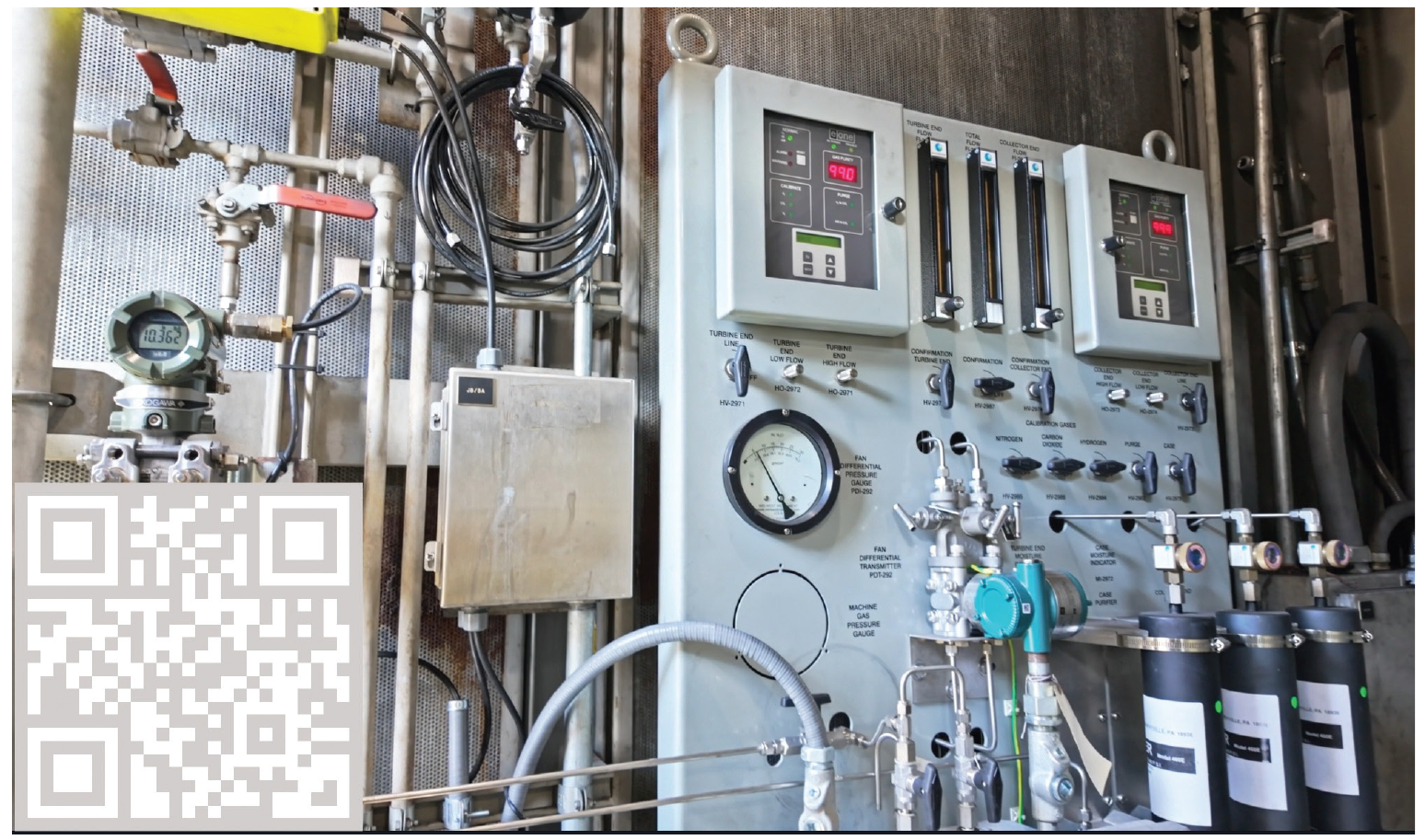
2. See how TCEC modernized a critical generator support system with a new dryer and fast purge upgrade that reduced cooling-water dependence, streamlined operations, and strengthened outage and storm-readiness. In Part 2, plant and vendor teams walk through the decision process, installation, controls integration, and post-startup support that made the project a success.
Purging Generators–and Hours
Purging a hydrogen generator generally takes six-to-twelve hours or longer to safely remove hydrogen gas from a generator case and replace it with an inert gas (CO2) to prevent explosive mixtures of hydrogen in air from forming. When a generator is shut down, hydrogen is purged with CO2 which is then purged with air. During re-gassing, air is purged out with CO2 which is then purged out with hydrogen.
Hydrogen is 14 times more efficient than air in removing heat and greatly reduces windage friction losses. Colorless, odorless, tasteless and nontoxic, hydrogen exists as a gas at atmospheric temperatures and pressure but is flammable or explosive between 5% -75% H2 in Air. It burns with a pale blue, almost invisible flame when concentrations of air exceed safe limits.
“Part of the equipment that’s involved in what we added or what’s already there is, there are hydrogen storage tubes which we already had that are piped directly into the generator,” Jackson says. “And we had CO2 bottles that were remote as well but completely inefficient because you can’t flow a lot of CO2 because then it ices up.” When dry ice is formed, 30-percent or more CO2 is lost in each bottle.
“What we have now is the E/One system with the liquid CO2 bottles and they’re in their own separate rack which we can just pick up and move and replace anytime that we need to. We can use up all the bottles, remove them, bring in another rack and have it all set up,” Jackson says.
“So, you have the CO2 bottles, some regulators (feeding) into what is called the vaporizer. This thing is a magic piece of equipment that is just a beautiful piece of aluminum. It’s almost like artwork (and) performs this function of taking this liquid CO2 and turning it into a gas without freezing up,” Jackson says. “And it performs this flawlessly. You can see where it starts to frost up and then dissipates across the different stages.
“From there it has some valving and some controls of the flow and you’re measuring the flow as you purge this generator with the CO2,” Jackson says. “The vaporizer we’ve installed is ambient operated, which means we don’t have to have a heater or any kind of electrical power to supply the vaporizer in this E/One platform.”
Spooling Around
The piping was reorganized so that the spool piece, formerly under the collector house inside an access door at the back of the manifold, was relocated to the outside piping on the H2 gas feed line for easy access for removal. “A safety spool is an integral feature to ensure that dangerous mixtures of H2 and air are avoided,” says Williams.
“This is really where the safety of this comes in,” Jackson says. “(Now) the spool piece is not hidden up in this cabinet that you can hardly get your fingers into to remove it or to replace it. Now, we can remove the spool piece easily, and we know that there’s no hydrogen gas inside the generator.”
Retiring the Old Dryers
Apart from the introduction of the automated purge process, the retrofit of the dryers was “central to our operations,” Jackson says. “The two existing dryers were in place for a long time with poor functionality.”
Among their issues: age, the outlet dew points higher than the inlet due point, the requirement of chilled water and house air, float trap issues, and no verification of H2 outlet dew point monitoring confirming drying of the gas.
The GGD II monitors provide inlet/outlet dew points for optimal performance, a positive displacement blower to ensure drying across all phases of generation operation, the elimination of house air and chilled water connections, increased generator efficiency and reduced downtime, a self-monitored drying process with annual preventive maintenance as opposed to quarterly. The GGD has a 20-25-year lifecycle with many installed in the early 2000s still in service.
“Our prior system was water-cooled with auxiliary cooling water. This system does not have that,” Jackson says. “Cooling water to us is like gold. You do not utilize cooling water, that cooling water is used in a different area where you’re going to improve the efficiency. That alone improved our efficiency. And then, of course, they’re a nice color. So that helps out too.”
Rust Never Sleeps
The GGD also is designed for hazardous location operation. TCEC’s equipment is situated in an open-air environment just seven miles from the stretch of the Atlantic known as the Treasure Coast, whose name refers to the Spanish treasure fleet that was lost in a 1715 hurricane.
“We’re close to an ocean,” says Jackson. “Our previous dryer was very old and very rusty. It was kind of decaying and needed to be replaced,” says Jackson. “Salt air–especially in coastal regions–will affect the power plant equipment due to its high chloride content and the high moisture content of the air to transport it. These two factors accelerate corrosion and material degradation. The materials selected must be able to endure this environment,” he adds.
Hurricane Preparedness
“The hurricane season lasts for many, many months, and if we can operate for a longer period of time before we’re required to shut down, it would help us out. Our goal is to minimize or eliminate downtime whenever it is safe to do so,” Jackson says.
“Shutdown decisions are based on forecasted wind speeds at the plant. Site improvements have increased the unit’s wind speed operating tolerance, allowing us to remain online through recent hurricanes. If forecasted winds exceed safe operating limits, we can remotely degas the generators from the control room, which allows the unit to operate longer before shutdown.”
Remote Operator Initiated Purge becomes invaluable for employee safety during hurricanes because “if remote degassing were not available, the unit would need to be taken offline before sustained winds reach approximately 40 mph to allow personnel to safely perform the procedure locally,” Jackson says.
“The thing that’s going to increase the reliability of the plant is letting the operators be able to control when that happens–and remotely from inside this control room,” Jackson says. “It gives us a bigger window to operate in and protects them from having to go out into the elements to perform this evolution.
“Now, from the control room on the Mark VIe, we are able to select the purge platform that we choose,” Jackson says. “We can either do it in a fast purge for safety or a maintenance purge (hydrogen-to-CO2, CO2-to-hydrogen). “Prior to having this E/One system we had to go out there and what used to take six to eight hours is now accomplished in one.
“The operators love this. They’re not standing out there on the concrete in the field to perform this function,” says Jackson. “It saves a vast amount of time which increases our reliability and the amount of time that we can operate because we’re not gonna have to schedule in that eight-hour purge time before we can actually work on a generator.”
Successful Projects Can Cure Insomnia
The plant’s new equipment was refined after a few glitches were addressed.
“Since we’ve installed our system, we’ve had a couple of minor, minor issues with our E/One system that required a phone call,” Jackson says. “One of the things was, we couldn’t get this regulator to regulate. We had way too much flow, we had too little flow, and we couldn’t understand why we had no control. And gave E/One a call.”
“They sent down a new regulator within two days and came right to the site and (E/One representatives) took a look at what we were doing and said, ‘Look, we just need to change out the regulator’ and it’s perfect.”
Another issue involved valves which “had been labeled backwards. Once they were correctly identified and connected, it worked perfectly.
“With regards to E/One equipment, I really see it as a value add for the customer,” says Lemus. “It improves their reliability and it improves their maintenance cycles on a very critical part of the plant, which is the hydrogen monitoring system for the generators.”
As for future plans, Williams says he’s “excited to demonstrate the newly installed equipment to sister plants. Capturing every bit of power is the goal.”
And even though Jackson may have some sleepless nights, he has no regrets. “This is a fantastic place to work. I love being in a power plant. I’ve had time where I was in an office and time in a power plant, and days in a power plant are fantastic days.” CCJ