


Roundtable discussions are a highlight of the CCUG program. One this year covered a round robin of topics, offering timely tips and reminders. For example, regarding high energy piping and pipe hangers, if you find a nut on the ground, don’t ignore it. Work into your plant “culture” an investigation of where it came from. If you have a water hammer event, review and inspect your paper hangers. Don’t wait for someone else to write it up. Have your people walk around with inspection vendors for “training. Do lunch and learns. Do drone inspections.
For buried tanks, make sure vents are operable and cathodic protection (CP) is sound. If you have carbon steel underground piping, you will have problems within five years without CP, noted one audience member. Annual general inspections are good practice.
One attendee related an incident when pressure regulators froze and failed, releasing 500 psig fuel gas “all over the plant,” almost blowing up the office building. So, check gas and line vents, whether bent over (to prevent rain intrusion) or straight. Rainwater gets in and can freeze. Check lightning arresters on H2 lines, and transformers for wet conditions (leaks into the building). Make sure the “good spare” is stored in dry, safe conditions.
During a segment on aux boiler layup, one attendee revealed his plant doesn’t lay up the aux boiler. Don’t be this plant! And don’t leave in wet layup for more than two weeks.
Another user mentioned that “the best project” his plant ever did was install a fast degas system for the H2-cooled generator.
The last part of the roundtable confirmed the issues users are facing getting replacement components and parts. Turbines are 5-year lead times, GSU transformers 3-year lead times. One attendee lamented that L-0 ST blades now have 5-year lead times. Even smaller components like transmitters, control valve components, spray nozzles, and heat detectors were all mentioned as getting hard to find.
Stuff like 20-in attemperator lines are no longer “off the shelf” items. Single-point vulnerabilities “will bite you!” Plants are now responsible for getting parts the OEM used to source, often leading to use of “hand-me-downs.” Even local contractors are running out of people.
However, as one user noted wryly, if you’re willing to pay a 25-30% expedite fee, parts will magically appear from suppliers’ shelves. Some vendors have “hold” programs in which you buy parts and the vendor holds them for a fee.
Users are rethinking outages and warning others to “get through the discovery period as soon as possible.” Where inspections were once staggered, users now suggest that you do as many as you can as early as you can to add lead time for planning outage events. Good contingency planning now means planning for two and even three outages in advance.
Have a “maintenance planning function.” insisted two users, someone or a committee who “owns the plant” during the outage.
Calibration. You have to be grateful to a user who puts together a ~50 slide deck to help the CC user community understand and manage instrument calibration, the importance of which cannot be overstated as plant staffing continues to shrink and plants approach remote, unattended operation through automation (ultimately based on instrument measurements). To emphasize this point, the slide deck reviews several infamous plant failures rooted in poor calibration. Significant segment of the presentation covers modern calibration management software.
Key best practices listed in the last slide include establishing a fixed calibration schedule for every instrument based on whether it is critical, required by regulation or standard, or non-critical; deploy management software to track history and schedules; ensure calibration traceability to recognized standards; document results and analyze trends; and train technicians on safe operating procedures.
GT inlet air anti-icing. Presentation is mostly a richly detailed photo montage of one plant’s journey (update New York location) from an extreme snow and GT inlet-air-housing icing event in 2022 to an installed anti-icing system in 2023. The new system (Fig 2) “takes up to 5% of the compressor discharge (bleed heat) and diverts it to a 239-nozzle injection grid installed in front of the pre-filters.”
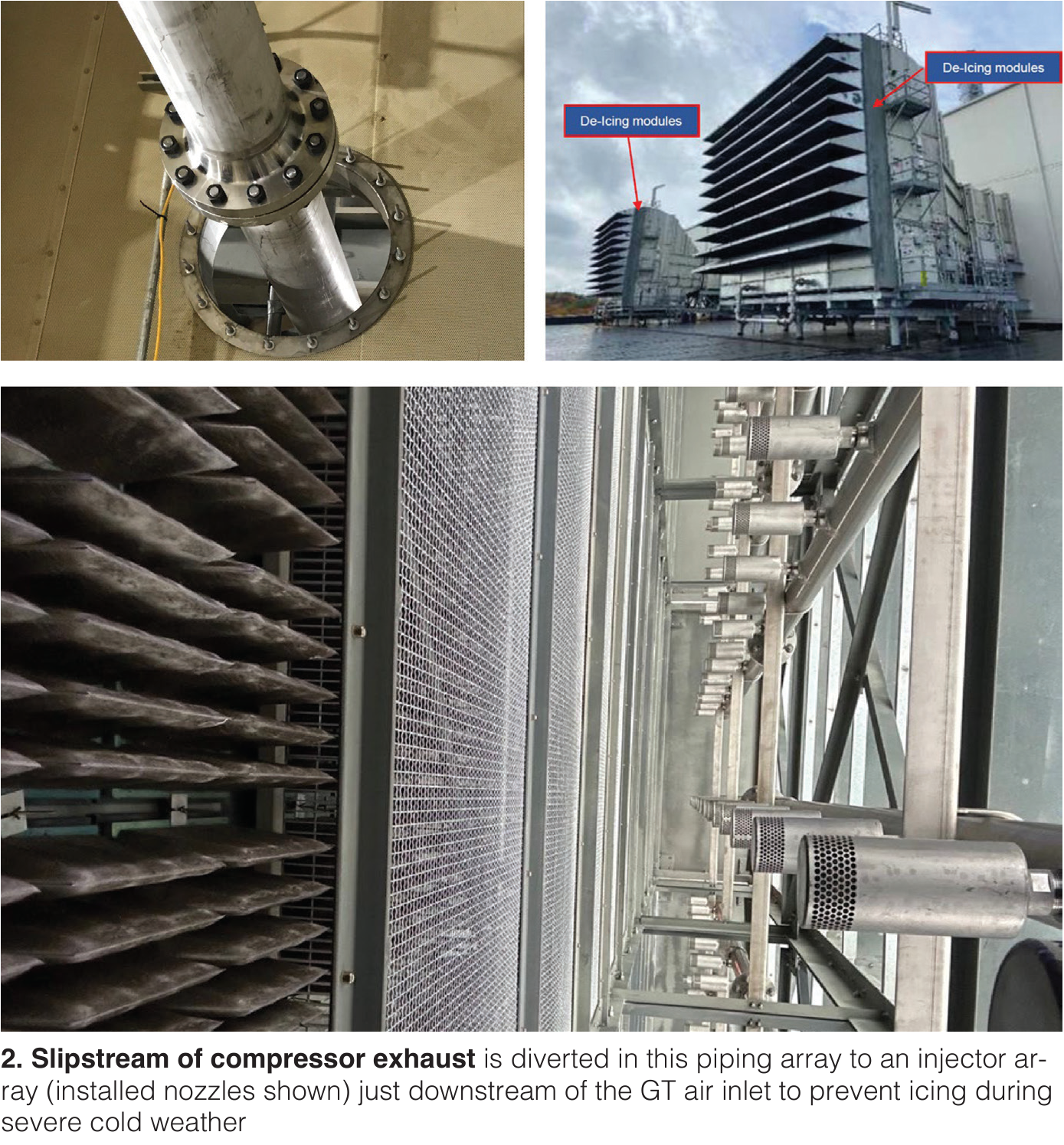
Key features include hard stops on the control valves, auto-draining filters on the anti-icing instrument air supply lines, and fully operable inlet bleed heat (to bellmouth), with the control logic permitting the IBH to override the de-icing system to ensure compressor safety.
Attemperator failure. A 2002-vintage CC in Missouri reported on a high-pressure attemperator failure occurring in 2024, during which the spray nozzle and the liner were damaged, with pieces of the liberated liner discovered well downstream (Fig 3). Repair sequence included replacing the nozzle and stem/lance and patching welding where needed; performing non-destructive examination (NDE) on all P91 and P22 pipe, replacing 80% of P91; cut/rewelding poor welds; and borescoping, accessing, and replacing the liner.
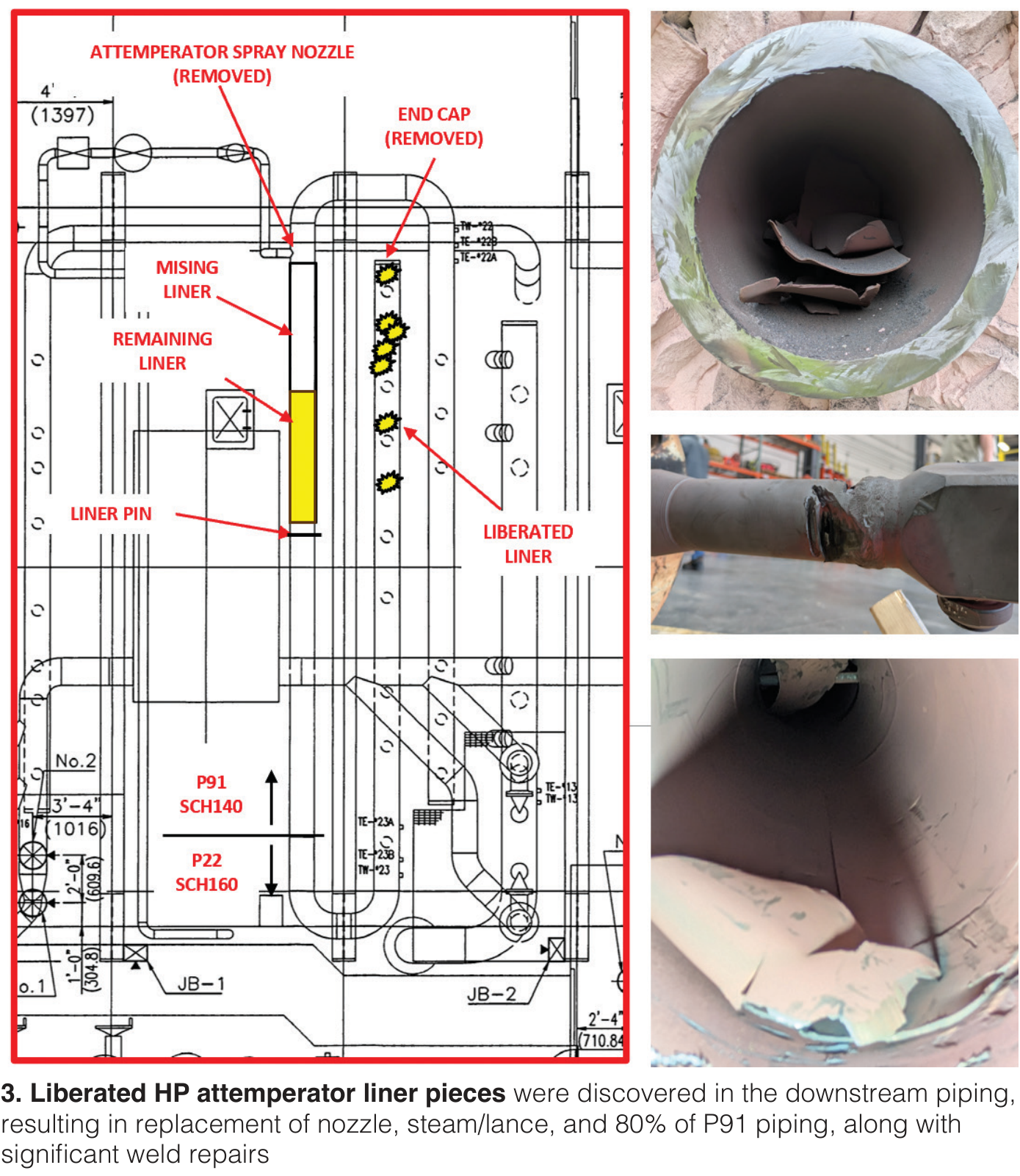
The silver lining (pun intended) was that repairing and redesigning the attemperator could recover lost ST/G output. Other slides detail the pre-failure operational situation, distinction between an attemperator and a desuperheater, and explanations of how both work, major equipment, risks from failures, tips on inspections, and failure prevention. Regarding the last, this plant increased inspection frequency from every three years to annually. Also, if your GT has been upgraded, make sure your attemperator design is still suitable.
CCUG vendor presentations
“Design for Emissions Stratification,”
Neal Holden, Vogt Power International
After a review of the SCR process and equipment, presentation explores causes of SCR under-performance, monitoring needs, and solutions, with a case study investigating NOx stratification at the stack. Holden emphasizes regular catalyst activity testing, as it is a better predictor of catalyst replacement intervals than ammonia slip (a lagging indicator), and maintaining SCR operating temperature within 50 deg F of its target.
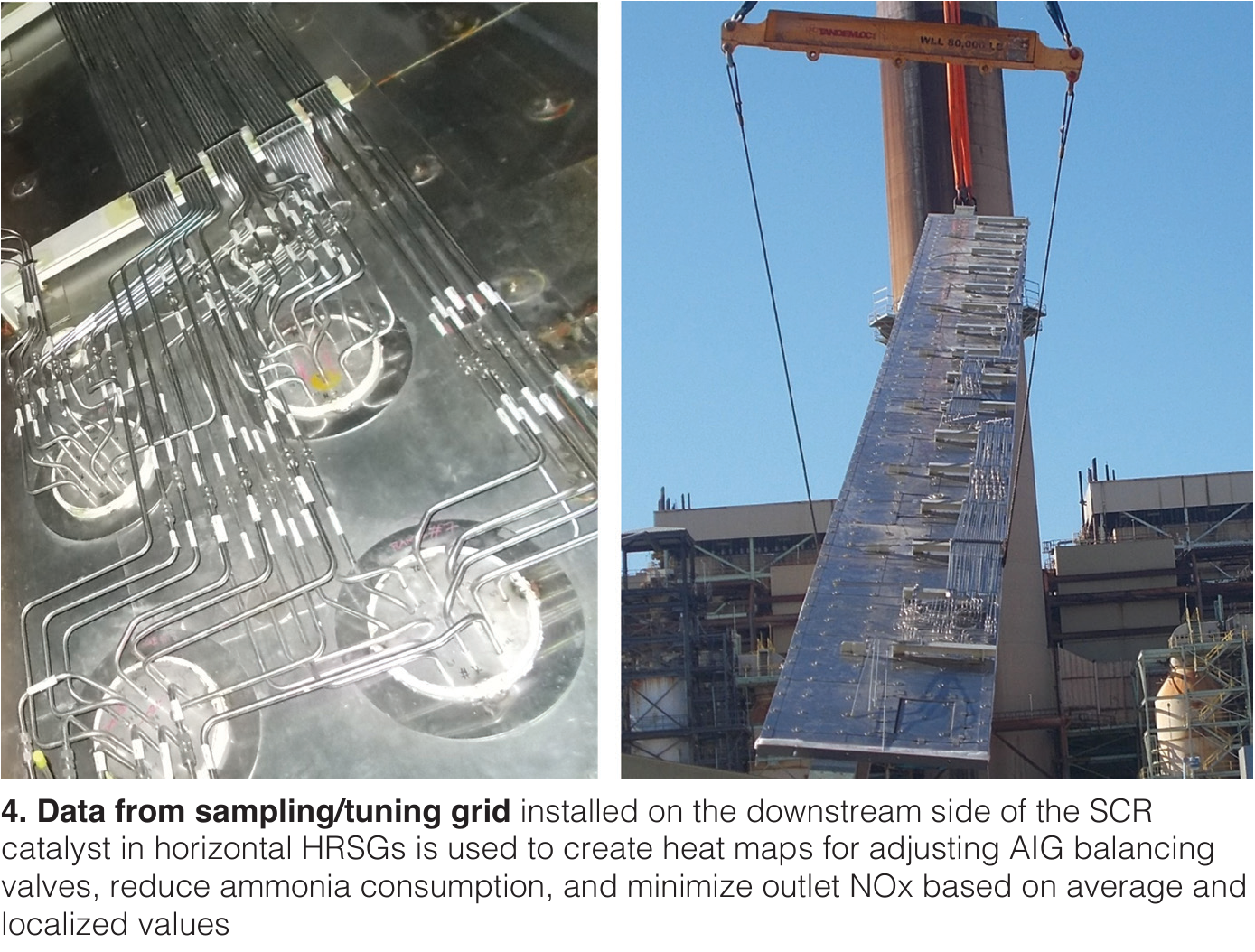
To address stratification, plant in case study added distribution grid hardware between the ammonia injection grid (AIG) and the catalyst, trimmed the baffles, modified the outlet duct and stack geometry, and installed a permanent grid of “test ports” (Fig 4) for in-situ sampling and tuning.
During Q&A, about half the audience raised hands when asked if they tested catalyst samples. One user claimed his SCR had never been tuned, only cleaned, during its 23 years of operation. Others mentioned that high ammonia salts levels are being discovered because of sulfur levels in the exhaust from burning fracking gas.
“Sound Decisions: Using Ultrasound to Protect Plant Availability in Capacity Markets,”
Peter Mantel, Distran USA Corp
Move over snoops, soap sprays, and other ways to detect leaks. According to Distran, handheld portable ultrasound “camera” devices can check for gas leaks by converting the sound emitted into an optical image of estimated leak size, regardless of the type of fluid or composition. Background noise is filtered out. Devices can also detect partial discharges from transformers and electrical equipment. Leak detection is safer because the device works from 25 ft away (optimal distance). Some dangerous leaks, such as dry steam, are invisible to the naked eye (Fig 5).
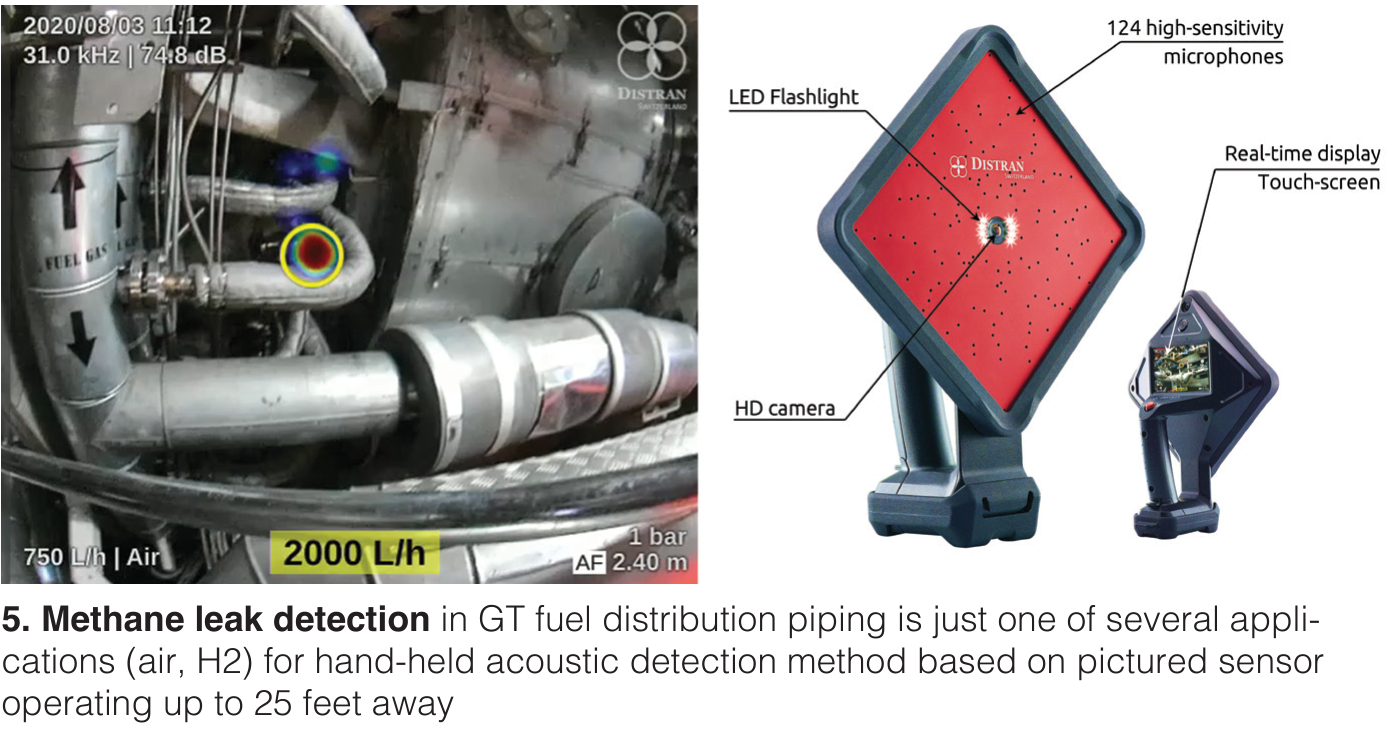
Leakage flow is an estimate within +/-30%, good enough to make informed safety and O&M decisions. Several people in the audience vouched for the devices, one saying they are “really good for air leaks and checking H2 lines.” Power plant applications include hot air from gas turbines, methane in fuel systems, condenser vacuum leaks, steam, and H2.
“Duct Burners Under Fire: Problems, Causes, and Solutions,”
Behnam Kholghi, HRST Inc
Seemingly anything that might go awry with a duct burner is covered in this 60+ slide presentation, and that’s after the basic review of its purpose, location, and components. The photo gallery is a veritable no-cost guide to what to look for when inspecting your HRSG aux burners.
Two non-obvious recommendations:
- Conduct a CFD (computational flow dynamics) study after a GT upgrade. Mal-distribution of turbine exhaust can damage side wall liners downstream of the burner elements and flame holders, and cause coking.
- Add block valves and drains to prevent condensation from collecting in the lower manifolds when not operating (Fig 6). Moisture can cause burner element deformation upon firing after downtime when the cold moisture shoots into a hot lance.
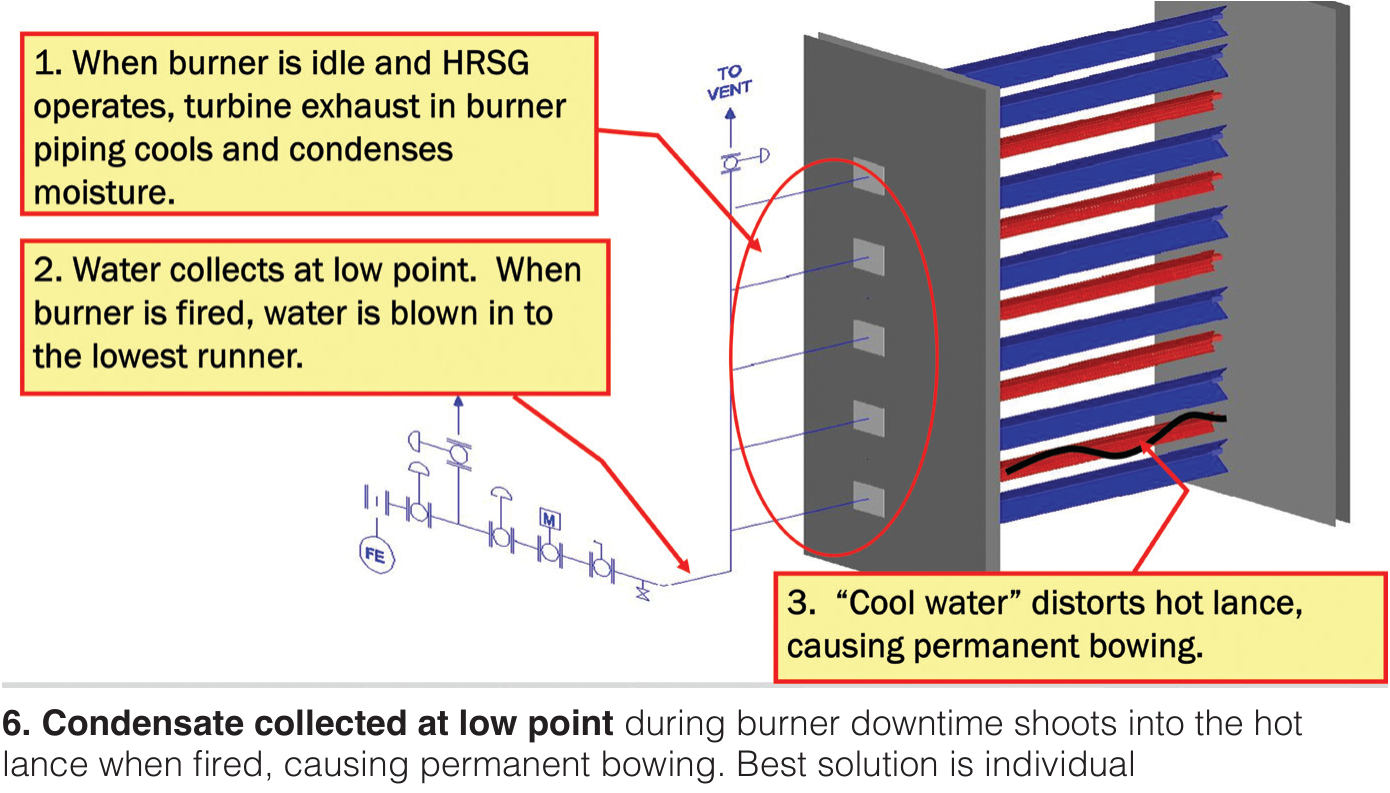
One obvious, but obviously neglected, recommendation: Install better viewports so you get good eyes on flame shape and distribution, and potential impingement on pressure and non-pressure parts. Even better, consider installing video cameras on the floor, roof, or walls for 24/7 monitoring in the control room.
“Enhance Technological Advancement with EMI Monitoring Diagnostics,”
Cutsforth
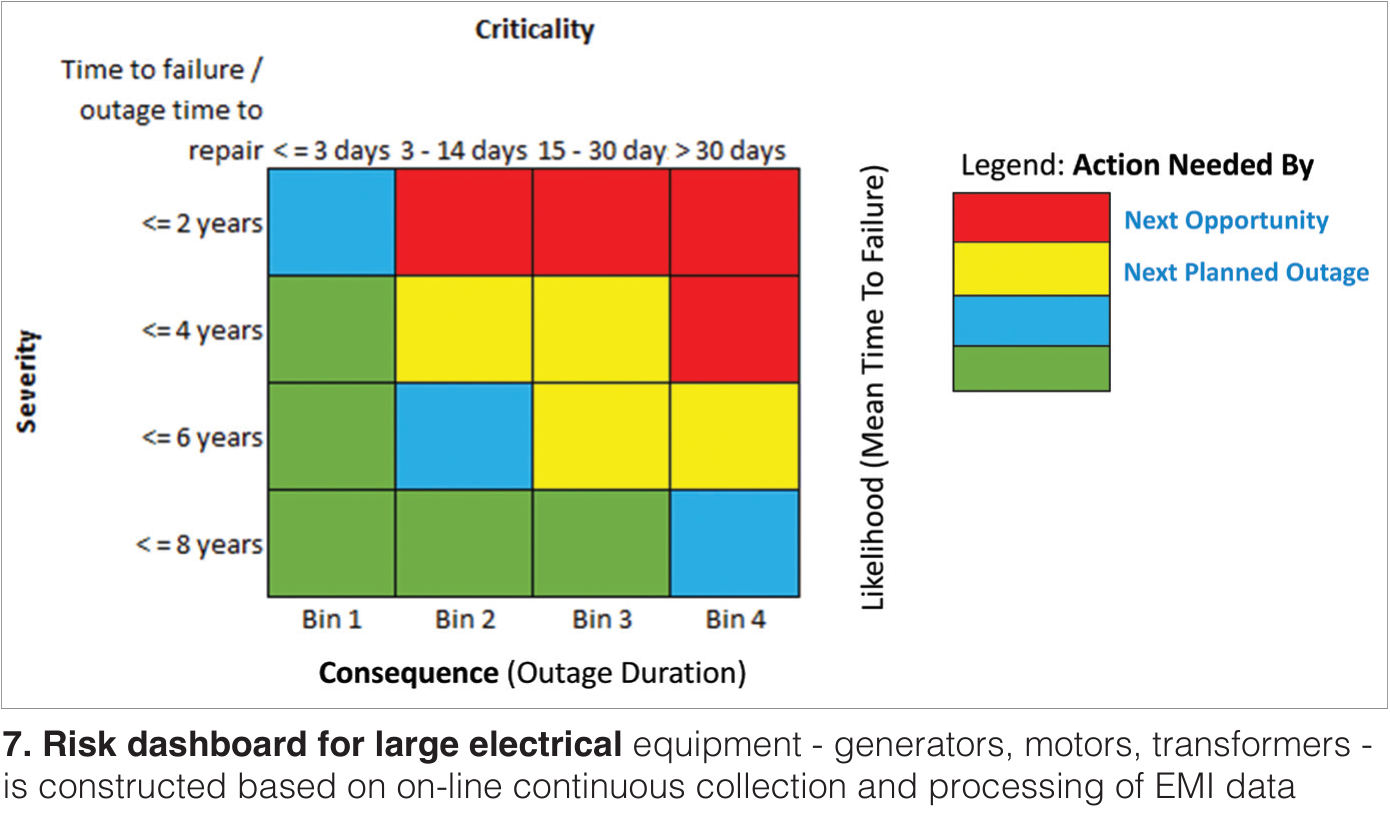
Monitoring electromagnetic interference (EMI) to detect incipient failures in large generators was first proposed in 1979 according to Cutsforth specialists. Over the following four decades, several large utilities progressively applied the concept to monitor generators, motors, transformers, and other large electrical components. Now, a plant in upstate New York is working with Cutsforth to convert ~50 plant-wide EMI detection system outputs into 20 diagnostic severity and urgency indicators and a color-coded production-risk dashboard (Fig 7) of potential consequences (e.g., outage duration) paired with a list of troubleshooting steps to inform the outage scope.
“Control Valve Repair & Maintenance: Best Practices for Combined cycle Power Plants,”
Dean Casey, MD&A
Some of the more salient suggestions from this imminently practical slide deck are: Perform valve stroking per OEM intervals to reduce oxidation buildup; invest in components with upgraded materials such as Inconel substitutes and stellite-lined bushings; invest in spare drop-in assemblies, along with proper crossheads and connectors, to compress the outage window; and adhere to clearance criteria guidelines.
Slides also contrast pros and cons of outage self-performance checks, on-site work, and shop inspection and repair. General recommendation is to send ST and other critical valves to a shop at least every other outage.
“Primer on Steam Cycle Chemistry,”
ChemTreat
Presenter begins with fundamental process and design considerations for the cooling tower, condenser, and HRSG, then dives into chemical treatment needs, control and performance issues, key performance indicators (KPIs), condenser air-inleakage, and other matters. As the slide deck is a skeletal outline of the training material, it’s probably best to contact ChemTreat for more thorough explication.
“GT Upgrades and HRSG Rerates,”
Greg Rueff, Vogt Power International
Several power plant presenters at past user events have expressed surprise at how their upgraded GT affected their HRSG performance. Given that market conditions will likely dictate many other GT upgrades, this slide deck is a must-read. Just one concern which surfaced in a case study of a 58-MW increased GT output: The original HRSG design was based on the 1998 ASME PTC code, which was revised in 2021.
After thermal modeling was completed in this case study, every HRSG pressure part had to be analyzed, including every weld on every branch connection and every thermowell. The HP attemperator saw a 74% spray flow increase, the reheat attemperator an 84% increase. The former required a few upgraded components (nozzle, control valve), while the latter was able to accommodate the changes but was brought up to the current code anyway, with the addition of a drain pot for condensate removal. Several modifications, detailed in the slides, were also made to the HP drum.
While this case study is acknowledged to be an extreme example of an upgrade/rerate, it is still prudent to undergo a thorough HRSG evaluation. For example, general maintenance work in which the “design” does not change is a repair and can be conducted to the original code, but if an aspect of the design changes, it must be brought up to the current code (though there is disagreement among officiating parties).
“Five HOP Principles: Your Roadmap to Operational and Professional Success,”
Matt Barnes and Rene Carabantes, MD&A
The topic of developing safety and high-performance cultures at plants should never get old. There’s always more to learn and more to be reminded of. The five principles of “human and organizational performance (HOP) are:
It’s okay to make a mistake but unacceptable not to learn from it.
Blame fixes nothing – shift the focus from blame (not the same as accountability) to open and honest learning.
Context drives behavior, context being such factors as management systems, leadership, corporate mandates, individual personalities, and expectations.
Learning and improving is vital, and must translate into actions
A leader’s response matters – e.g., do more asking employees what they need, less telling them what to do.
Balance of the slides review a case study applying HOP at a plant in Georgia.
“LCI Preventative Maintenance & Issues,”
Jim Zeleznik, MD&A
Presenter offers a system overview of the load commutated inverter (LCI) and handy checklist of ten preventative maintenance tasks for one OEM’s water-cooled static starter and common issues. Know that UCVx control boards have been failing at an elevated rate.
“Case Studies from Field Inspections of Formed Tees at Large CCGT,”
Tetra Engineering
General recommendation here, based on programs at five plants (four with commercial operating dates between 2015 and 2023 and one from 1999), is to have a formal inspection plan in place for “formed Tees” in HRSGs, one that is separate from the critical piping system (CPS) inspection and not abridged to fit into a larger outage scope. A typical 2×1 F-class GT facility can have more than 20 large-bore tees which operate in the creep regime. While the main failure culprit being searched for is creep, presenters say they often find other types of damage.
The concerns with such tees arise from EPRI work showing failures being experienced at less than 100,000 operating hours in radiant boilers operating at much higher pressure and stress levels. CCJ