
















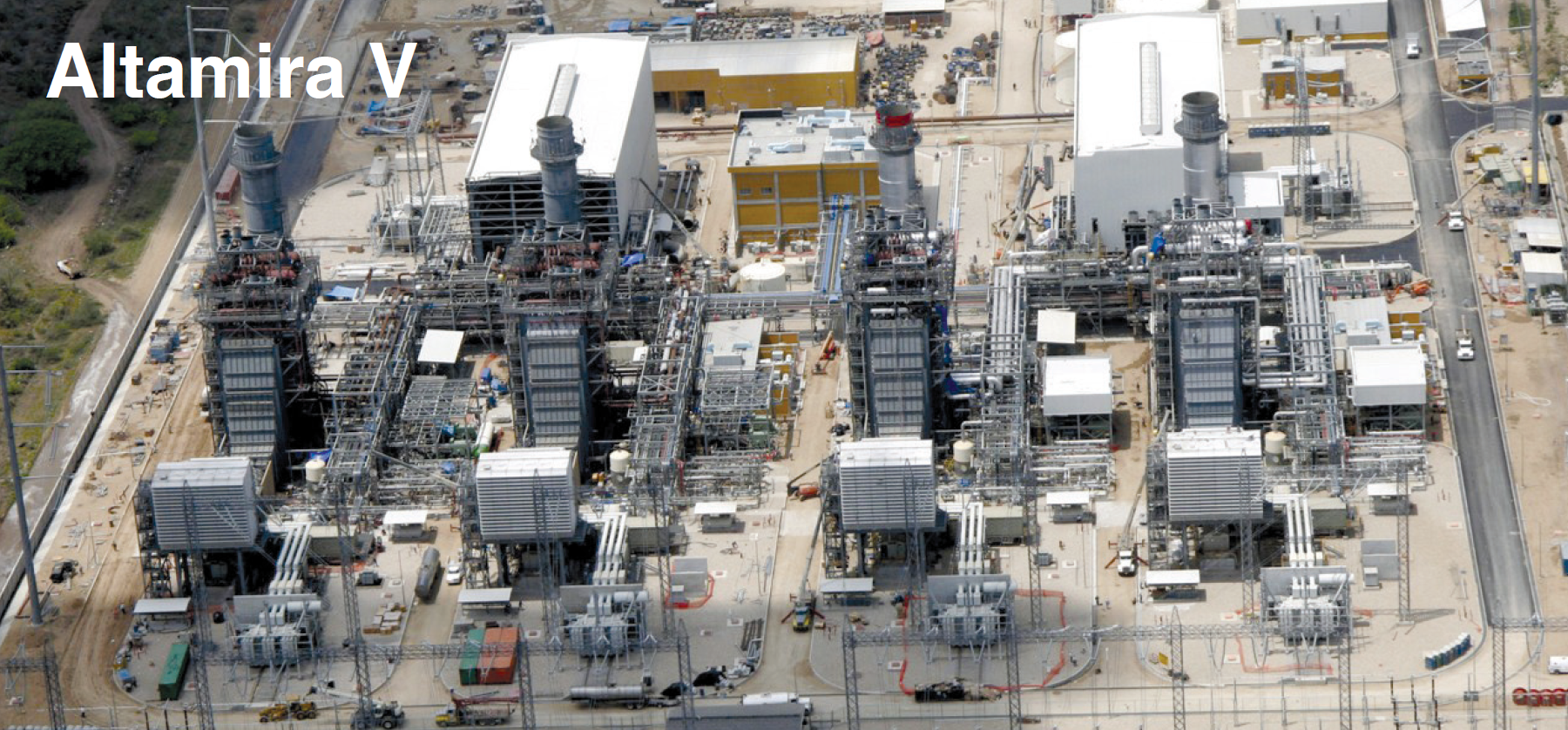
Quantum Energía emerged as a major player in Mexico’s power sector after Mexico Infrastructure Partners along with Federal Government and Mexico’s pension funds acquired Iberdrola’s 13-plant portfolio in 2024. The company now manages about 8.5 GW of generation, nearly all modern combined-cycle capacity. At Altamira V, a 2025 major outage on Block 2 shows how the new owner is approaching reliability, not as a series of isolated fixes, but as a coordinated plant-wide reset looking for long term reliability.
Rather than limiting the outage to routine major-maintenance tasks, the site combined turbine work, controls upgrades, cooling-system replacement, filtration improvements, electrical-protection work, and mechanical-integrity projects in a single execution window. The result is a case study in how one outage can be used to reduce multiple chronic reliability risks, increase capacity and improve heat rate at the same time.
More than a standard major outage
Altamira V entered the outage facing familiar combined-cycle challenges: aging controls hardware, steam-turbine vibration exposure, corrosion risk, recurring air-inlet maintenance, and vulnerability in essential systems during blackout scenarios.
The outage scope reflects a broad reliability strategy. In addition to major work on GTs 3 and 4 and ST 2, the plant included replacement of the GT3 and GT4 filter houses, replacement of the cooling tower, and migration from Mark VI to Mark VIe controls. That package suggests a move away from project-by-project correction and toward a more integrated view of fleet reliability.
The company also appears to be reassessing maintenance practices inherited from the prior owner. In the filtration program, Quantum indicates that previous filter replacements were made every two years and hot-gas-path inspections every three years, even though AGP-standard parts were capable of about 32,000 hours. The 2025 outage was timed to align with that interval, signaling a more condition- and capability-based approach to maintenance planning.
GT upgrades target life and damage prevention
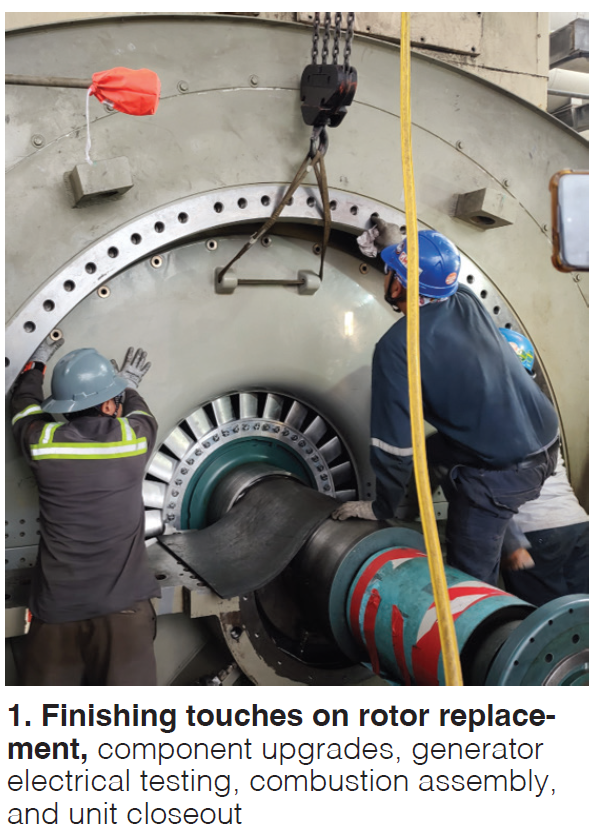
On the GT side, GE Vernova replaced the existing 7FA.03 rotor with an RLE rotor intended to provide longer operating life and incorporate updated design improvements (Fig 1). It also replaced S5 robust vanes in the compressor section to reduce exposure to blade-detachment events that can trigger major downstream damage and extended outages.
This upgrade addresses both life consumption and catastrophic risk. A rotor replacement can extend the service envelope of the unit, but the compressor hardware upgrades also aim to prevent the type of failure that turns a planned outage into a long forced outage.
Taken together, the package strengthens the GT train in three ways:
- Extends rotor life with updated hardware
- Reduces compressor damage exposure
- Supports future availability by addressing major risk items during one planned window
Steam-turbine and controls work address two persistent failure modes
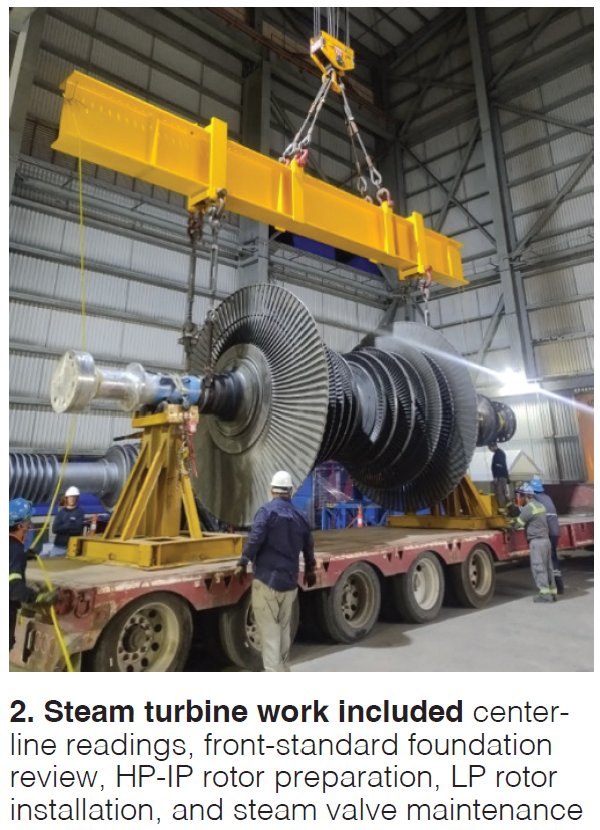
Steam-turbine scope focused on vibration risk rather than waiting for a forced event. The OEM replaced the GEV D11 HP rotor to reduce the potential for high-pressure vibration associated in part with rotor bow seen elsewhere in the fleet (Fig 2). It also used FARO laser alignment to restore centerline geometry and reduce the risk to bearings, deflectors, and the rotor itself.
That is a practical reliability move. Vibration issues on the steam side rarely stay confined to one component, and correcting alignment during a rotor replacement improves the value of both activities.
Controls modernization was the other major lever. Block 2 was upgraded from Mark VI to Mark VIe, including the load commutated inverter and exciter. The objective was to reduce failures tied to aging circuit boards, improve processor and network performance, and restore spare-parts support.
For owner/operators, the value of that migration goes beyond nuisance-trip reduction. Aging controls can slow troubleshooting, complicate support, and weaken confidence in plant response during transients. A successful migration improves maintainability as much as it improves hardware obsolescence risk.
Cooling and filtration upgrades reduce recurring operating burden
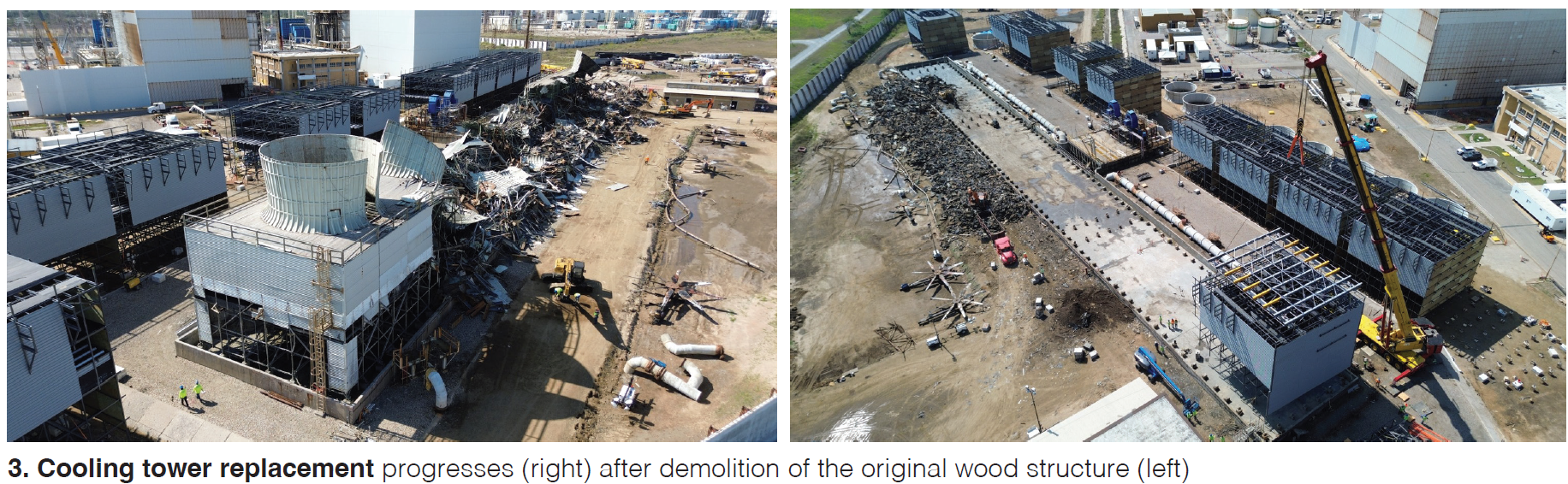
The outage also extended well beyond the turbine train. Cooling tower 2 was replaced with a fiberglass-reinforced-plastic tower from Evaptech in place of the original wood structure (Fig 3). The reported benefits are operationally significant: better saltwater resistance, lower salt-particle drift, and new mechanical equipment from established suppliers.
Filtration upgrades were handled with the same long-view approach. The plant utilized Camfil Power Systems to replace carbon-steel gas-turbine filter houses with 316L stainless-steel units and upgraded the filtration system from class F9 to F10 while retaining a two-stage arrangement also provided by Camfil (Fig 4). The target replacement interval also moved from two years to four.
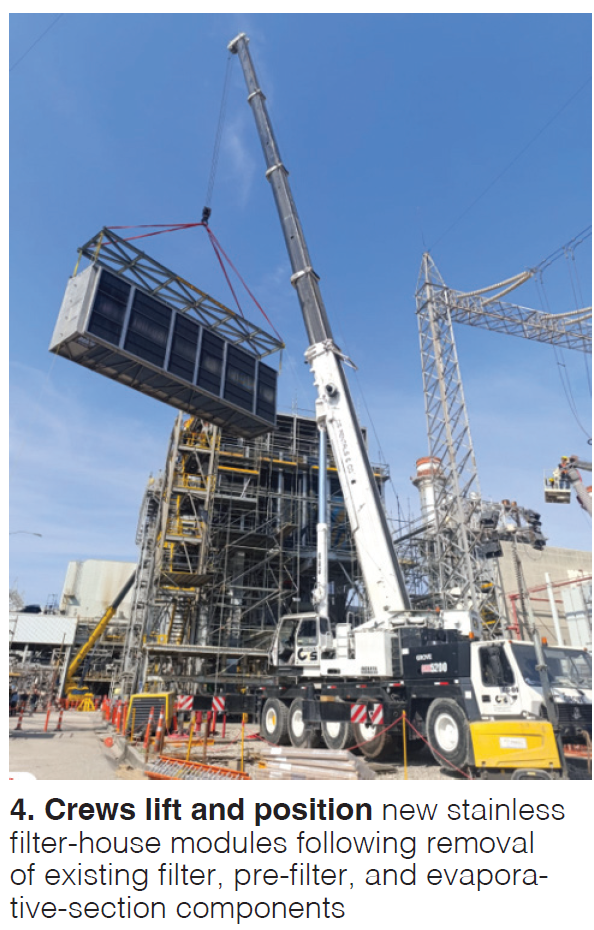
That combination is important because filtration performance depends on more than media efficiency. Housing integrity, corrosion resistance, sealing, and bypass control all affect actual machine cleanliness. Replacing the housings along with the filters suggests the plant is treating inlet-air quality as a system issue, not simply a consumables decision.
Quantum’s stated goal is to maintain compressor cleanliness well enough to eliminate four scheduled offline water washes per year, based on prior plant experience. If achieved in service, that would reduce downtime burden while also improving compressor condition between major inspections.
Reliability and capacity gains come from linking subsystems
The strongest lesson from Altamira V is that the biggest reliability gains often come from tying subsystems together.
Better inlet filtration supports compressor cleanliness, heat rate, wash frequency and, most importantly, a significant increase in capacity due to lower inlet pressure drop. New housings protect the value of the upgraded filters by reducing leakage and bypass risk. A new rotor and upgraded compressor hardware deliver more value when paired with cleaner inlet air, modernized controls, and stronger electrical protection. Steam-turbine vibration risk is better managed when rotor replacement, alignment recovery, and related mechanical work are completed together.
The same systems view appears in the plant’s essential systems work. The outage scope also included upgrades to the automatic emergency generator system, essential systems, and protection relays for the 400-kV substation and both gas- and steam-turbine generators. That broadens the reliability strategy from rotating equipment alone to plant resilience under upset conditions.
For plant leadership, that changes the character of the outage. The site is not simply restoring worn equipment to prior condition. It is reducing multiple future maintenance drivers at once, including board failures, vibration exposure, corrosion recurrence, fouling burden, and blackout-related equipment risk.
Execution complexity remains the trade-off
Bundling this much work into a single outage creates its own challenges. Major rotating-equipment replacements, controls migration, cooling-tower work, filtration-house replacement, and balance-of-plant upgrades all compete for schedule, labor, and commissioning attention. That is the central trade-off. A broad outage can create greater long-term value, but it also increases execution complexity and schedule pressure.
Filtration upgrades, for example, only deliver their intended benefit when sealing, drainage, face velocity, and maintenance discipline are all managed correctly. Controls migration similarly delivers better maintainability only after cutover, integration, testing, and restart are completed successfully.
In other words, a bundled outage strategy can reduce future risk, but only if outage execution remains disciplined enough to avoid creating new startup or commissioning issues.
Takeaways for CCGT operators
Altamira V offers a practical template for plants working through ownership change, inherited maintenance assumptions, or a growing list of recurring reliability issues.
Three lessons stand out:
- Use the major-outage window to solve linked reliability problems together
- Separate work that merely restores condition from work that reduces future operating burden
- Treat filtration, vibration control, electrical protection, and blackout resilience as core reliability issues, not side projects
 For Quantum Energía, the broader message is clear. A fleet asset manager with one of Mexico’s largest gas-fired portfolios cannot depend on piecemeal corrections if it expects consistent performance across multiple combined-cycle assets. Altamira V suggests the company is moving in that direction, using a major outage not just to replace parts, but to reset the conditions that drive forced outages, maintenance demand, and long-term availability.
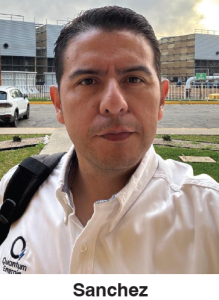
Ramón Sánchez, director of power generation at Quantum Energía, sums it up, “These results are the outcome of an integrated approach, driven by a team with deep technical expertise and the ability to execute with precision in complex operating environments, ultimately, turning strategy into sustainable results.” CCJ
A glimpse into Mexico’s largest IPP
Quantum Energía is one of Mexico’s most critical independent power producers, contributing significantly to the reliability and modernization of the country’s electrical grid. As Mexico continues its energy transition toward cleaner, more efficient technologies, Quantum’s fleet of modern combined cycles plays a central role in delivering reliable, affordable electricity across the national territory.
With a portfolio spanning more than 8.5 GW, operations cover key regions including Mexico’s Northeast, Northwest, West, East, and the Baja Peninsula. Their strategic placement and technological diversity ensure system flexibility and resilience, particularly important for meeting peak demands and supporting intermittent renewable generation.
Plant Name Configuration Total MW GT Model Altamira III & IV CCGT 1,100 7F Altamira V CCGT 1,155 7F Baja California III CCGT 325 7F Dulces Nombres I-IV CCGT 994 GT24 La Laguna II CCGT 580 7F Enertek CCGT Cogen 144 W501D5A Escobedo CCGT 878 M501J Tamazunchale I CCGT 1,179 7F Tamazunchale II CCGT 514 M501JAC Topolobampo II CCGT 917 M501J Topolobampo III CCGT 766 7HA.01 La Venta III Wind 102 Gamesa G52/850