
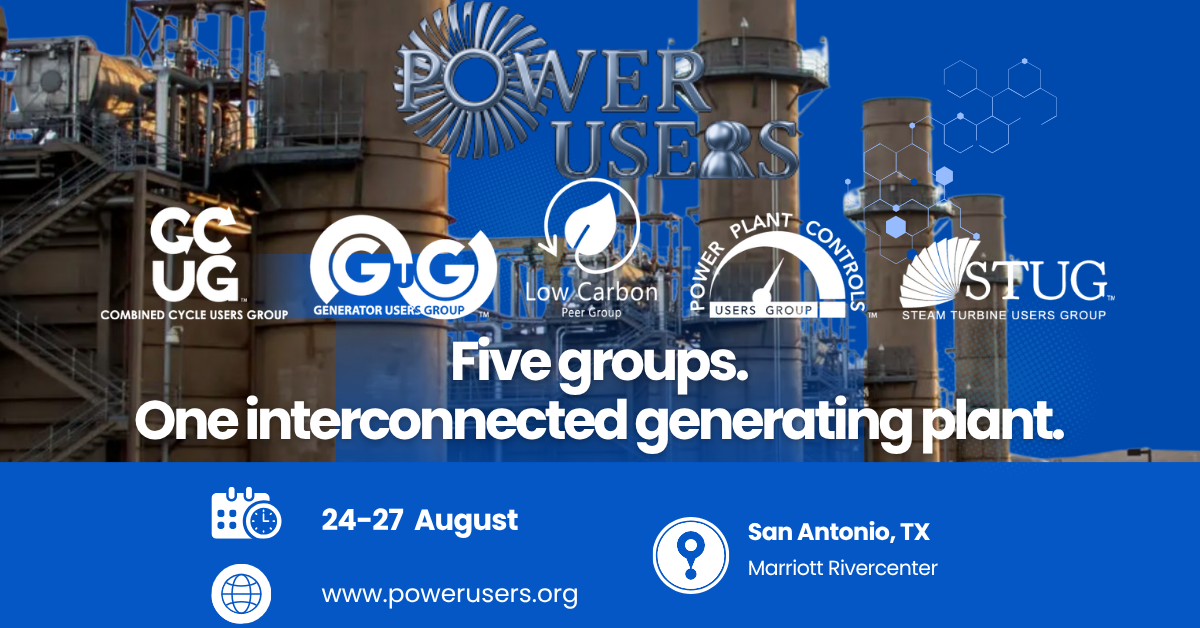
 The 2026 Power Users Combined Annual Conference returns to the San Antonio Marriott Rivercenter on the River Walk, Aug 24-27. Its working advantage is simple: The Combined Cycle Users Group (CCUG), Power Plant Controls Users Group (PPCUG), Steam Turbine Users Group (STUG), Low Carbon Peer Group (LCPG), and Generator Users Group (GUG) run five parallel programs, and one user registration opens every room.
That matters when your plant problem refuses to respect organization charts. A steam-turbine event can start with a control signal, finish at the generator, and expose a training or spare-parts gap along the way. You do not have to stay in the track represented on your badge. Follow the problem.The technical sessions are for user attendees. Vendors participate through committee-approved presentations, sponsorships, and the vendor fair. The program summarized here was current August 15, so check the conference site before finalizing your personal agenda.
Each group keeps its own mission and steering committee. CCUG looks at the integrated plant, PPCUG at the control layer, STUG at the steamer, GUG at the generator, and LCPG at dispatchable lower-carbon resources. The separation keeps discussions technical. The shared badge allows attendees to reconnect the pieces. That is useful when a fleet upgrade promises more output at the gas turbine but shifts loads, temperatures, alarms, or inspection requirements elsewhere in the block.
Integrated plant: CCUG
Failure mechanisms arrive first. Monday afternoon puts flow-accelerated corrosion in HRSGs ahead of critical-spares management and forced-outage events. The program then moves to evaluation and corrective actions following waterhammer in a cold-reheat line. Those subjects belong together. A damage mechanism is only half the story if the needed material, inspection support, or engineering decision is not available when the unit comes down.
Do not overlook Monday’s user roundtable. The short, prepared presentations tell you what is on the program; the roundtable is where you can ask whether another plant has seen the same symptom and what it checked next.
Supply chain is now an O&M variable. Tuesday’s sessions include catalyst-replacement planning in the age of data centers and supply-chain bottlenecks, plus navigating SCR catalyst issues in a long-lead-time market. You might have a sound technical scope and still miss an emissions deadline because the procurement clock started too late. Also on the schedule are operational-knowledge, training, and qualification gaps; valve and seal work; serious-injury and fatality prevention; and varnish mitigation in circulating-oil systems.
Load growth gets a plant-level treatment. Wednesday begins with protecting the shaftline while managing power demands from AI data centers, followed by aging combined-cycle steam-turbine considerations, AI-assisted decisions, combined-cycle top issues, and outage planning and execution.
The afternoon adds co-optimization of combined-cycle operations with advanced models and AI, hydraulic-system problems, end-of-design-life component requalification, and resilience from Day 1.
Thursday returns to the deck plates with extreme-weather lessons, cloud-based cybersecurity, near-miss and LOTO lessons, confined-space lessons, and balancing corrective and preventive work orders.
Controls: PPCUG
Come early if Mark VIe is new to you. Monday morning offers both beginner and experienced plant-control training. The afternoon advances from digital process control and predictive analytics to generator protection and controls TIL implementation. This is a useful sequence for a controls engineer, but it also gives operators and maintenance personnel a common vocabulary before the more detailed case histories begin.
A control system has a lifecycle, too. Tuesday covers data centers from a controls perspective, heavy-duty turbine control using MBC and OpFlex, steam-turbine control capabilities, plant-control lifecycle management, fleet controls issues, smart-signal and asset-performance management, remote support, and the control system of the future. Wednesday follows with machine-learning anomaly detection, the evolution of NERC MOD-027-1 into MOD-026-2, DCS optimization after gas-turbine upgrades, an alternative to OEM model-based-control black-box logic for the 7FA, and remote monitoring intended to prevent trips and preserve output.
The balance-of-plant assessment following turbine upgrades deserves attention outside the controls department. A new gas-turbine operating envelope can make an old permissive, valve sequence, or alarm philosophy the next constraint. The control change that looks small on a screen can be expensive in the field.
Thursday includes a CPS Energy session on why quizzes can build better plant operators than lectures, plus a Salt River Project and Lone Star Controls case history on a controls retrofit to Mark VIe. If your upgrade plan stops at hardware cutover, both sessions are reminders that the people operating the new system are part of the scope.
Steam turbine: STUG
Start at the turbine deck. STUG opens with EPRI’s state-of-the-industry report, ST101, key steam-turbine issues, and EPRI resources. Monday afternoon’s field findings from Viking Turbine Services then puts observed turbine-deck problems in front of the room. This is the right place to compare what you are seeing with what others have already found.
Life-extension decisions dominate Tuesday. Siemens Energy’s fleet insights lead into end-of-design-life component requalification, modernization applications on combined-cycle plants, and varnish in circulating-oil systems. The program then drills into casing cracking, rotor-life assessment, blading damage and repair, section replacement and uprate planning, operation under abnormal conditions, combined-cycle valve and seal work, and actuator refurbishment and controls considerations.
Use the data you already collect. Wednesday includes GE Vernova top issues and TILs, the half-joint stud and nut update associated with GEK122083, and a presentation on using operating data to quantify major-outage improvements. Valve challenges, ASP and NGV experience, the sourcing and repair-shop network, legacy Alstom outage considerations, rotor bow, key documents for the O&M manual, and aging-unit considerations fill out the day. Bring your own problem list. How often do you find only one aging issue?
Before the meeting, compare your bulletin list, last major-outage findings, and open engineering recommendations with these titles. The value is not simply hearing the fleet update. It is leaving with a shorter list of uncertainties for your next scope.
Generator: GUG
Diagnostics should come before the rewind decision. Monday moves from continuous asset-health analytics to offline diagnostic testing and visual inspections, rotor turn-to-turn testing, magnetization screening, generator purge packages, and stator-core testing and repair. Tuesday adds generator field failures, an LM6000 partial rewind, maintenance-program development, stator-core challenges, high-voltage bushings, end-winding block modifications, stator-bar insulation cracking, and generator cooling.
Plan the fleet, not only the next outage. The agenda pairs asset-management-program development with condition monitoring, vibration and winding integrity, root-cause and TIL reviews, H65 design enhancements, rotating-excitation maintenance, collector-ring care, maintenance-outage testing for inner-cooled units, fleet major findings, and proactive GVPI replacement plans. That is enough material to test whether inspection scopes and contingency plans are aligned across machines.
Look for the decision points behind each inspection: what result changes the outage scope, what can remain in service, and what evidence justifies a rewind or replacement. A test without an agreed response threshold is only data.
Thursday is the case-history morning: vibration sparking and spark erosion, an Aeropac 1 ground-fault investigation and recovery, a stator rewind driven by high El-CID readings, stator ground-fault analysis, and a Westinghouse modular-unit rewind. These are the sessions to attend with your test records and one-line diagrams close at hand.
Low-carbon firm resources: LCPG
The subgroup format is the point. LCPG was organized so utilities can evaluate low-carbon firm, dispatchable resources together rather than make every company learn through its own pilot. Monday begins with technology priorities, conference goals, current challenges, and commercialization of emerging technologies. Tuesday moves through hyperscaler demand, IRP and supply-chain issues, fuel cells, linear generators, long-duration energy storage, Echogen power systems, nuclear updates, and fusion.
No single technology gets the whole day. Wednesday’s roundtable asks how members can get more value from LCPG, then the track covers geothermal, cleaning up combined cycles, carbon-capture economics, hydrogen and clean fuels, and integrated methane pyrolysis. An optional Southwest Research tour follows Thursday. If your resource plan must remain dispatchable while carbon intensity falls, this room offers a fast comparison of options that otherwise live in separate conferences.
This is also the track for the questions that do not fit a vendor slide: siting, fuel supply, integration with existing assets, operating duty, and what a demonstration actually proved. A peer group earns its keep when an incomplete answer stays incomplete until the evidence catches up.
Work the five-room format
Map conflicts before you arrive. The agenda contains deliberate crossovers: AI and data-center demand appear in CCUG, PPCUG, and LCPG; life extension runs through CCUG, STUG, and GUG; outage execution touches nearly everything. If your company is sending more than one person, divide the rooms and compare notes before dinner.
Use the vendor-fair windows. Vendor fairs with lunch and evening networking are scheduled Tuesday and Wednesday. Technical presentations are supposed to stay technical; selling belongs on the exhibit floor. That separation gives you a place to challenge the mechanism in the meeting room, then ask about parts, tooling, schedule, and support at the booth.
The conference adjourns at noon Thursday, followed by a limited-space tour of MD&A’s San Antonio Service Center from 1 to 4 p.m. Watch the Power Users archives for slide decks authorized for release; access is limited to registered owner/operators. If you do not already have a library card, register before you get home. CCJ
Steering committee directory
Combined Cycle Users Group (CCUG)
Mission focus: Integrated combined-cycle, CHP, and cogeneration plant design, construction, operation, maintenance, safety, regulatory issues, and workforce development.
| Olivia Ambuehl | Dominion Energy |
| Phyllis Gassert | Talen Energy |
| Jason Jauregui | CAMS |
| Aaron Kitzmiller | Vistra |
| Robert Mash | GE Vernova O&M Services |
| Jonathan Miller | Calpine |
| Jon Mongold | NAES Corp |
| Brady Parscale | NAES Corp |
| Marih Salvat | Tenaska |
Generator Users Group (GUG)
Mission focus: Owner/operator exchange on generator design, installation, operation, maintenance, overhaul, safety, reliability, efficiency, and transfer of experience.
| Ryan Copley, PE | TECO/Tampa Electric |
| Leopoldo Duque Balderas | Valia Energía |
| Andres Olivares | Calpine Corp |
| Jeff Phelps | Southern Company |
| Joe Riebau | Constellation Power |
| Craig Spencer | Calpine |
| Jagadeesh Srirama | NV Energy |
| Mike Young | Salt River Project (SRP) |
Low Carbon Peer Group (LCPG)
Mission focus: Collaborative evaluation, deployment, and information sharing for low-carbon firm, dispatchable resources across technologies and regions.
| Ben Carmichael | Southern Company |
| Dan Connors | American Electric Power |
| Alan Ettlinger | New York Power Authority |
| Todd Flowers | Dominion Energy |
| Adam Reichenbach | Duke Energy |
Power Plant Controls Users Group (PPCUG)
Mission focus: OEM- and technology-agnostic exchange on controls hardware, software, instrumentation, cybersecurity, digital transformation, and plant-control-system performance.
| Richard Chiafolo | Dominion Energy |
| Brian Hall | TECO |
| Zamantha Lopez Aldaco | Salt River Project (SRP) |
| David Martorana | Tenaska |
| Eric Mui | CPS Energy |
| Peter So | Calpine |
Steam Turbine Users Group (STUG)
Mission focus: Open owner/operator exchange on combined-cycle steam-turbine and associated generator operation, maintenance, inspection, troubleshooting, repair, performance, and reliability.
| Jake English | Duke Energy |
| Jared Harrell | OxyChem |
| Jay Hoffman | Tenaska |
| Connor Hurst | TECO |
| Mark Johnson | Florida Power & Light |
| John McQuerry | Calpine |
| Jeremy Pou | Tennessee Valley Authority (TVA) |
| Matt Radcliff | Dominion Energy |
| Brandon Stewart | Southern Company |
| Seth Story | Luminant |
| Steven Weaver | Salt River Project |