

Planned work outages are an exercise in efficiency and preparation. As global power demand continues to increase, plant operators are compelled to execute required maintenance within increasingly shorter outage windows. The pressure on already stretched labor resources and the strict O&M budgets compounds the challenge of outage planning. Getting better information on equipment health offers distinct advantages when deciding where and when to allocate time and capital.
Shifting from preventative to predictive maintenance
Historically, maintenance decisions are based on a preventative, or time-based, maintenance strategy. Under this model, maintenance intervals are established using historical information, such as past mean-time-between-failures (MTBF) and equipment condition records from previous inspections and overhauls. The intent is to establish routine overhauls at intervals shorter than any expected failure mode. While this is generally effective at preventing unexpected failures, this approach frequently leads to unnecessary refurbishment of equipment that still possesses remaining useful life. Not only does this drain maintenance budgets and extend outage timelines, but it also exposes equipment to the risk of ‘infant mortality’ caused by reassembly or installation errors.
So what options are available to move from a time-based maintenance strategy to a strategy where decisions can be made based on actual equipment condition?
Transitioning from a time-based strategy to a predictive, condition-based maintenance strategy requires an accurate assessment of current equipment health. It also requires the ability to identify signs of degradation and understand how this degradation will impact future equipment operation. Many facilities lack the necessary instrumentation to capture the data required to make this assessment or the specialized subject matter expertise required to translate this raw data into actionable information.
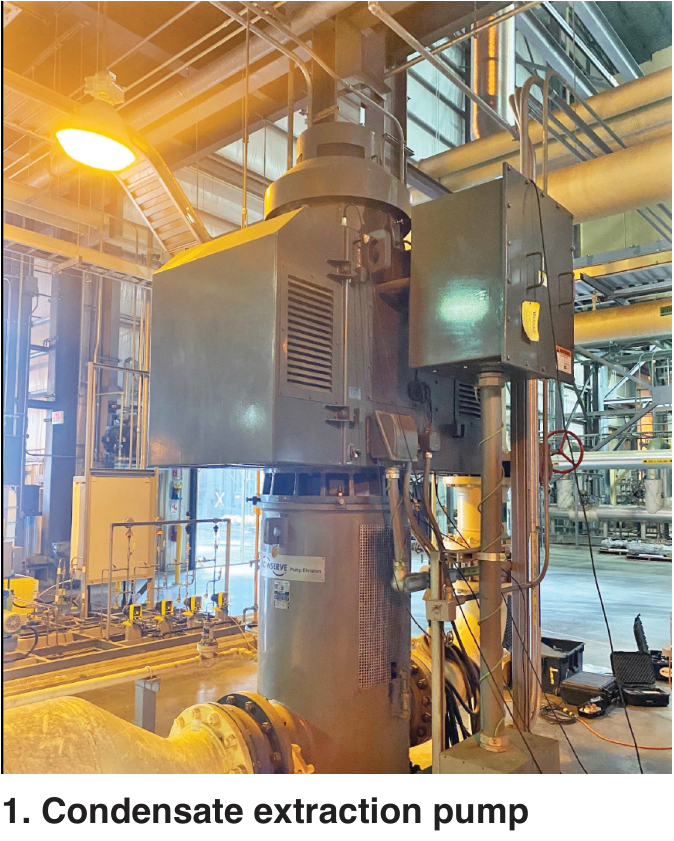
Recognizing the benefit of condition-based decision making, a combined cycle end user in the Northeast sought an accurate picture of equipment health before scheduling maintenance of their condensate extraction pumps (Fig 1). They engaged with Hydro’s field engineering division, Hydro Reliability Services, to perform a full health audit on this equipment to understand where to best concentrate their resources.
Field testing process
The health audit conducted at the CCGT facility encompassed bothfield testing and a rigorous review of equipment design and history. The primary objective was to evaluate the mechanical and hydraulic health of the equipment under typical operating conditions.
The pumps tested were two condensate extraction pumps of the vertical can configuration. Each pump is rated for 100% of the plant load. The pumps take suction from the condenser hotwell and discharge through an economizer to the LP drums that feed the boiler feed pumps. Tested parameters included:
- Hydraulic: Suction flow (gpm), suction and discharge pressures (psig)
- Electrical: Motor volts (vac) and amperge (amps)
- Mechanical: Pump speed (rpm), vibration signatures in velocity (ips), displacement (mils), and acceleration (Gs)
- Thermal: Thermographic imagery
Test results
The field-test data clearly showed that the “A” condensate extraction pump showed signs of significant degradation. Indications of substantial wear were evident in both the hydraulic and the mechanical parameters measured. The total develop head as measured was 12.5% than the head on the tested performance curve for that flow point; the efficiency at this point was 15.2% lower than expected. As would be expected with the degradation in efficiency, the brake horsepower at this point was 14.3% higher than what was indicated on the factory test curve (Fig 2).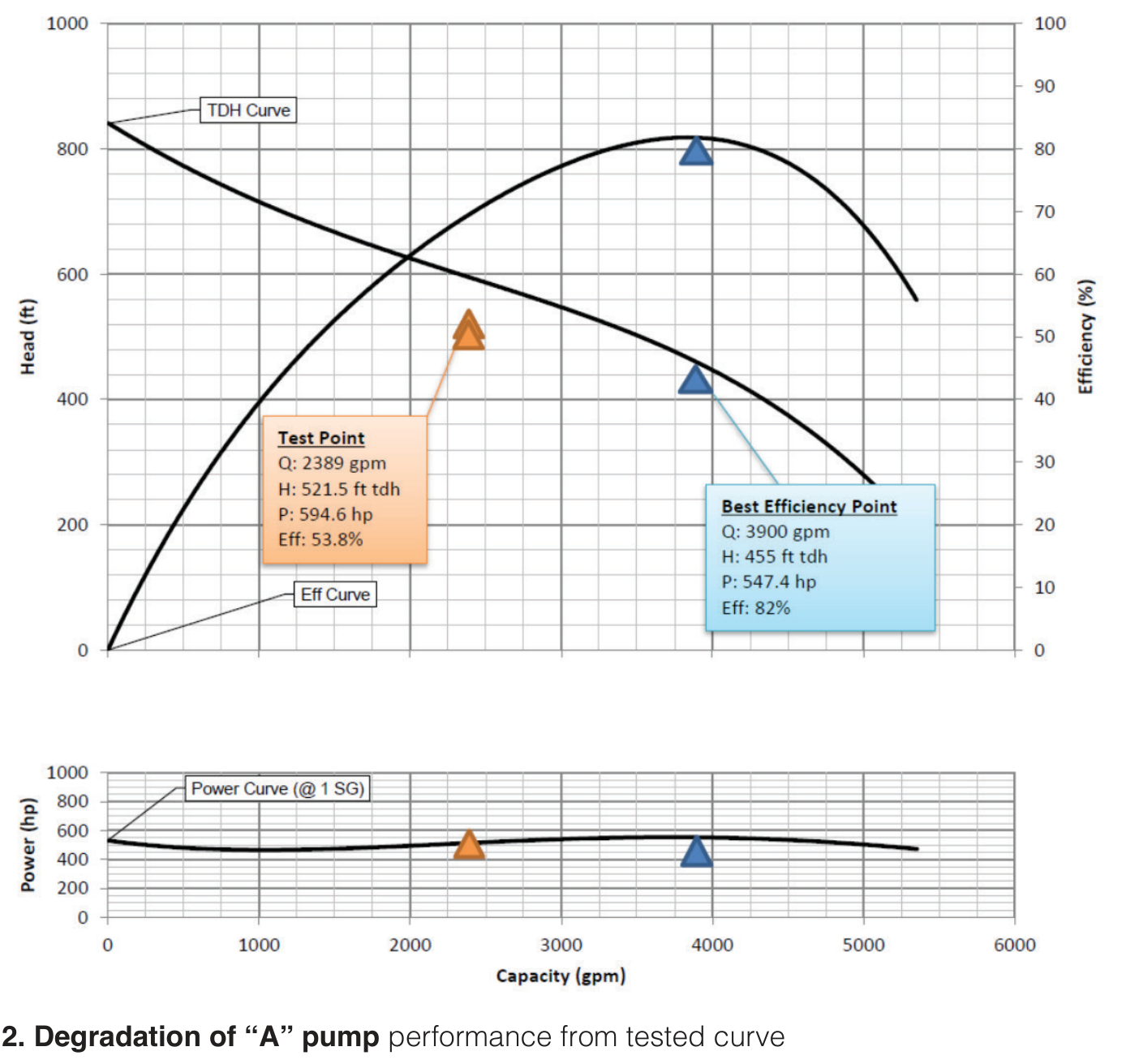
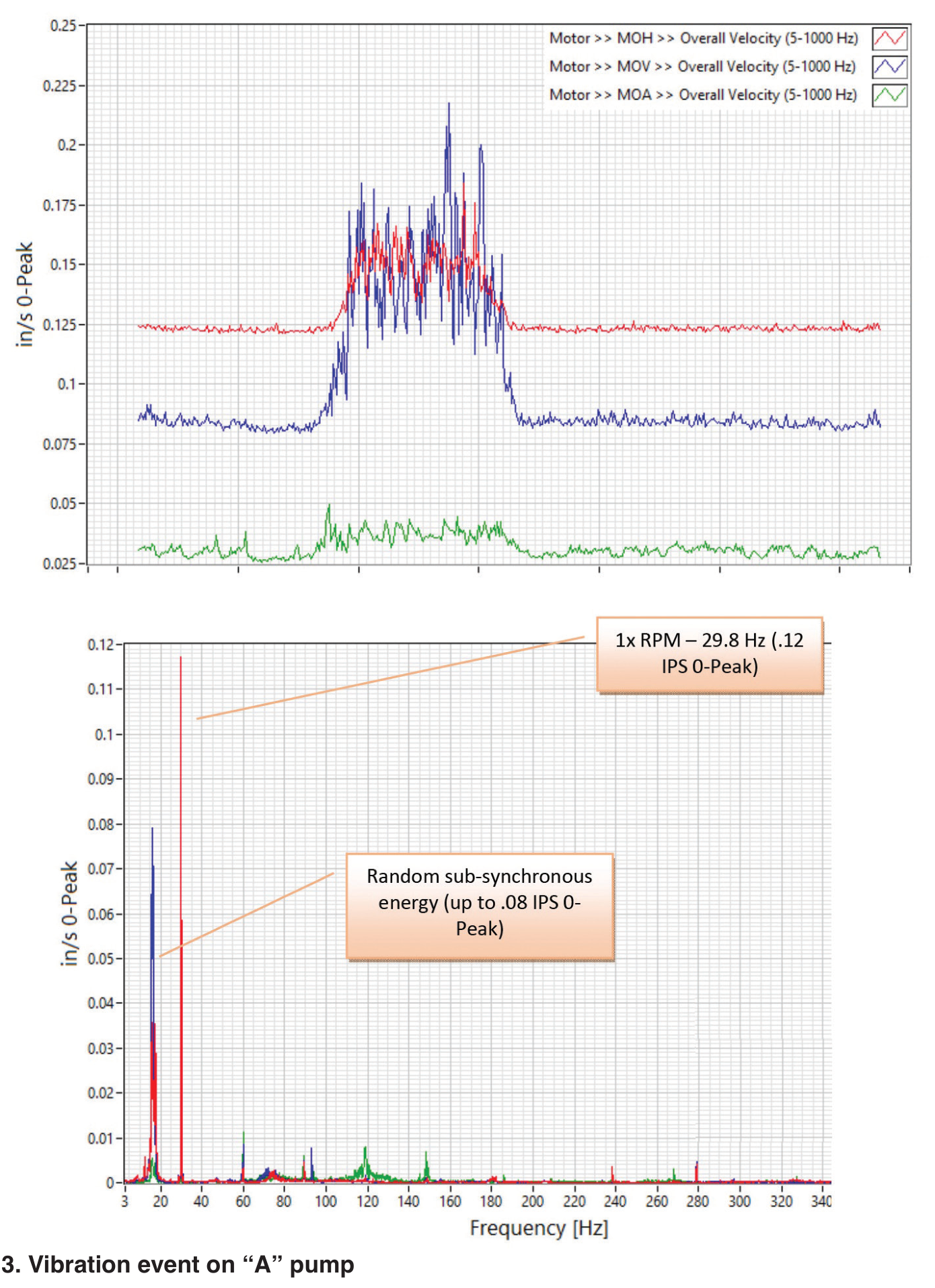
During the field testing, the “A” pump experienced a notable vibration event. For approximately 6 minutes vibration amplitudes in the outboard motor measurement locations increased. While the amplitudes did not exceed the first alarm level, the pattern was still concerning. At this same time, the suction flow trend showed a slight increase. During this time, the subsynchronous energy increased at approximately 54% of the run speed (Fig 3).
Conversely, the test data of the B condensate pump showed that it was in good health both hydraulically and mechanically. Although slightly lower in efficiency than expected, the total developed head was very close to the test curve and there were no anomalies in the vibration data.
Evaluation of the test data
Following the testing phase, the data was reviewed to evaluate the best path forward for O&M. It was clear that pump “A” was in need of an overhaul to restore the equipment to its original design clearances.
Both the degradation in performance (head and efficiency) and the mechanical issues could be attributed to excessive running clearances caused by component wear. The close clearance areas of the pump limit internal recirculation; opening these clearances will increase recirculation and decrease efficiency. The close clearance areas also contribute to rotor stiffness and stability, which explains the subsynchronous vibration anomalies.
With this data in hand, the site was able to schedule refurbishment of the A pump with confidence that the capital expenditure was fully justified. In the interim period leading up to the outage, the plant was able to immediately realize cost and energy savings by prioritizing the operation the “B” pump, which test data had proven was more efficient and required less horsepower to operate.
Ultimately, this case study underscores the tangible benefits of getting an accurate picture of equipment condition as part of the outage planning process. By investing in a comprehensive health audit, the plant avoided the costs and risks of unnecessarily tearing down healthy equipment, while accurately forecasting the required budget and parts for the degraded unit. By using specialized testing such as health audits, plants can confidently transition to a condition-based strategy, ensuring that labor and capital are deployed only where the data proves they are needed most. CCJ