

















The 7F Users Group’s 2025 vendor and solutions-provider program highlighted how much of the reliability discussion now extends beyond the gas turbine itself. Presentations covered rotor life extension, compressor stator-vane looseness, generator inspection and hydrogen-purge safety, controls calibration, intake filtration, lube-oil varnish, leak detection, coupling-bolt replacement, and owner’s-engineer support. Together, the sessions gave users a practical view of the aftermarket options available to keep mature 7F assets reliable, dispatchable, and economically viable as operating profiles continue to change. All these presentations are available to end users registered at www.powerusers.org.
OOEMs
PSM: Full-service OEM alternative. During a review of PSM’s history and product/solution suite, Katie Koch stated that the firm planned to have full PSM-manufactured 7F rotors available beginning in 2027 and that its first “fielded turbine wheel” entered service in May 2024. A “drop-in compatible” combustor is now available as an option to the OEM’s DLN 2.6. PSM bills itself as “the only non-OEM offering complete 7F upgrades.”
The coming year is big for PSM, Koch continued. The GTOP4 (gas turbine optimization) offering is being commissioned, followed by three other installs. The year marks a decade of FlameSheet commercial operation. After a dozen outages and detailed assessments, FlameSheet harware “looks pretty good.” Mods to the Gen IV Flamesheet have improved its emissions profile and reduced startup dynamics.
Other milestones include demonstrations of the exhaust bleed scheme (for 10% better turndown), FlameSheet upgrade with the torch circuit and micromixer technology, and the GTOP3.1 unflared compressor for 2.8% greater airflow.
Digital services now includes Autotune, FlexSuite, advanced M&D with 24/7 expert monitoring, and a replacement for the OEM’s “locked-down model-based controls (MBC).
PSM is also formulating and executing on a fleet management process which includes updates to customer information letters (CILs), database for tracking life cycles of parts, and better communication updates through an on-line customer portal.
Readers are encouraged to access separate presentations, each with a stunning amount of detail, on FlameSheet, GTOP, and the 7F rotor program.
MD&A – Latest repair, parts services. Jose Quinones reviewed the company’s current parts supply and repair capabilities for several machine models and OEMs, including the 7FA.03, then zeroed in on latest services for the 7FA.04, which include 1st stage blade tip inspection and repair, 1st stage shroud tile repair, 2nd stage blades and nozzles, 2nd and 3rd stage shroud block repair, and combustion liner and transition piece repair.
Quinones highlighted the successful 1st stage blade tip repair and the low-K abradable coating for the 1st stage shroud tiles. Slides are replete with photos and diagrams illustrating both.
ROTORS
Doosan: LTE & Refurbished rotors. Company calls its long-term solution for rotor life extension DART (Doosan Advanced Re-engineered Turbine), leveraging its “major footprint” in 7F exhaust and compressor discharge casings, turbine wheels, exhaust frames and diffusers, and bearing housing. A 7F rotor can get an LTE (lifetime evaluation) and overhaul in 3-4 months, claims the firm, for ten years or more of additional life, and pointed to a project “completed a few weeks ago.”
While Doosan can handle turnkey projects, it is cooperating with PSM to provide more options for rotors and investing in parts for inventory to address the current supply/demand crunch.
COMPRESSORS
CTTS fixes loose stator vanes. All GT models with square-based stator vanes are subject to vane looseness and hook fit casing cracks, and potential crashes, says Rich Armstrong. Loose vanes are most prevalent adjacent to extraction stages, at the back end of the compressor, and near horizontal joints. Slides review causes of vanes coming loose, and most importantly, what to look for. Although borescope inspection van detect some evidence, a thorough evaluation requires removal of the top of the casing.
CTTS’ vane pinning solution exhibits the lowest cost in the shortest amount of down time and, critically, addresses vibration dampening and vane movement (which OEM solutions do not, Armstrong said). With 95+ compressor vanes (at conference time) so repaired since 2003, vane pinning is fully qualified and well-proven.
GENERATORS
AGT Services warns on generators. Users responsible for aging generators can get uncomfortable (but very knowledgeable) in a hurry reviewing Jamie Clark’s slides on generator outages. To put it simply, supply of shop services and components and demand for repairs, upgrades, and replacements are out of sync. Review how he builds the case in the slides.
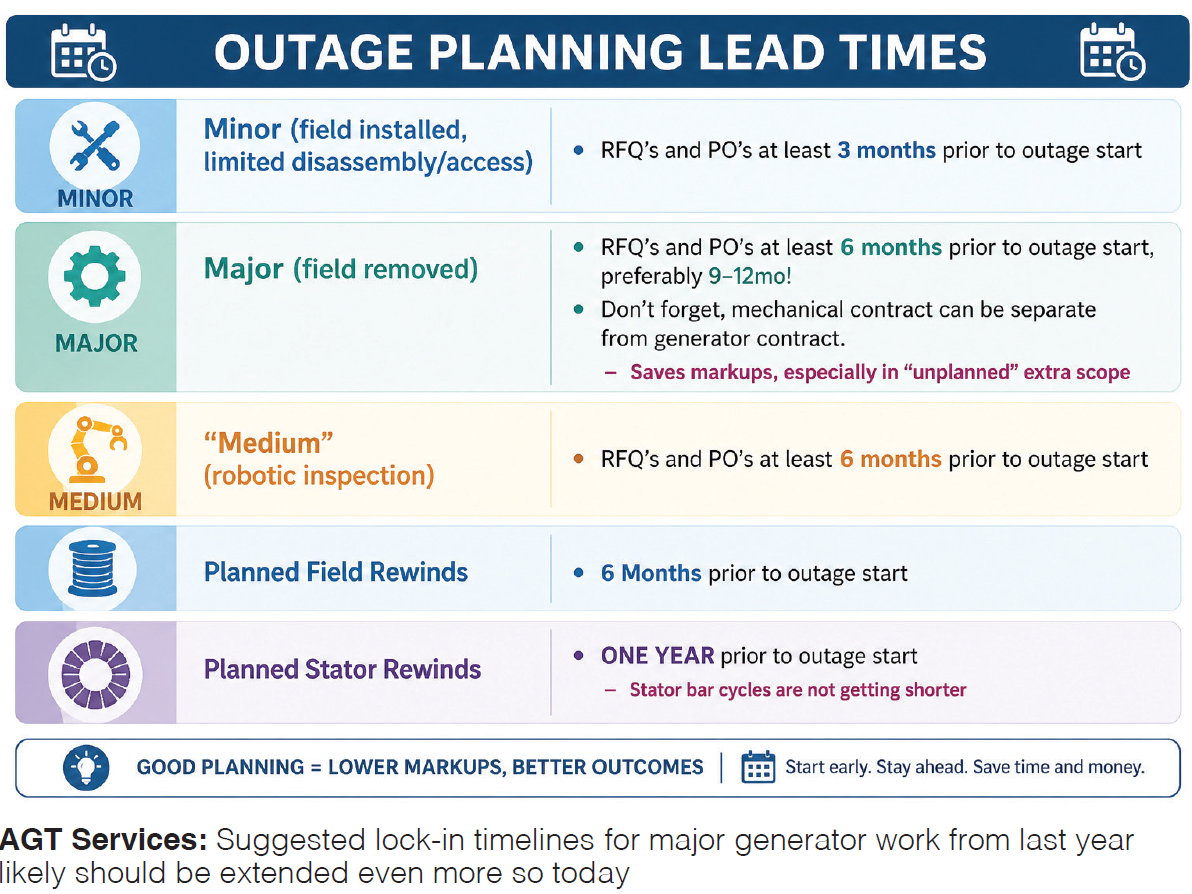
Balance of slides help users “get their minds right” regarding the different types, levels, and duration of inspection techniques; repair durations; when to lock in resources (earlier, not later) for major work (illustration); evaluating winding resistances; realities of procuring spare fields; and limitations on field inspecting and repairing only “what you can see and feel.” Comparison between a robot wedge map from a spring outage and a hand wedge map from a spring outage three years later is especially illuminating.
If you only take away two things from the presentation, Clark writes, let it be (1) borescope under the retaining rings on day one, hour one, and (2) verify insulation resistance and polarization index, commonly known as the Megger test, per IEEE 43 and 95.
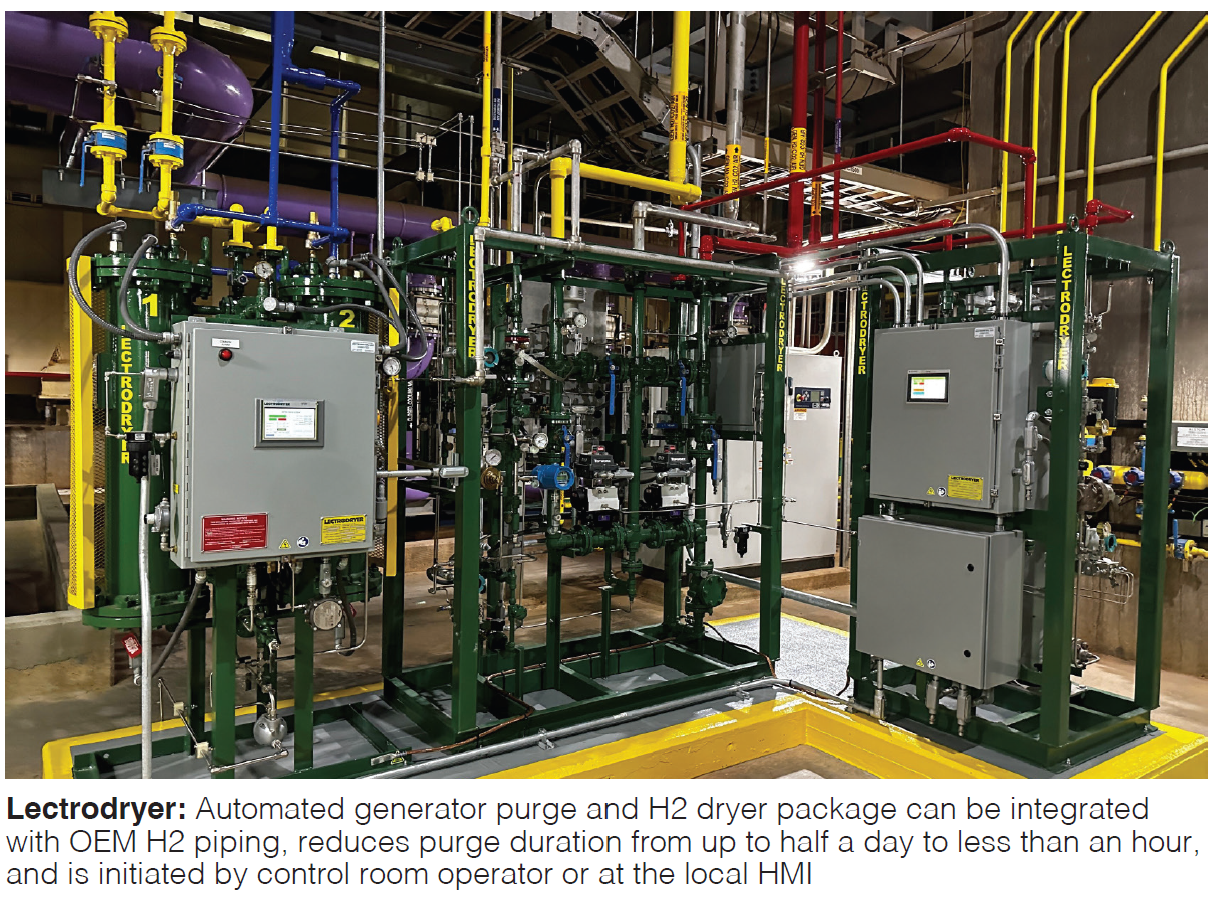
Lectrodryer’s generator fast purge. Rob Kallgren surely got the audience’s attention with photos of three catastrophic generator explosions, then proceeded to explain how a fast automated H2-purge and dryer installation (specific features covered in slides) can avoid them and reduce purge duration from 6-12 hours to less than one hour. He covered three case studies – shutdown for a hurricane, cracked H2 piping weld, and loss of seal oil. Details are not in the slides but Kallgren would be pleased to fill you in if you contact him.
CONTROL AND M&D SYSTEMS
AP4 handles I&C. Presentations takes you back to the fundamentals of thermodynamics, the Brayton cycle and gas turbine efficiency and performance calculations to emphasize that instrumentation are the health indicators and inputs to the machine control and safety systems. If not properly calibrated, they can cause outages and poor performance. Recommendation: Establish a formal performance evaluation process which includes tracking system, periodic site audits, regular maintenance, and comparison to a valid baseline condition.
BOP SUBSYSTEMS
ExxonMobil – address hot and cold varnish. Cody Evans distinguished between hot and cold varnish in lube oil systems, characteristics, how formed, where each is found in different areas of the turbine, and why it’s important to test for both. Oil analysis (slides review four standard techniques) is a good predictor of cold varnish, which may not impact operation if the tolerances in the hydraulic systems are not too tight.
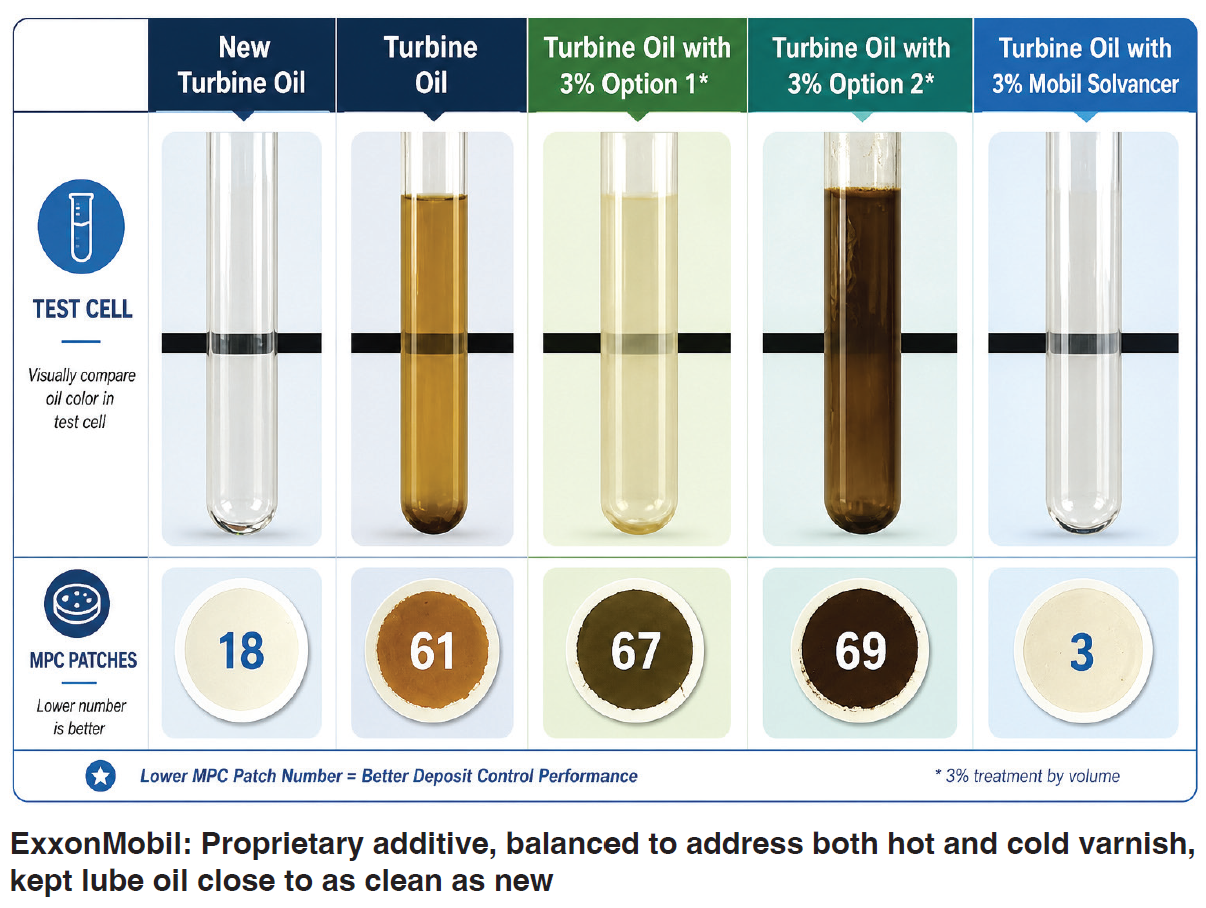
Hot varnish, or sheer-stress-induced deposits, is almost always the result of another mechanical or environmental cause and is best indicated by a gradual rise in bearing temperature (not caused by other factors). Oil analysis and vibration may not correlate.
Company’s Solvancer additive is said to be the only one on the market formulated to adequately treat both hot and cold varnish and suitable for long-term use. Other options, in fact, like PAG with amine antioxidant, may actually aggravate varnish formation when used for more than three months.
Donaldson urges optimizing filtration. Bob Reinhardt encourages users to focus as much on operational impacts from poor filtration as they do on maintenance aspects. He stresses that all the important filtration objectives are not necessarily addressed by current industry standards. Total cost of ownership (TCO) of a GT can be optimized with modern intake air housing designs and by selecting filter materials which may have a higher first cost but pay dividends over the life of the machine (illustration).
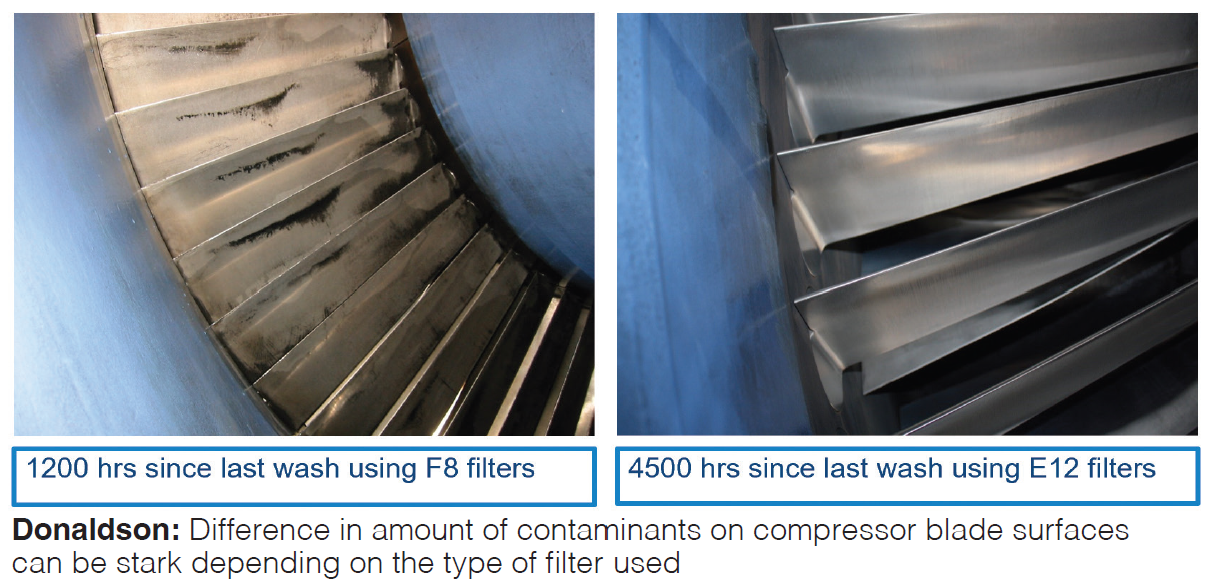
Opening slide is a stunner, an illustration of the volume of air moving through a 7FA per hour and the amount of contaminants collected (180 lbs/hr in a desert location!). Following slides show how to do a thorough TCO assessment of filters, for example comparing filters using a rating system that includes efficiency rating, water tightness, and cleaning pulse recovery rate, then plugging those values into a TCO model for the unit.
HP Leak Detection – all in the name. There’s a better way to detect leaks at piping flanges than having a worker do the “flag flutter” test. Experts from HP Leak Detection explained their patented, demonstrated “CRANK” technique, in which the system is tested at 1 psi with a “balloon” clamped to the flange. The balloon deploys at 0.2 psi signifying a leak. If the flange passes the balloon test, it is ready for continuous monitoring and a gold cap replaces the balloon (illustration).
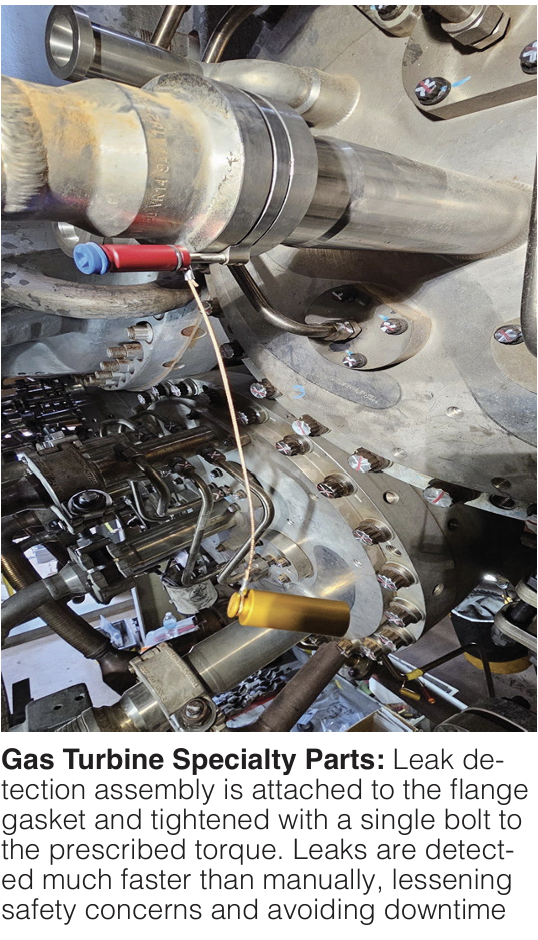
Should a leak occur during operation, the gold cap lifts off, acting as a warning flag to workers. A pressure switch/transmitter can be added to provide a signal to the control room or a remote location. Technique accommodates a wide range of gases and flange types. One important application is turbine compartment airflow. Several prominent O/Os have signed on with testimonials.
Nord-Lock offers better bolts. Removing friction-drive and shear-drive coupling bolts often isn’t straightforward, and workers resort to destructive removal. The drop-in (no mods required), permanent replacement Superbolt EZFIT design offers “tremendous radial expansion and joint clamping power,” thanks to a split expansion sleeve which mates with the customer’s machined holes.
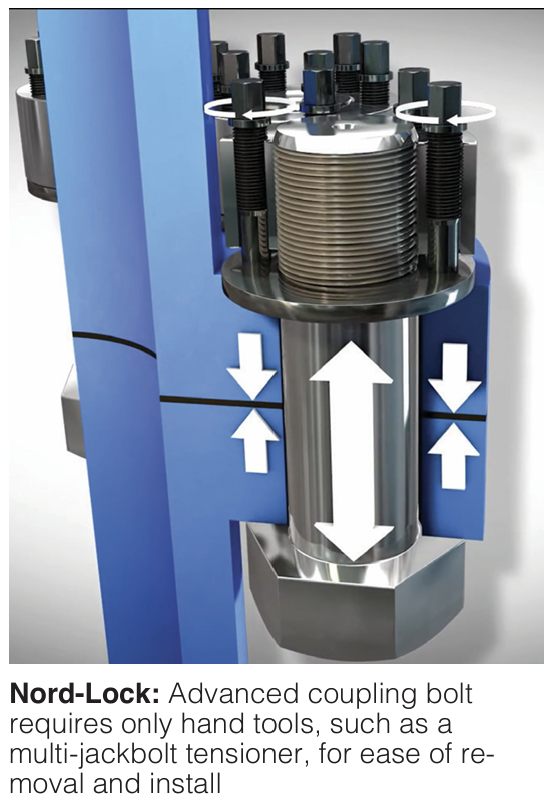
The advanced bolt avoids the wing-type locking feature, 50-lb tensioner device, mis-aligning the tensioner puller screw into the conical thread, dangerous windage plates/covers, and rental of specialty hydraulic equipment. Design, manufacturing, and engineering details are covered in the slides, along with several applications in GT powerplants and short list of customer sites using the technology.
GENERAL PLANT SERVICES
CEIS IEM advocates O/E role. Benefits of employing an owners/engineer (O/E) during major projects are legion but can be summarized as receiving technical expertise during every phase of the project – planning, execution, commissioning, and start up. Services are especially valuable for facilities or O/Os with thin staffs, unfamiliarity with contractors, and/or inadequate expertise or experience with contract negotiations and overseeing contractors.
Examples are provided of projects where O/E services proved their value, and specific findings during a project (such as a water bottle and lighter found in a generator during a close-out inspection). In one testimonial, a utility project manager noted that the O/E had suggested better fixes than the OEM’s for known problems. CCJ