

More than 500 registrants from 56 countries signed up for the March 31 IAPWS/CCJ webinar on damage and failure in the phase transition zone of steam turbines. That turnout said plenty before the first slide appeared. The subject was narrow by title, but not by consequence. Deposits, pitting, corrosion fatigue, stress-corrosion cracking, steam purity, carryover, and shutdown protection all converge in this part of the low-pressure turbine, and when plants get any of them wrong the result can be cracked blades, damaged discs, forced outages, and expensive inspections that still miss the early warning signs.
Barry Dooley, Structural Integrity Associates, UK, and Bobby Svoboda, Svoboda Consulting, Switzerland, used the session to answer eight recurring questions from users: why the PTZ matters, what it is, what chemistry exists there, why failures occur, whether IAPWS steam-purity guidance addresses the problem, whether the PTZ can shift from one blade row to another, how much shutdown protection matters, and whether CO2 and organics deserve attention.
Their answer, taken as a whole, was straightforward: the mechanisms are well understood, the warning signs are known, and the industry already has guidance to reduce risk. Plants still get into trouble when they tolerate repeat cycle-chemistry problems or leave the low-pressure turbine unprotected during shutdown. Review the key research findings below and access the full webinar below.
Why this topic keeps coming back
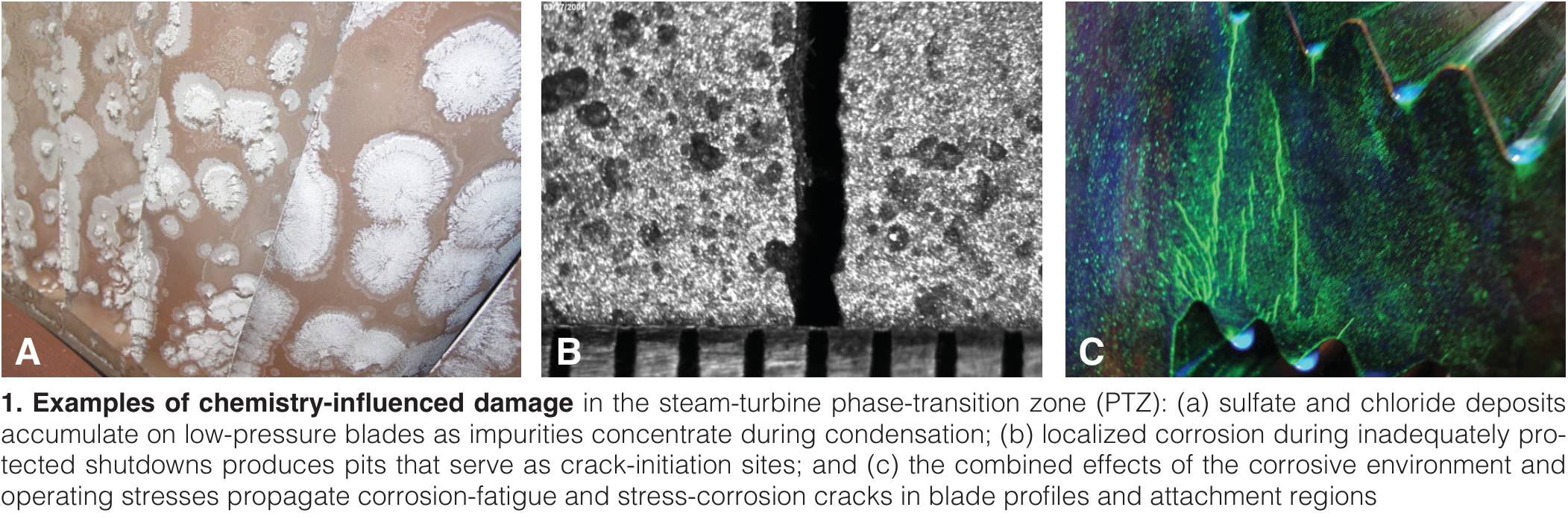
Dooley began with the damage mechanisms most strongly influenced by cycle chemistry. For the PTZ, the leading concerns are corrosion fatigue of blades and discs in the low-pressure section and stress-corrosion cracking of discs in the same region. Deposition and pitting are part of that story, not side issues. In Dooley’s experience, pitting is where these failures start.
He showed failure examples from L-1 and L-0 rows, attachment areas, and blade profiles. The message was not subtle. Cracks may present differently, but the initiating condition is the same. Deposits form, shutdown protection is absent or inadequate, oxygenated moisture develops on the surface, pits form, and those pits can transition to microcracks and then to full damage mechanisms under operating stress.
One of the most useful reminders in the presentation concerned changing operating mode. The PTZ is not fixed to one blade row forever. On a CCGT unit, for example, a shift from 2 × 1 operation to 1 × 1 can move the turbine expansion line on the Mollier diagram and shift the phase transition zone from the L-1 row to the L-0 row. If a plant changes operating configuration and assumes the old chemistry risk map still applies, it can be surprised by damage in a different location.
What the PTZ really is
The phase transition zone is the location in the turbine where expanding steam crosses the saturation line and moisture first nucleates. In the webinar, Dooley described steam entering the low-pressure turbine superheated and leaving for the condenser with roughly 11% to 12% moisture. The PTZ begins where that expansion line crosses into wet conditions.
That sounds simple on paper, but the environment created there is chemically aggressive and mechanically dynamic. Superheated steam carries impurities, oxides, and ions into the low-pressure section. As the steam crosses the saturation line, it forms very small moisture droplets, often called early condensate or first condensate. Some of these droplets impinge on blade and turbine surfaces and form liquid films. Deposits also form on those surfaces through precipitation, evaporation of moisture, impingement of metal oxides, impingement of salt crystals, or adsorption of impurities.
The measured chemistry is what makes the PTZ dangerous. According to Dooley, early-condensate concentration ratios can reach roughly 150 to 200 times the impurity concentration in superheated steam. If steam contains 1 ppb chloride, the first droplets may contain 150 to 200 ppb. Those droplets are typically around 0.1 micron in size. Liquid films on PTZ surfaces can range up to about 100 to 120 microns in thickness and may carry concentrations another order of magnitude above early condensate. Both droplets and films are characterized by very low oxygen content during operation. The oxygen problem arrives later, during shutdown, when deposits become moist and the environment changes.
How damage develops
Dooley compressed a large body of PTZ research into one operating lesson: these failures require a sequence of events. His estimate was that roughly 14 steps are involved in driving corrosion fatigue or stress-corrosion cracking from chemistry conditions in the PTZ.
The sequence starts with impurities entering the steam from volatility, partitioning, carryover, or attemperation. Once the PTZ forms, droplets and films concentrate those impurities on blade and disc surfaces. Deposits accumulate. During shutdown, if the turbine is not protected with dehumidified air or another effective method, those deposits can become moist and oxygenated. That sets up passivity breakdown and pitting.
Dooley distinguished between metastable and stable pits. The former may form and die. The latter survive and grow. Repetitive non-protected shutdowns are what allow pits to reach critical size. Once large enough, they can nucleate microcracks. If the area also contains an electrolyte film during operation, the microcrack can transition into corrosion fatigue or stress-corrosion cracking.
One reason plants are caught off guard is that the initiation stage can last a long time and be hard to detect. Dooley said many investigations begin with a familiar complaint from the owner: the unit had an NDE exam or inspection only months earlier and nothing alarming was reported. Early pit growth and microcrack initiation can escape routine inspection. A clean report is not proof that the mechanism is absent.
Carryover, deposits, steam purity
The presentation then moved from mechanism to control. Carryover was one of the main topics because it governs how much impurity reaches the steam path. Dooley reviewed both mechanical and volatile carryover and tied them to existing IAPWS guidance. Mechanical carryover is evaluated as the ratio of sodium in steam to sodium in boiler water. If that number is high for the unit’s pressure, more impurities are entering the steam than expected and the drum internals or operation may need attention.
He stressed that carryover should be checked every six months. Plants that do not know their carryover are operating with one of the repeat cycle-chemistry situations he repeatedly called out.
The volatile side of the issue also has practical consequences. At higher pressures, some species partition into steam more readily than operators once believed. Dooley noted that chloride and sulfate transport is better explained by hydrochloric and sulfuric acids than by older assumptions centered on ammonium or sodium salts. That matters because it changes how plants think about what really enters the turbine.
Dooley also made a point that often gets lost in chemistry discussions: even units with the best steam chemistry can still get salt-crystal deposition in PTZ-relevant areas. Good chemistry minimizes risk; it does not suspend the laws of solubility or eliminate the need for shutdown protection.
Svoboda picked up that theme by reviewing the IAPWS Steam Purity Technical Guidance Document. The objective is to limit the effects of poor steam chemistry, not pretend contaminants can be driven to absolute zero. He reviewed the main impurity classes, including cation conductivity (now known as CACE) as a general impurity indicator, carbon dioxide, sodium, chloride, sulfate, silica and silicates, sodium hydroxide, metallic oxides, and organic matter.
His comments on deposition location were useful for anyone trying to connect chemistry data to turbine findings. Metallic compounds usually deposit toward the inlet of the high-pressure turbine. Sodium hydroxide can appear from the HP into later sections as either deposits or concentrated liquid films. Chloride, sulfate, silica, and silicate issues extend into the low-pressure turbine. In the PTZ specifically, acids are a primary concern.
Svoboda also reminded listeners that chemistry problems are not limited to corrosion. Deposits can obstruct steam flow enough to reduce output and efficiency substantially. He cited cases where phosphate deposits interfered with turbine valve operation and where sodium chloride contamination from seawater ingress caused severe boiler-tube deposit problems. Silica deposits, meanwhile, alter blade surface profile and erode aerodynamic performance.
CO2, organics, conditioning agents
In what was a very lively Q&A session, one attendee asked whether CO2 and organics are important to PTZ damage. The presenters’ answer was nuanced.
Svoboda said carbon dioxide is generally harmless in the steam turbine itself when adequate ammonia alkalization is maintained. The larger CO2 concern is elsewhere in the cycle, especially in heat exchangers and the condenser. Organics deserve more attention because they can decompose into acidic products. Depending on the treatment chemistry and operating conditions, those products can increase cation conductivity and complicate interpretation of contamination events.
He also discussed conditioning agents and film-forming substances. Amines can improve alkalization in the PTZ, but decomposition products and masking effects still must be understood. Film-forming products offer the additional possibility of hydrophobic protection. That lines up with Dooley’s point that film-forming substances may help by limiting wetting of PTZ surfaces during shutdown, although he was careful to say the available turbine data are not yet sufficient to claim the same level of confidence that exists for dehumidified air.
Keep LP turbine dry during shutdown
If one line from the webinar deserves to be posted in every chemistry office and outage trailer, it is this: keep the blades and discs dry during shutdown.
Dooley said flatly that PTZ failures initiate at pits and that those pits are associated with inadequate shutdown protection. His preferred control method was dehumidified air. He showed an example of a mobile dehumidification system connected through a steam extraction line and said units that previously experienced damage but later installed dehumidification have not shown comparable pitting in subsequent examinations.
The point is not that chemistry limits no longer matter. They matter a great deal. The point is that chemistry control and shutdown protection work together. A plant can improve steam purity, verify carryover, review instrumentation, tighten contamination response, and still leave a damaging gap if the LP turbine sits wet during layup.
Dooley grouped these recurring deficiencies under the heading of repeat cycle chemistry situations, or RCCS. His list included repeated contamination above action level, contaminant ingress above shutdown limit, continued attemperation during contamination, lack of online instrumentation, no knowledge of carryover from drums, no LP turbine shutdown protection with dehumidified air, high air in-leakage, and failure to challenge status quo operating assumptions. He noted that IAPWS guidance documents address each of these conditions and that additional benchmarking guidance is in development.
PTZ damage is not a niche issue limited to a few plants with poor housekeeping. It is a repeatable failure pathway in conventional and CCGT units worldwide. The industry has spent decades measuring droplets, films, deposits, and failure surfaces. The science is not mysterious. What remains difficult is disciplined execution: know what is entering the steam, know where the PTZ sits now, not where it sat under last year’s operating mode, and do not leave the low-pressure turbine wet during shutdown. CCJ