

 A turbine end user could once treat lube-oil management as background maintenance. That is no longer a safe assumption. During a recent CCJ webinar offered by C.C. Jensen on proactive turbine-oil maintenance and varnish control, presenter Eddie Rowland, joined by former GE Vernova engineer Tom Freeman and Duke Energy lead engineering technologist Steve Malec, made the case that oil condition now sits much closer to the center of unit reliability.
Their reasons were straightforward: machines run hotter, duty cycles have changed, maintenance intervals are longer, and the consequences of varnish and contamination show up in places operators cannot afford to lose, including servo valves, bearings, gears, and heat exchangers. Continue reading for a full recap and access the webinar recording.
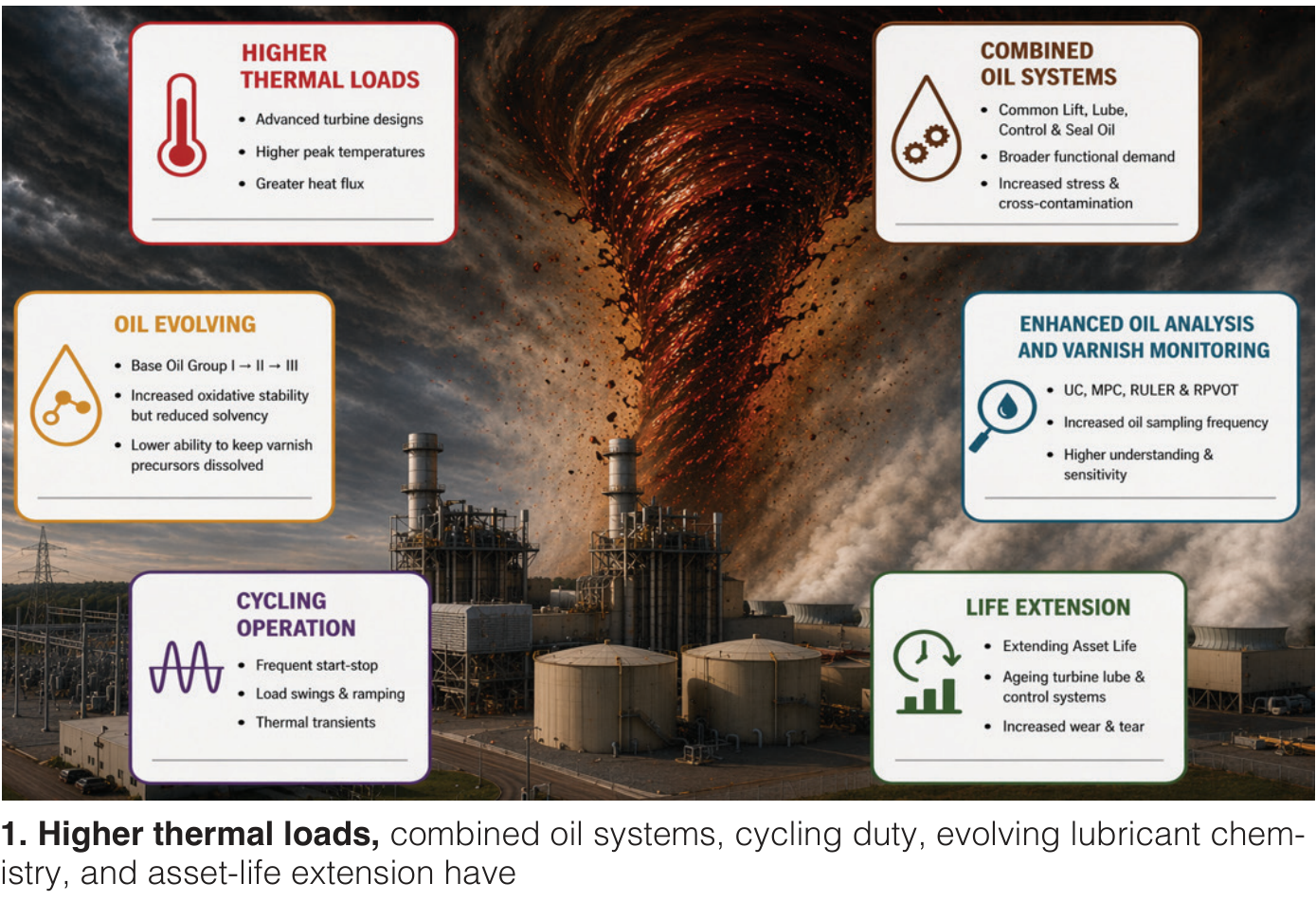
Freeman set the tone by tracing how the operating environment has changed. Older machines ran at lower firing temperatures and more predictable duty cycles. Newer fleets do not. He cited firing temperatures moving from about 1900F in early machines into the mid-2000s for F-class units and into the upper 2700F range for newer designs, while oil systems also became more complicated as OEMs combined functions that once were separated. At the same time, cycling has become routine (Fig 1). In Freeman’s words, “Get in front of this because you wait too long, you’ve got more stuff to do than just change oil.” That line captured the webinar’s central message better than any slide.
Malec backed that up with an end-user view from Duke’s Florida fleet. Some units still start and run for long stretches, he said, but others cycle hard because market conditions and solar penetration keep changing the dispatch profile. One of his stations at one point started and shut down every day. The practical implication is that oil is no longer living in a steady thermal and contamination environment. It is being heated, cooled, agitated, and exposed to different patterns of moisture ingress and system upset than many legacy programs were built around.
Monitoring cannot be casual
Rowland argued that the first mistake is to look for a single condemn-or-keep number. Turbine oil, he reminded the audience, is mostly base stock, roughly 97%, with only about 3% additives. A useful oil report therefore has to cover more than one property at a time: lubricant condition, contamination, additive health, and machine wear signals. He said there is no universal go-or-no-go gauge for when oil must be discarded. Each site has to set its own action limits and, just as important, watch whether the rate of change is accelerating.
That is why sampling discipline got so much attention. Malec described a recurring field problem that will sound familiar to most plant staffs: a particle count suddenly spikes, looks unrealistic against the trend, and turns out to be a bad sample. On some machines, Duke samples from ports that must be flushed before the bottle is pulled. If that flush step is shortened or skipped, the result can drive the wrong diagnosis. Malec said his group resamples when a result does not fit the trend instead of rushing to a conclusion.
His testing schedule was equally practical. Duke samples quarterly for particles, water, and TAN, does annual RPVOT and RULER work, and runs varnish checks semiannually at his stations. He put the reasoning in plain terms: varnish testing twice a year matters “because that’s so critical just to stay on top of it.” Rowland then walked through the toolkit behind that program. An ultracentrifuge test ranks insolubles and varnish precursors on a 1-to-8 scale. MPC, or membrane patch colorimetry, ranges from 0 to about 100, with concern rising once the result moves past 20 (Fig 2).
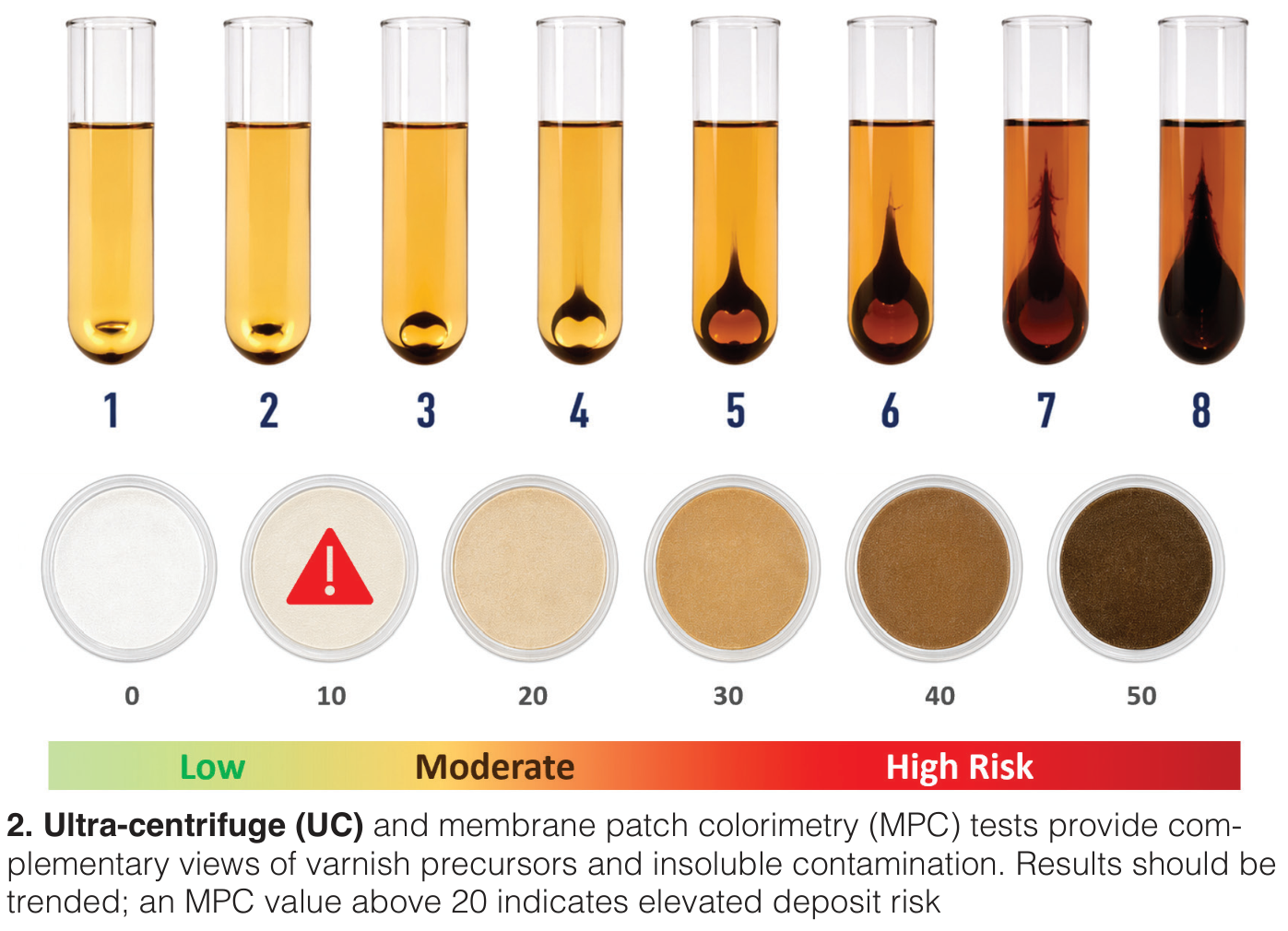
Rowland said the two tests should be used together because plants can encounter “clear varnish,” where one indicator may look acceptable while deposit risk is still real. He also cited RPVOT as a measure of oxidation stability, saying a good turbine oil should be above 800 minutes and new oil may run up to about 1200 minutes. RULER testing, he added, is commonly watched for antioxidant depletion, with alarm attention beginning at about 50% of new-oil value.
The webinar returned several times to a point that is easy to overlook: it is usually cheaper to keep contamination out than to remove it later. Rowland said plants that do a poor job controlling ingress often wind up fighting particles, water, and varnish after the damage path has already opened. In that respect, oil analysis is not just a lubricant test. It is also a machine-condition and work-process check.
What proactive control looks like
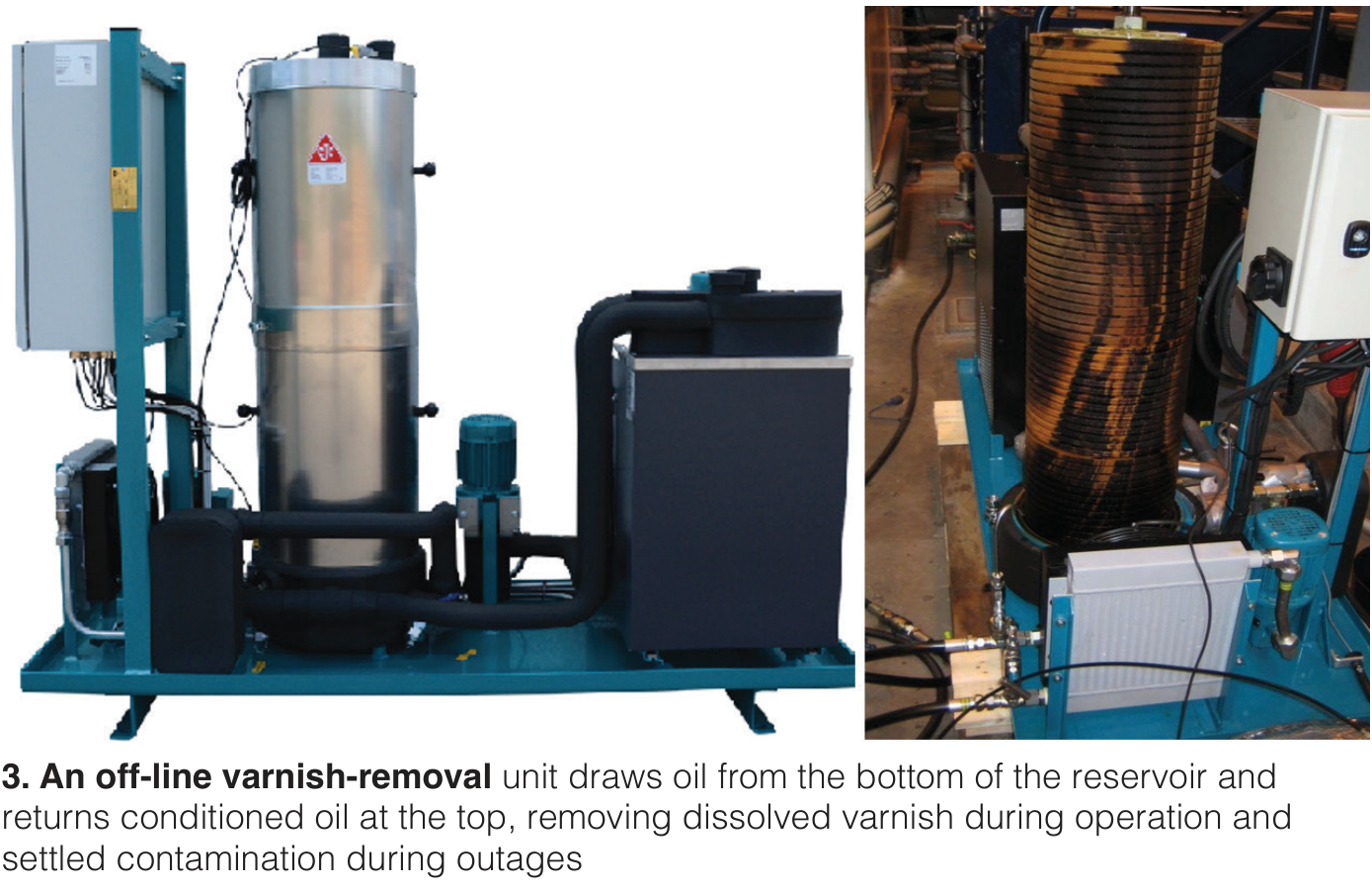
The equipment discussion stayed grounded in mechanism. Rowland said there is no “magic filter” that handles every oil application the same way, then described the company’s varnish-removal approach for gas-turbine service. The idea is to cool the oil to about 40F so oxidation byproducts precipitate, agglomerate, and can be captured by adsorption media instead of remaining dissolved in the fluid. He described the arrangement as an off-line loop drawing from the reservoir bottom and returning to the top for continuous circulation (Fig 3). The turbine does not have to be running. In his view, that is what allows the unit to work both during operation, when dissolved varnish concentration is high, and during downtime, when settled contamination can be picked up before restart.
Malec’s field comments were useful here because they moved the discussion out of theory. He said the Duke sites under his watch have “somewhere north of 80,000 gallons of oil” in service, a large enough inventory to make careless replacement thinking expensive. He also said one power block at his station was built 19 years ago and still carries its original oil charge, with makeup oil added over time for leaks, outages, and tank cleaning, but without a wholesale drain-and-refill event. That does not prove every plant can reach the same result. It does show the scale of life extension possible when contamination control and monitoring are sustained.
Malec also described the importance of ownership. He called himself the owner of the oil and grease program at his station, which fit well with Rowland’s later argument that every site needs a champion who is accountable for oil-health decisions. In a thinly staffed plant, that matters. Rowland noted that many users are trying to do work once spread across larger maintenance organizations, and that a reliability program only works if somebody owns the practices, the trending, and the follow-through.
Freeman added another useful layer by warning users not to treat OEM and industry specifications as a complete maintenance strategy. Baseline specs matter, but they are minimums, not the whole playbook. He urged attendees to stay current with the latest OEM guidance and to recognize that oil formulations and additive packages change over time, sometimes in ways that look small on paper but alter field behavior.
Q&A stayed in the field
The strongest part of the webinar may have been the closing question period because it stayed close to the day-to-day problems users actually face. One thread dealt with synthetic oils and changing formulations. Freeman said plants should not assume the oil going into a system today behaves like the oil qualified years earlier, even when the label looks familiar. As he put it, “don’t count on that stuff being linear.” Later in the discussion, panelists recommended benchmarking in-service analyses against recent new-oil samples, not against a virgin-oil data sheet from a decade ago. That advice matters because additive systems evolve, and a trend that appears flat against an outdated reference can still hide loss of margin.
Another discussion centered on how to verify claims made for small varnish-treatment systems. The answer was not to trust branding language. Panelists pointed instead to before-and-after sampling, inlet and outlet comparisons, and case-study evidence that shows whether varnish precursors are actually being removed. Questions on soapy residues produced another practical answer: deposits of that type can come from water, contamination, degraded oil, depleted additives, or even grease introduced during major overhauls. In other words, the residue itself is a symptom, not a diagnosis.
Attendees also asked about ion charge bonding systems. The response was cautious. Speakers said such systems can remove some material but questioned their effectiveness and economics in large mineral-oil volumes where varnish precursors are dissolved at operating temperature. Malec was more direct, saying he has some ICB units in noncritical applications and has “not [had] very good luck with them.”
The final Q&A points touched lead times, unit footprint, rental availability, and what equipment a user might need beyond a gas-turbine varnish unit. Those questions widened the discussion from varnish alone to broader oil conditioning. Malec noted that PTUs also deserve attention, especially on steam-turbine systems. Another speaker added that cycling can worsen water ingress through shaft seals, making water control a growing concern alongside varnish.
The webinar’s bottom-line lesson was sound. Oil should be treated as a managed asset and a reliability indicator, not as a consumable to be ignored until a sticking valve or bearing problem forces action. Freeman supplied the best shorthand for that philosophy early in the session. Get in front of it. For combined-cycle plants trying to run harder, cycle faster, and stretch asset life longer than designers originally imagined, that is no longer just good housekeeping. It is reliability work. CCJ