
 Ask Scott Schreeg of SVI Bremco what turns a manageable exhaust-liner repair into a forced outage and the answer gets specific fast: a failed stud weld, a loosened sheet, or a hotspot hidden behind the liner system. None looks catastrophic at first glance. But once exhaust flow starts working behind the liner, the problem can move from local damage to a widening mechanical event. For gas-turbine exhaust systems, HRSGs, and simple-cycle stacks, liner reliability is the barrier between hot gas and the outer casing, and between a planned repair and a unit suddenly out of service.
What makes the issue so unforgiving is the way floating liner systems fail. They are built to absorb thermal growth and live with turbulent exhaust flow. When they are intact, that flexibility is an asset. When one part loses support, the same operating conditions that the liner was designed to handle can begin pulling adjacent sections loose.
Schreeg’s field message is blunt: defer a small liner repair too long and the scope can grow into casing overheating, insulation loss, downstream contamination, restricted exhaust flow, falling debris, and a much different outage conversation.
Mechanism
The technical core is straightforward. A floating liner system protects the casing while allowing the exhaust structure to expand and contract through starts, stops, and load changes. It depends on a chain of details holding together at the same time: sound stud attachments, adequate stud density, proper seam stiffening, sheet sizes that can move without distorting, and overlap geometry that keeps flow from catching an exposed edge. If one of those details is wrong, the liner can begin to move in ways the design never intended.
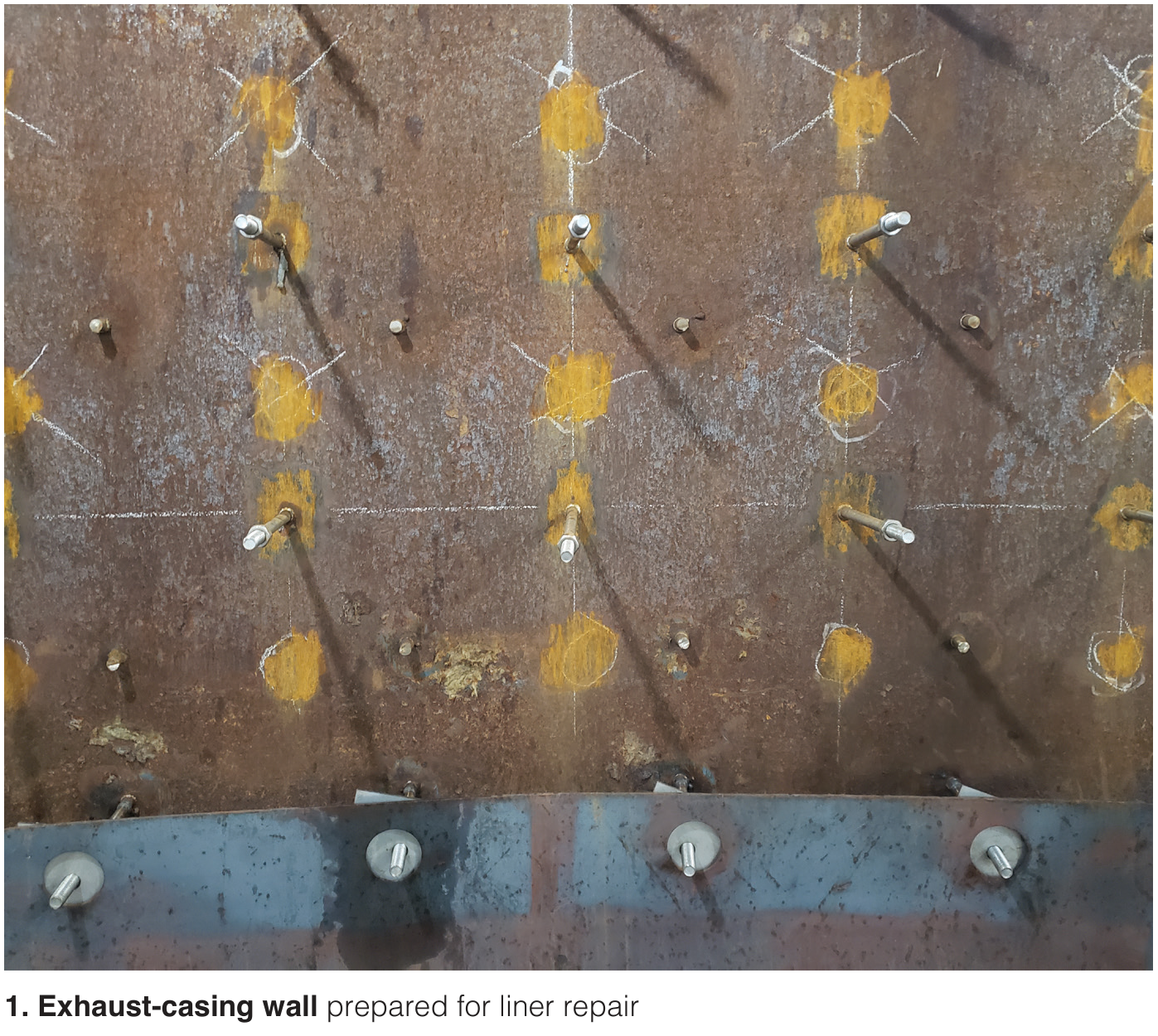
Schreeg points first to stud welding. Attachment quality, he argues, is one of the most important variables in liner life. Poor weld penetration, bad field procedures, and cold welds all show up later as broken support points. Once studs begin failing, liner sheets lose restraint and become more vulnerable to vibration, movement, and distortion under exhaust flow. Retrofit work can be especially tricky because crews are working with existing surfaces, field conditions, and material variations that complicate installation quality (Fig 1).
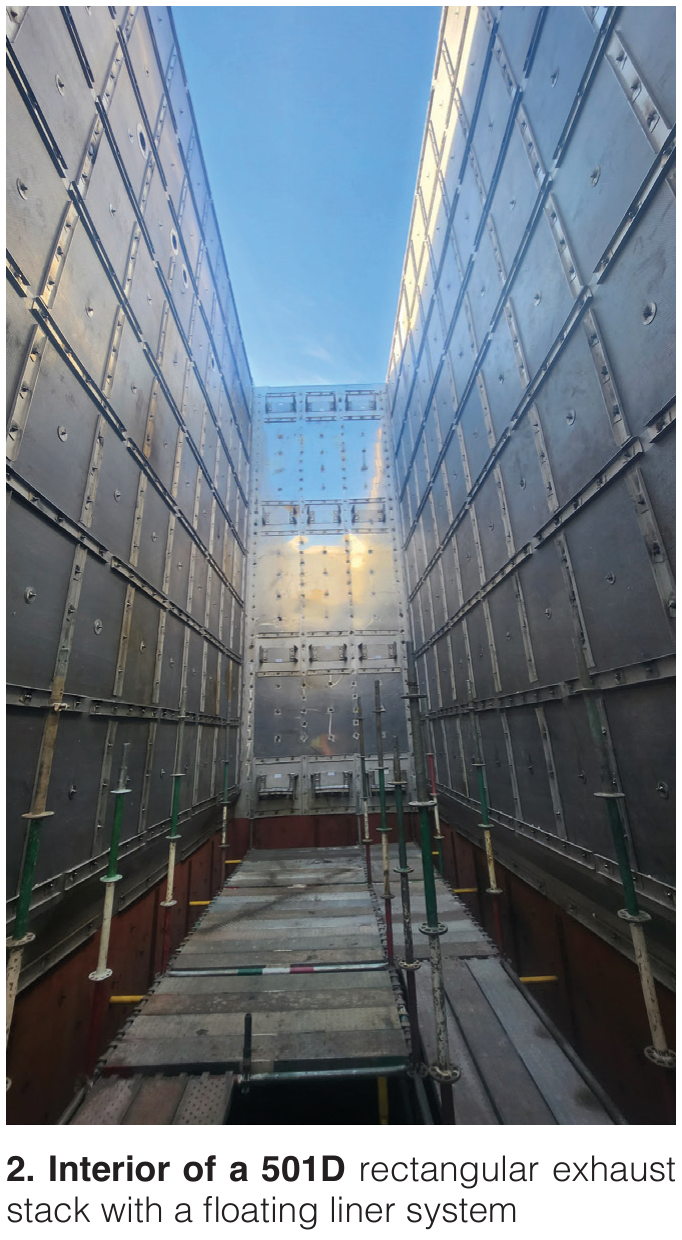
Other repeat offenders are design-related. Excessive stud spacing, especially near turbine outlets and diffuser sections where turbulence is high, reduces rigidity and invites liner movement during thermal cycling. Lack of edge stiffening does the same thing at the seams. Batten channels or similar reinforcement methods are often needed to keep edges flat and maintain overlap (Fig 2). Sheet size matters too. Larger sheets carry greater thermal-growth forces and are more likely to distort or buckle in a floating design. Then there is lapping direction. If sheets are installed so the flow sees an exposed edge instead of a protected overlap, exhaust gas can begin lifting the liner during operation. Once flow intrusion starts behind the sheets, failure tends to accelerate rather than stabilize.
Operational Implications
That escalation is why Schreeg treats liner distress as more than an isolated metal problem. Detached material can move through the gas path and create secondary damage. Insulation can be displaced and migrate downstream. Casing temperatures can climb. In HRSG service, the fallout may extend to duct burners, silencers, pressure parts, and catalyst systems. As insulation and fiber move through the exhaust path, plants can find themselves dealing with emissions-performance concerns at the same time they are trying to control a mechanical repair.
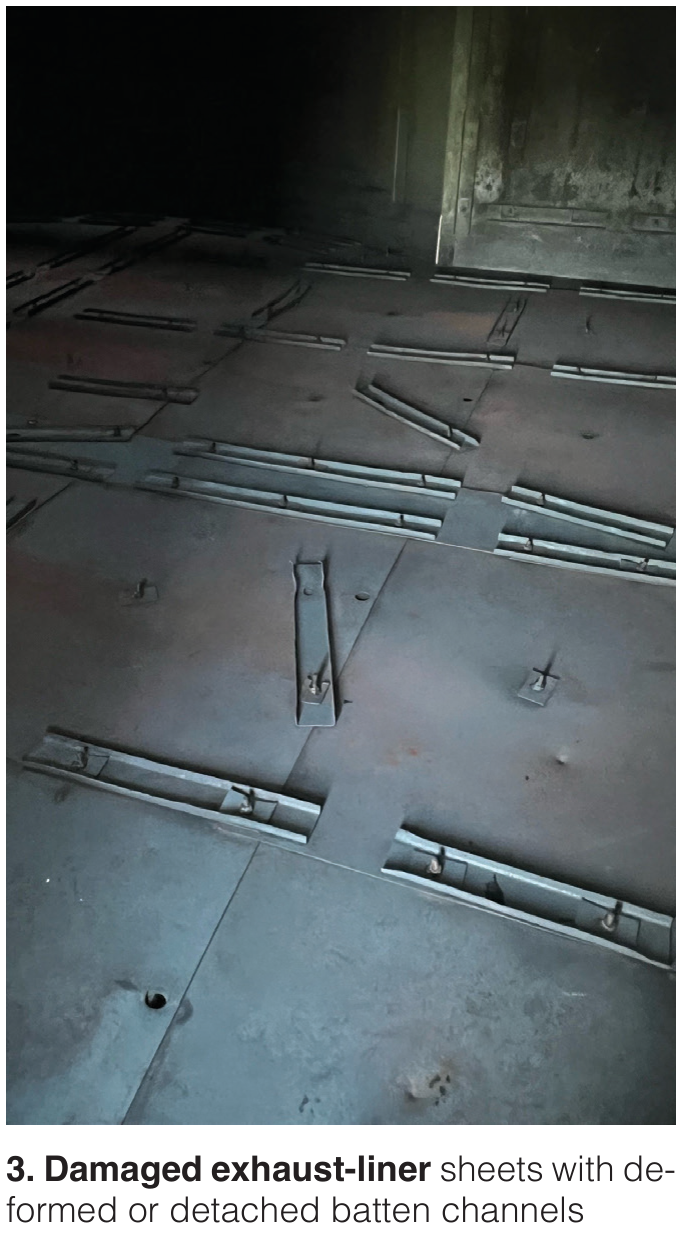
The practical inspection picture is familiar to outage teams: broken studs, missing hardware, displaced insulation, visible fiber debris, distorted sheets, lifted corners, thermal stress near joints and transitions, and areas where hot gas appears to have been running behind the liner (Fig 3). The trouble is that by the time several of those signs are obvious, the job may already have moved well beyond a localized repair. A small corrective scope taken during a planned outage is one thing. A large casing repair or an unplanned outage during a tight operating period is something else entirely.
Options and Trade-Offs
Once a plant identifies liner trouble, the first decision is whether the problem is truly local or whether it points to a broader design weakness. If the damage is limited, a planned-outage repair may be enough: replace failed studs, restore support, correct a seam condition, reset affected sheets, and recover displaced insulation before more of the system opens up.
That is the low-cost path, but only when the root cause is also local. If the distress is tied to stud spacing, weak edge support, oversized sheets, or bad lapping direction, a repair that addresses symptoms alone may simply buy time until the next failure.
That is where the trade-off sharpens. A broader retrofit or redesign costs more and may expand the outage scope, but it can be the smarter reliability choice in sections exposed to the highest turbulence and temperature swings. Schreeg’s point is not that every damaged liner needs wholesale replacement. It is that experienced teams separate one-off damage from recurring design exposure. The deciding information comes from careful outage inspection and, just as important, thermographic scans while the unit is operating.
Thermal patterns tracked over time can reveal developing hotspots behind the liner before internal damage becomes obvious, giving plants a better basis for deciding whether to patch, redesign, or stage a larger repair.
Actions and Lessons
The takeaway is refreshingly practical. Treat liner details as reliability items, not fabrication trivia. Verify stud-welding quality. Review stud spacing in high-turbulence sections. Check that seam stiffening is adequate for the local flow and temperature profile. Make sure sheet size and overlap direction match the service demands of the section. Pair those design checks with disciplined outage inspections and periodic thermal monitoring under load.
Schreeg’s field perspective comes down to timing: the goal is not to get better at repairing liner failures after they open up, but to catch the first broken connection, lifted edge, or emerging hotspot before exhaust flow turns a fixable defect into forced downtime. CCJ