

 By David Such, Such Turbine Consulting LLC
Editor’s Note: CCJ welcomes Dave Such as a regular contributor to Turbine Tips. Dave recently retired from Xcel Energy after a 40-year career focused on the operation and maintenance of GE 7F gas turbines. The Combined Cycle Users Group recognized his contributions to the industry with its Individual Achievement Award in 2022, honoring a body of work that spans from commissioning some of the original 7FA units through full life extension.
Dave spent 15 years on the 7F Users Group steering committee and pioneered the use of third-party refurbishment and manufacturing of 7F turbine components at a time when the OEM was the only option. He served as technical lead for gas-turbine flexibility upgrades at Xcel Energy, including installation of DLN 2.6+ with axial fuel staging. He has mentored owner/operators across the industry and never hesitated to share parts, knowledge, and field experience when a colleague was in a bind. This is his first Turbine Tips column. He can be reached at dave@suchturbine.com.
The temperature hovers just above freezing this morning, but with wool socks, my feet are plenty warm inside my steel-toed Redwing boots. The mist of Kroil stings my nostrils, though that is more pleasant than the olfactory assault of a grinding wheel on steel. I can taste it all on my lips. The rattling of impact wrenches penetrates my earplugs and jars my brain. The bright orange FME covers on the open flanges provide the only contrast to the cold gray metal that surrounds me.
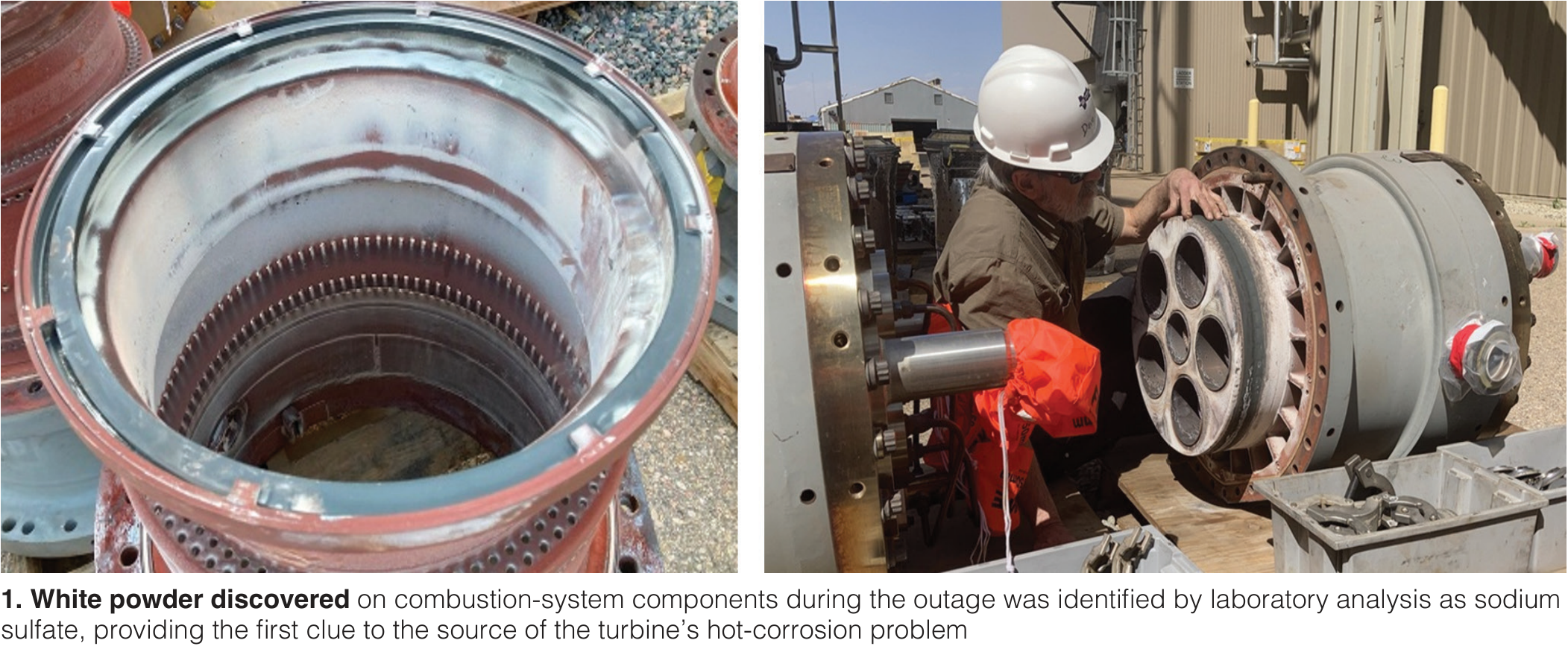
This combustion turbine overhaul is similar to many, but when the fuel nozzles, liners, and flow sleeves come out, they are coated with a mysterious white powder.
Samples of the white powder were sent to the lab and analysis reveals that this substance is sodium sulfate (Na2SO4), a corrosive salt. Bingo. My memories flash back. When this mineral gets sucked into the flame, it melts and passes through stage 1 only to condense when the temperature drops in the second stage of the turbine. This molten mineral goo can stick to the airfoils. If turbine buckets are not protected by an MCrAlY coating, the hot corrosion could quickly eat into the base metal and cause a catastrophic failure. Even so, this hot corrosion will eventually eat through the MCrAlY.
When we get the turbine case off, my eyes are immediately drawn to the blueish tint of the stage 2 buckets, and my mind rewinds to an overhaul two decades ago that exhibited a similar condition. The term “hot corrosion” comes to mind, but let’s not jump to conclusions without some help from the chemistry department and a trusted metallurgist. Their assessment confirms my suspicions.
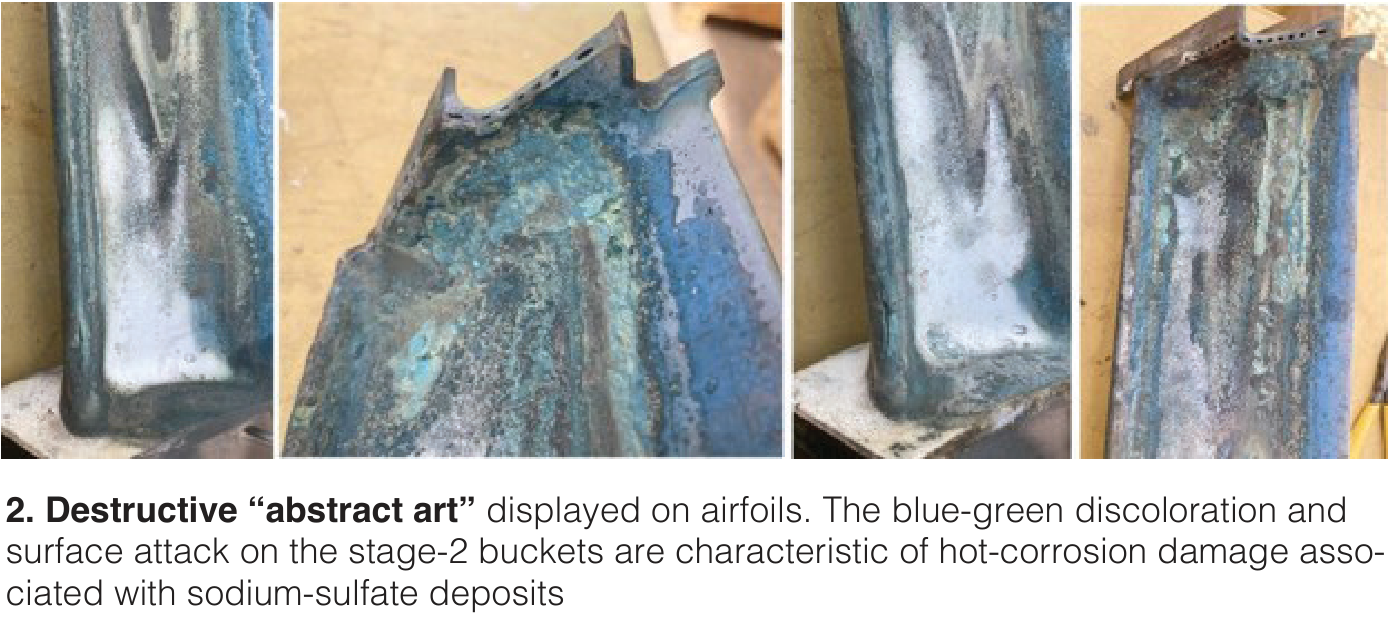
Until they are chemically stripped at the repair shop, we won’t know how compromised these buckets may have been. I suspect they will find patches with deep corrosion grooves on the surface and possibly voids beneath, but as the adage goes:
“One valid test is better than a thousand expert opinions.”
I try to chip off little samples from multiple buckets, but it is very difficult, and I have to be satisfied with a half teaspoon after much effort. The uneven splattering of these condensed minerals on the airfoils may explain why the turbine efficiency decreased in the last several months of operation.
Although the reductionist in me understands that this is sodium sulfate, I must ask: where did this come from? My previous experience leads me up a tall ladder and into the inlet filter house. I crawl through the Hobbit door and continue to the downstream side of the evaporative cooler. As suspected, the knees of my black Carhartt jeans are now white, coated with sodium sulfate. The root cause, I believe, is high mineral content in the water used by the evap cooler combined with excessive flow which led to carryover. The high-mineral water carried over to form puddles in the trough downstream of the mist eliminator and other low points, and eventually evaporated, leaving the minerals behind which got sucked into the compressor and beyond.
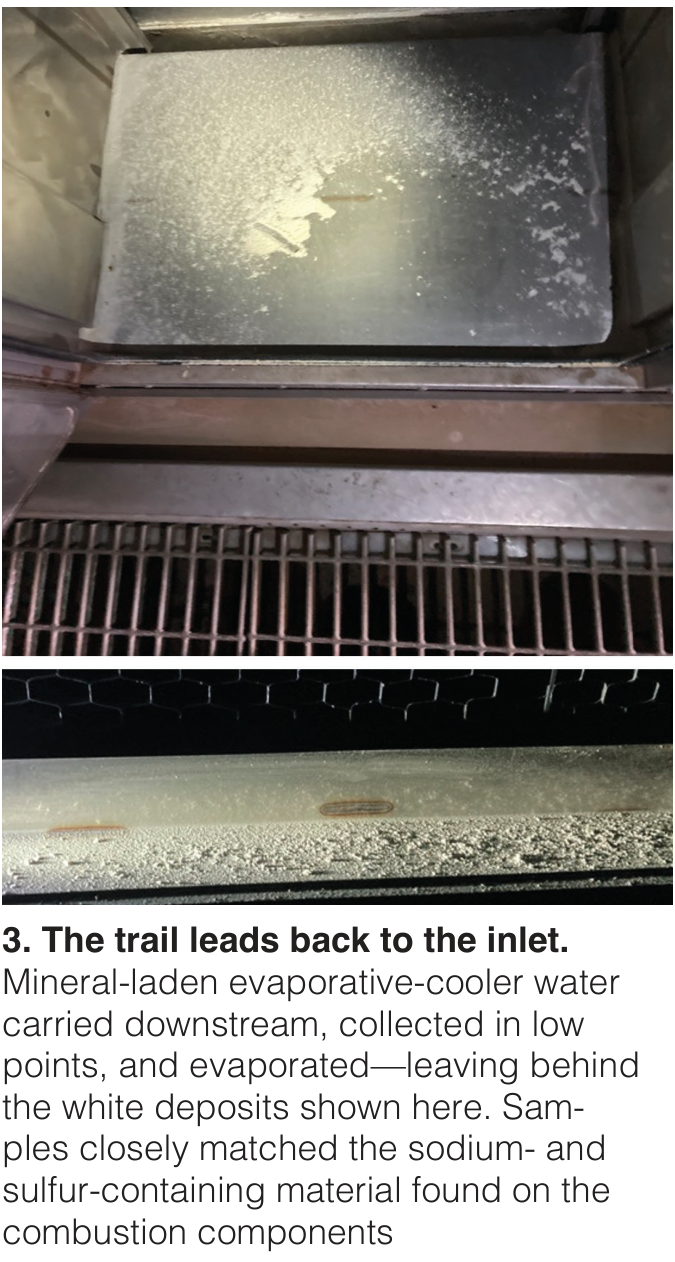
Just to be sure, I sample the powder here and compare it to what was adhered to the combustion components. It is basically the same animal: sodium and sulfur.
At this point, the logical questions are these:
- Can we improve the chemistry of the evap cooler water by blowing down the sump when the conductivity reaches a certain level?
- Can we improve the chemistry of the evap cooler water by blending domestic or well water with demineralized water?
- Can we reduce excess water overflow (carryover) from the evap media and mist eliminators?
Yes, yes, and yes, but not without effort. The payback will be to preserve turbine efficiency and to reduce refurbishment or fallout replacement costs.
Don’t let water with high mineral content (or the powdered minerals it left behind) enter your compressor, combustion system, and turbine. The potential hot corrosion will cost you in the long run, but it can be minimized.
I am an engineer, not a chemist nor a metallurgist, so if anyone with those credentials would like to add anything (or correct me), please chime in by sending me a comment. Here is a good reference article describing the hot corrosion phenomenon:
https://www.sciencedirect.com/topics/materials-science/hot-corrosion/
Fun fact: The white powder form of Na2SO4 used to be known as Glauber’s salt which was used as a laxative from the mid-1600s up until the invention of Ex-Lax Milk of Magnesia and the like in the early 1900s. But please – don’t try this at your power plant. CCJ