

The 15th annual meeting of the Air-Cooled Condenser Users Group (ACCUG) was held July 29-31, 2025, at the Lake Granbury Conference Center in Granbury, TX. Participants included owner/operators as well as leading suppliers and international consultants gathered to discuss improving unit and system performance, share valuable lessons learned, and reduce overall operating expense. Those interested can easily access the source material (slide decks) for the following presentation recaps (as well as prior years) at the ACCUG website. The ACC Users Group (acc-usersgroup.org) was established in 2009.
2025 sponsors included Chemted LLC, Conco Services, FanTR, Galebreaker Industrial, Groome Industrial Service Group, MVM EGI, Projectile Tube Cleaning and SPG Dry Cooling, along with support by the International Association for the Properties of Water and Steam (IAPWS) and Combined Cycle Journal.

ACCUG 2026
July 14-16
Nashville, Tenn
Highlights: Visit to new TVA Cumberland CCGT. Special focus area on the latest developments in ACC technology and commissioning. Contact Andy Howell, aghowell19@gmail.com, for more information.
Barry Dooley (Structural Integrity), session co-chair, opened the event with a detailed discussion of Corrosion and cycle chemistry issues specific to air-cooled condensers, focusing first on the serious consequences of corrosion/flow-accelerated corrosion in these units.
A useful feature was his explanation of the Dooley, Howell Air-Cooled Condenser Corrosion Index (DHACI), a specific and user-friendly guideline for internal inspections. He highlighted visual and microscopic inspection results to assess damage over time. He then turned to monitoring condensate iron to categorize corrosion and track improvements. A highlight of this discussion was a review of the IAPWS Corrosion Product Decay Map. Dive deeper into corrosion monitoring in flexible and fast-starting plants here.
He ended with an update review of film-forming substances, and valuable information freely available through https://iapws.org/.
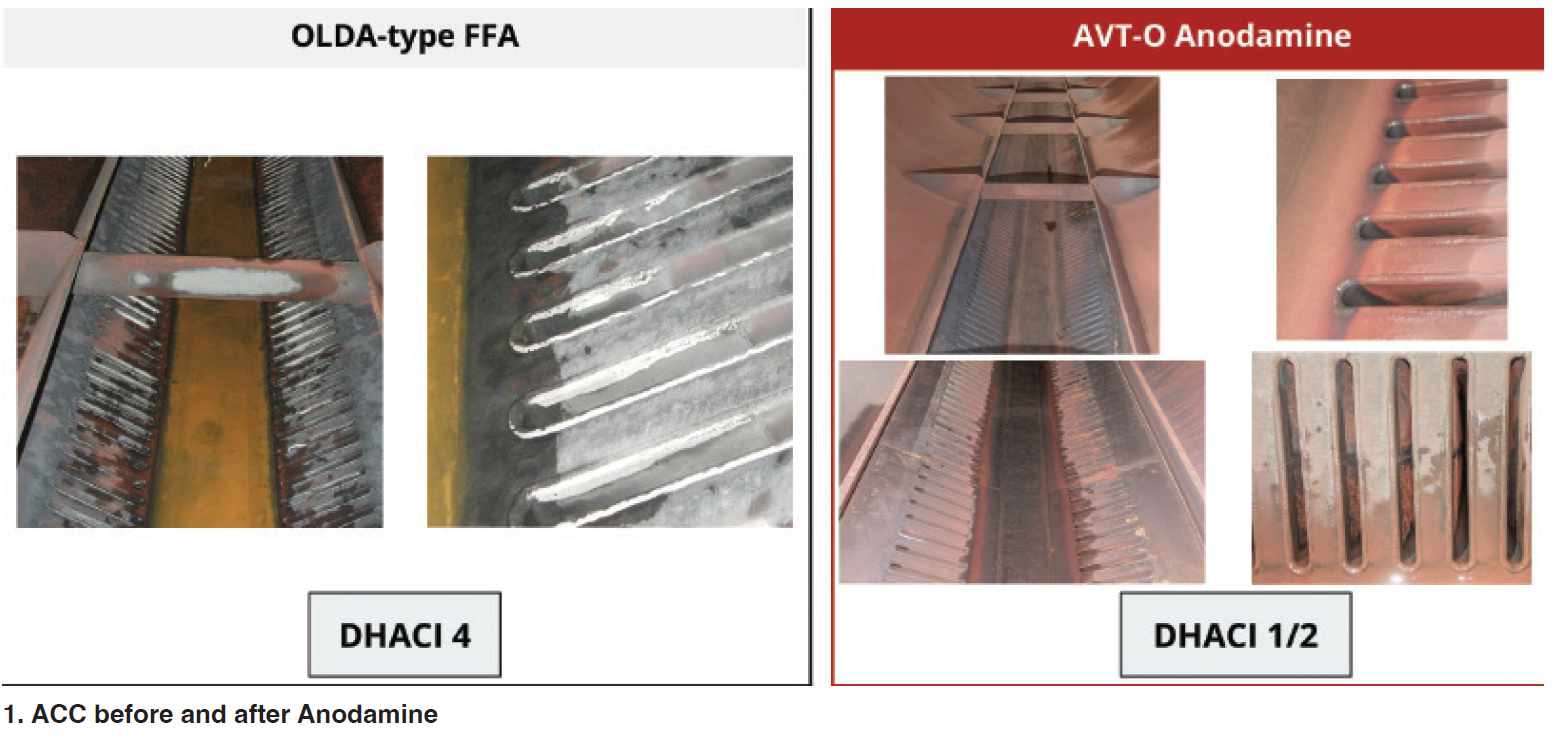
Brian Courtright, Anodamine, followed with Film-forming chemicals for ACC corrosion mitigation . He featured four identical H-class 1×1 CCGTs at two sites, with triple-pressure HRSGs. Since 2021, all units have been running Anodamine AVT(O) with ammonia.
Tracing chemistry evolution back to 2017, he stated that chemistry had been the root cause of many ACC (and other system) corrosion issues. Specific to the ACCs, he showed corrosion before AVT(O) Anodamine, related to the DHACI (Fig 1). Similar examples were given for turbine extraction ducting and the LP steam turbine.
Next was Sean Cusick, SPG Dry Cooling, discussing Baseline FAC inspections at the Hunterstown Generating Station in Pennsylvania. The inspections occurred just before Anodamine addition to the steam cycle. Inspection methodologies included ultrasonics for tube thickness analysis. The baseline was established to monitor the effects of Anodamine over time.
In an interesting global overview, Andy Howell, co-chair, then presented a survey of Primary problem issues with air-cooled condensers . The ACC Users Group had conducted a survey of users to capture priority concerns from ACC operators, to focus ACCUG efforts on areas of greatest need for problem resolution.
Of the 17 resulting issues, 4 were listed as primary:
- Generation losses in hot weather (possibly compounded by air in-leakage).
- Generation losses due to wind. (The 3 m/s ACC design standard is often not adequate for actual site conditions.)
- Air in-leakage/air removal.
- This includes oil leaks and seals, bearing column durability (and shaft failures), and general gearbox failures.
Other areas of concern included leak repairs on ACC tubes, vibration, water washing systems, fan blade reliability, noise, and others. All were discussed by conference participants in detail.
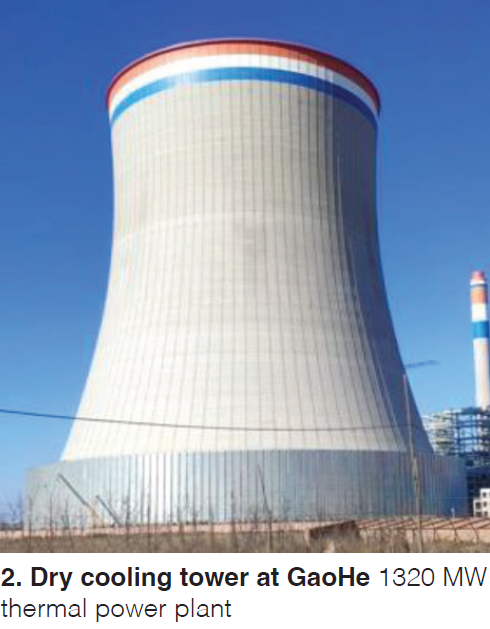
György Budik, MVM EMI, then showed the largest hyperbolic dry cooling tower in the world, a 220 m high tower serving two 660 MW units (Fig 2). Budik showed more conventional units in his global review, including hybrid wet/dry units.
His focus then turned to dry cooling at nuclear power plants, a promising application that has rarely been implemented.
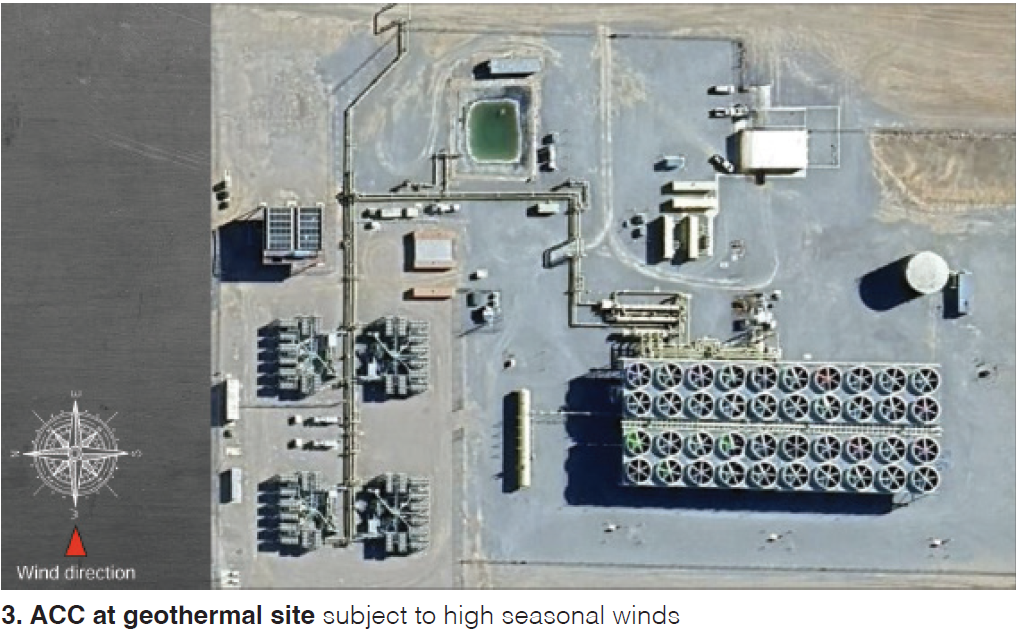
Jeff Ebert and Gary Mirsky, Galebreaker, then discussed Wind effects on an ACC at a geothermal power station . See Fig 3.
John Moore, Moore Fans, next offered a presentation on Mechanical design of axial flow fans for air-cooled condensers . The focus was on durability, noting the unique mechanical stresses, both static and dynamic, for ACC applications. His process overview covered aerodynamic design, structural design and analysis, and testing and evaluation. Benefits discussed included high aerodynamic efficiency, optimum structural design, fatigue resistance, use of corrosion-resistant materials, ease of installation, and reduced maintenance.
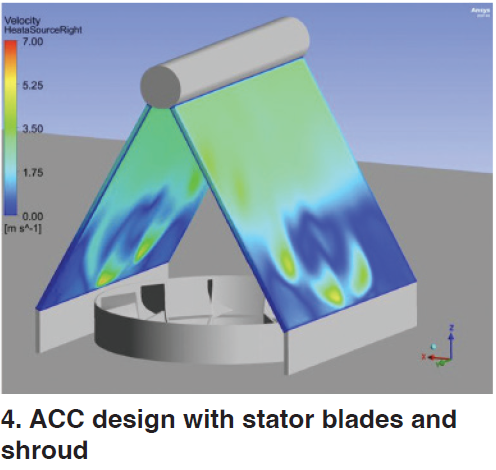
Andy Howell, co-chair, then offered a presentation submitted by Mohamadreza Vaghar, Mapna Development Company, Iran, on Fluid flow analysis in the air-cooled condenser system .
This covered investigations of air flow modifications over tube bundles to improve efficiency, and a technical evaluation of the absence of wind walls. The goal of the first is to improve air flow uniformity. The proposed solution is stator blades with and without a shroud. Use of the shroud (Fig 4) produced a more uniform flow profile and increased average velocity.
Howell then facilitated a discussion of Misting for megawatts addressing a primary ACC concern of reduced generation during hot weather (elevated backpressures in ACCs). Misting has specifically been underutilized due to its inherent inefficiency (droplets not fully evaporating) and the traditional assumption that only highly demineralized water can be used to avoid mineral deposit buildup. These assumptions are valid but their possible reconsideration was discussed.
Traditional actions to improve vacuum have included air in-leakage reductions, adding ACC rows, increasing fan speed, reducing wind effects, and fin cleaning. These steps can significantly improve ACC vacuum in many cases but are limited from achieving full load in hot weather.
Options available to achieve full load must include evaporative cooling, including water misting, parallel cooling with a water-cooled condenser, and use of a deluge system. However, evaporative systems may come up short in achieving adequate backpressure for full load if other factors are not also addressed, such as wind effects, air in-leakage and fin cleaning. A complete evaluation with recommended improvement steps is necessary to fully recover lost generation in hot weather.
Dewald Visser, Asset Performance Partners, offered Towards a broad-spectrum approach to testing modern air-cooled condensers. He covered early and modern ACC designs, air in-leakage testing methods and equipment improvements, liquid ring vacuum pump challenges, dephlegmators, condenser operation, dissolved oxygen level management, and a generalized broach-spectrum approach to testing and analysis.
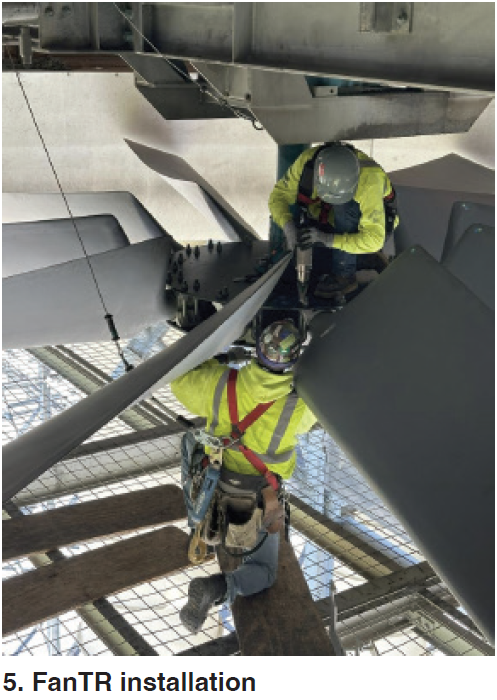
Bernardo Navarro, Fan Technology Resources (FanTR) and Jared Miller, Evapco Dry Cooling, discussed an Innovative fan blade with aerolastic design. The focus was a new cooling fan blade named X-flow, designed for “extremely high efficiency.” Other benefits of this unique aerodynamic design are lower operational costs, reduced vibration, and an interchangeable hub with all FanTR models (Fig 5).
 The manufacturing process is one-shot vacuum infusion for increased durability. This monolithic construction eliminates adhesives or bonded parts. The final design result is less stress on gearboxes and structures, less influence by cross winds, reduced maintenance costs, and longer life.
Jason Sobotik and Gerald Frank of Groome Industrial Service Group presented a practical approach in ACC fan life-cycle maintenance that treats reliability as a system issue in which blades, balance and alignment, drivetrain health, and structure interact. They began with common vibration drivers, including particulate impingement, blade damage, and erosion, then link these to owner impacts such as rotor imbalance, lost fan efficiency, and accelerated wear. Recommended corrective actions focus on field work: vibration analysis and balancing, routine inspections, cleaning, and blade resurfacing to recover performance before considering replacements.
They provided an “operator’s translation” of vibration data: displacement for peak-to-peak movement and velocity, in inches per second or millimeters per second, for trending and severity calls. Response guidance scales with risk. Minor vibration often indicates cleaning or alignment needs. Significant vibration warrants balancing, alignment checks, and looseness investigation. Major vibration may justify fan, motor, or gearbox replacement when risk is unacceptable.
They widened the lens to drivetrain and structure. For gearboxes and motors, root causes include oil-system gaps, misalignment, bearing wear, and overloading. Structural contributors include resonance, wind and weather, corrosion, and fan-to-shroud contact.
The preventive cadence is clear: monthly visual checks, quarterly vibration and torque checks, annual full-system inspections with oil changes, pitch checks, and cleaning, plus gearbox overhaul or replacement every 3 to 5 years. Benefits include reduced downtime, higher reliability and efficiency, lower parasitic load, improved safety, and better compliance.
Patrick Saussus, Evapco, and Bob Neely, Amarillo Gear Company, addressed Common problems with gearboxes and offered details on solutions. The items discussed included oil leaks (output and input shaft), gear tooth wear and breakage, bearing failures, and oil pump malfunctions.
The Amarillo Quantum Q500 (Fig 6), designed specifically for ACC application, features no oil seals (no replacements), the output shaft bearings located in the oil sump (no grease or regreasing required), and no lip seals in the input shaft (for reduced maintenance).
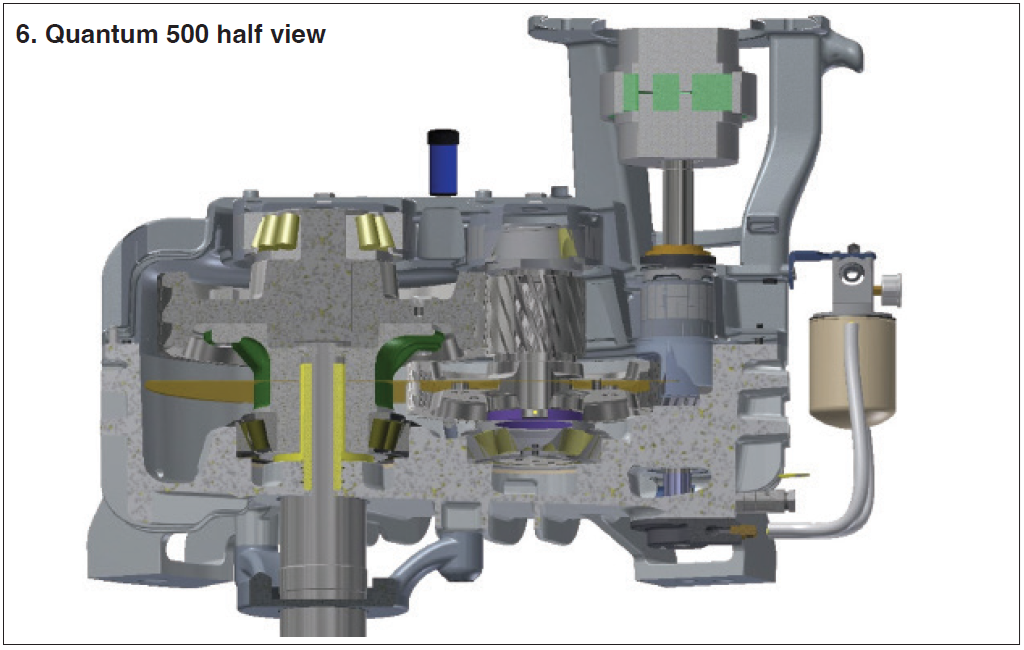
They offered details on gearbox design and manufacturing, castings, gear design specifics, tapered roller bearings, lubrication benefits, and leak-free design (input and output). They then addressed retrofit options and benefits, including installation examples.
Dan Rosseljong, Sumitomo Drive Technologies, presented Top five considerations for maximizing ACC gearbox return on investment.
- Starting torques. Due to frequent starts and stops, this discussion addressed comparisons of parallel gearbox (forced-draft ACC) and right-angle gearbox (induced-draft ACCs) designs as well as use of variable frequency drives to limit starting torque.
- Maintenance-friendly gearbox sealing and lubrication.
- Proper installation and alignment.
- Regular inspections and inspection points.
- And the Sumitomo policy of open support, namely no charge for asking questions.
Andy Howell then concluded with a Focus topic: cold-weather ACC operation. Potential concerns are startup with cold lines, condensate freezing, and the general impacts of offline system freezing. Air in-leakage can also bring sub-freezing air into the condensate and air extraction pathway. The discussion centered on key indicators of potential or existing problems, preventions, and responses.
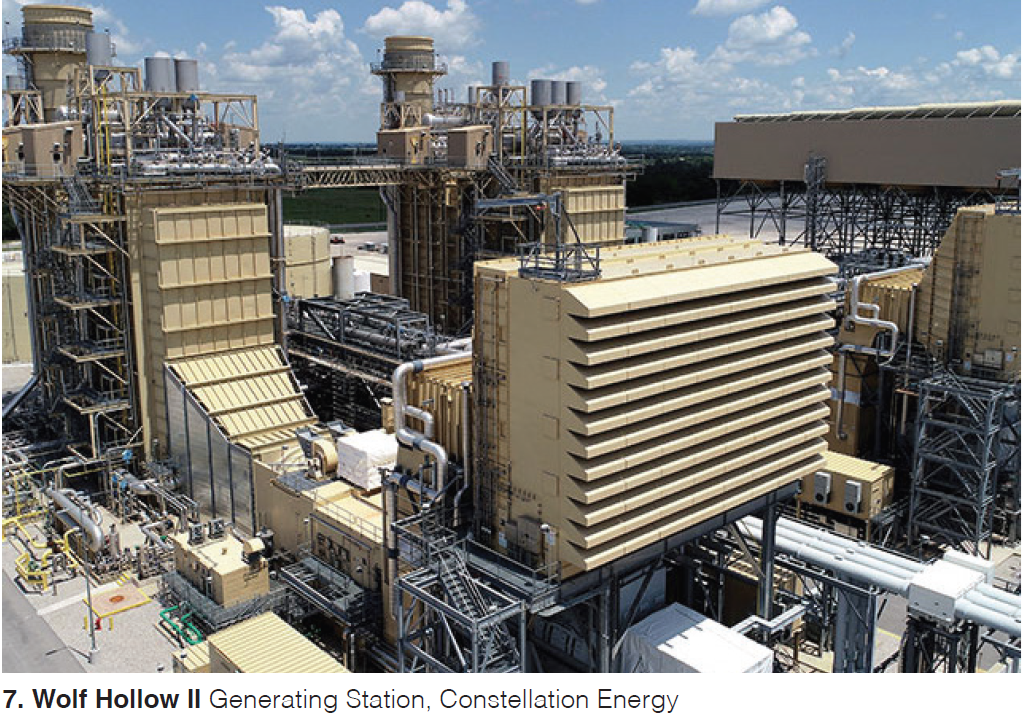
Wolf Hollow II : The conference concluded with an ACC tour at Constellation’s 1115 MW Wolf Hollow II Generating Station in Granbury, TX (Fig 7).
Again, additional information on the Air-Cooled Condenser Users Group is available at acc-usersgroup.org. CCJ